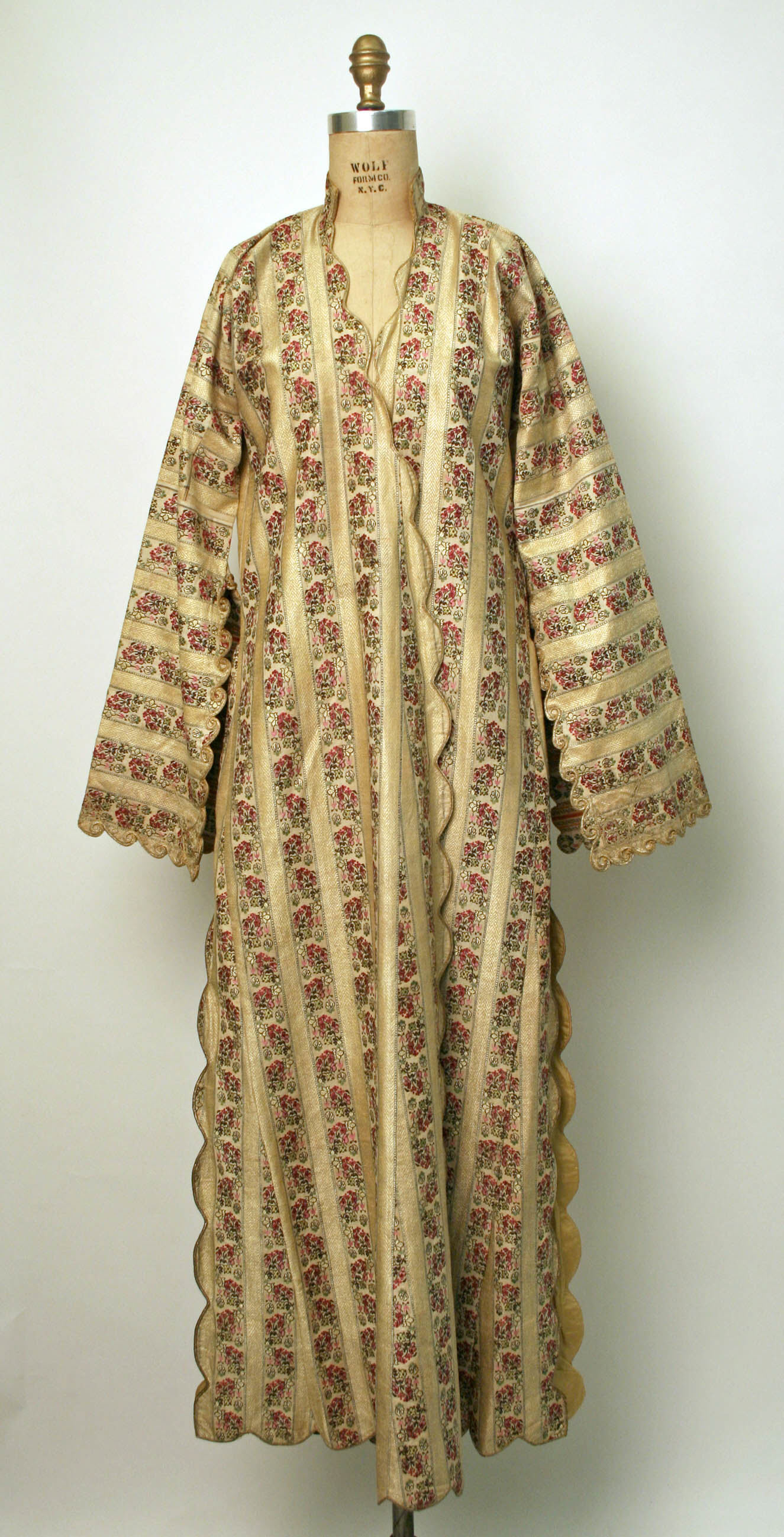
Deconstructing the Uçetek Entari: A Study in Architectural Silhouette and Global Dialogue
Within the rigorous, analytical environment of the Katherine Fashion Lab, the Uçetek Entari presents a compelling subject for a standalone study. This Ottoman-era garment, whose name translates to "three-skirted dress," transcends its historical classification to emerge as a masterclass in structured fluidity and cross-cultural intelligence. Our analysis moves beyond mere archival documentation to dissect the Entari as a strategic design object, where its seemingly contradictory elements—a rigid, architectural torso and a cascading, tripartite skirt—coalesce into a powerful statement on power, mobility, and aesthetic synthesis. This examination focuses on the intrinsic properties of its construction and materiality, treating it as a discrete case study in pre-industrial couture principles.
Architectural Framework: The Strategic Silhouette
The Uçetek Entari’s primary innovation lies in its deliberate segmentation of the female form, a design decision with profound socio-aesthetic implications. The bodice, often tailored and close-fitting, functions as a structured carapace, establishing authority and formal presence. This upper framework, frequently featuring a deep V-neline and long, narrow sleeves, creates a vertical axis of control. The stark contrast arrives at the waistline, where the garment erupts into its defining feature: the three distinct, overlapping panels that form the skirt.
This tripartite construction is not merely decorative; it is a feat of engineered dynamism. Each panel is cut and set to allow for a specific range of motion and visual effect. The wearer’s movement generates a rhythmic, layered sway, a kinetic display that is both grandiose and calculated. The silhouette, therefore, communicates a dual message: anchored power in the torso and graceful, orchestrated mobility in the lower body. In Lab terms, it resolves the perennial design conflict between structure and flow by not blending them, but by juxtaposing them for dramatic, functional effect. The silhouette itself becomes a non-verbal communication tool, denoting status through the luxury of complex construction and the implied mastery of space.
Material Intelligence: Silk and Metal as Conduits of Meaning
The prescribed materials—silk and metal-wrapped thread—are not arbitrary selections but the core mediums through which the garment’s narrative is articulated. The silk ground, particularly luxurious varieties like çatma (cut velvet) or heavy kemha (brocade), serves as a high-value canvas. Its luster and drape articulate wealth, while its substantial weight provides the necessary architecture for the skirt’s layered panels, ensuring they move with a deliberate, heavy grace rather than a frivolous flutter.
The true analytical focus, however, rests on the metal-wrapped thread embroidery. This element transforms the garment from a tailored object into a portable treasury and a map of cultural convergence. The metal thread, typically silver or gold wrapped around a silk core, introduces a textural duality: it is at once luminous and rigid, sparkling yet severe. Its application is never casual. Embroidery motifs—stylized tulips, carnations, hyacinths, and complex saz leaves—often draw from a Persianate botanical lexicon. Meanwhile, geometric interfaces and architectural motifs hint at Byzantine and Mamluk influences. The stitching techniques themselves, such as the raised dival işi (a form of couching), create a low-relief topography on the silk surface.
This embellishment is a strategic investment. It represents capital conversion—literal wealth (precious metals) converted into cultural capital (display of taste and access to global motifs) and social capital (immediate visual recognition of status). The embroidery is also a deliberate act of light capture, designed to interact with candlelight and sunlight to animate the wearer with a subtle, moving luminescence. In the Lab’s perspective, the material choice is a direct, calculable input that maximizes output in terms of symbolic communication and sensory impact.
The Global Heritage Context: A Networked Artifact
To classify the Uçetek Entari’s origin as "Global Heritage" is to engage in precise supply-chain and influence-tracking analysis. The garment is a terminal node in a vast, pre-modern network. The silk likely traveled via the Silk Roads, originating in China or later, from Bursa’s own renowned ateliers. The metal for the threads could trace its provenance to mines in the Balkans or Anatolia. The design motifs navigated trade routes and diplomatic gift exchanges between Istanbul, Isfahan, Florence, and Venice.
Therefore, the Entari is a product of managed synthesis. It is not a pastiche but a deliberate curation of global elements subsumed into a distinct Ottoman sartorial language. The wearer of a 16th-century court Entari was, quite literally, embodying the reach and cosmopolitanism of the empire. This aligns with contemporary luxury strategy, where heritage is not a static provenance but a dynamic, curated narrative of exceptional sourcing and cross-cultural fluency. The Entari stands as an early exemplar of fashion as soft power, using aesthetic means to project an image of sophisticated, interconnected authority.
Conclusion: A Legacy of Calculated Contrast
The Katherine Fashion Lab’s dissection of the Uçetek Entari reveals a garment of remarkable strategic coherence. It is a study in the power of calculated contrast: structure versus fluidity, matte silk versus metallic shine, localized tailoring versus global iconography. Every element serves a dual purpose—aesthetic and symbolic, functional and communicative. It resolves complex design challenges through clear segmentation and material intelligence. As a standalone study, the Entari provides a historical blueprint for contemporary design thinking, demonstrating how to build narrative depth through silhouette, source meaning through material, and articulate identity through a conscious, curated engagement with a wider world. It is not merely a historical costume but a perpetually relevant case study in the architecture of dressed power.