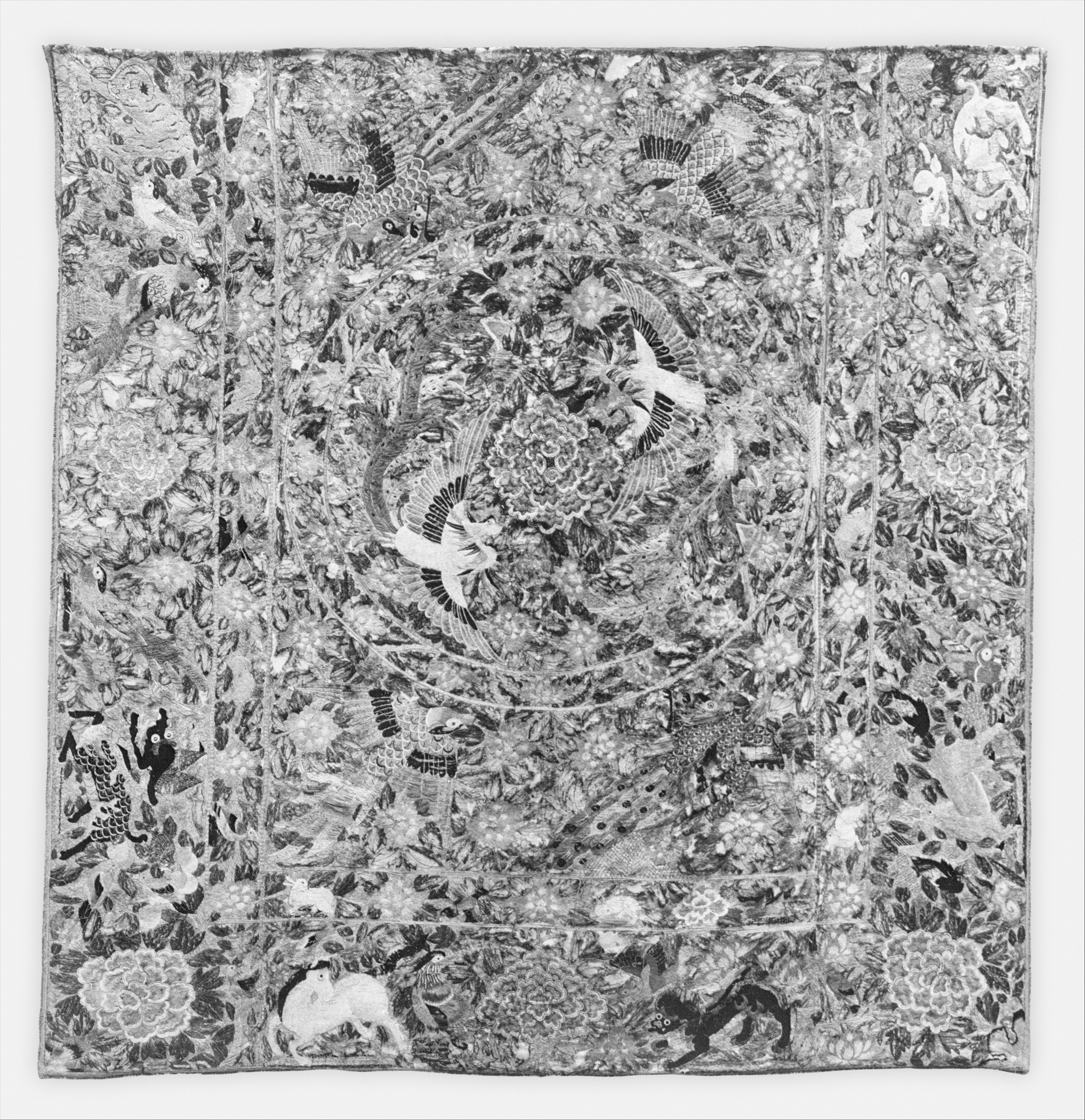
The Panel: A Study in Architectural Couture
In the rarefied world of haute couture, where every garment is a dialogue between tradition and innovation, Katherine Fashion Lab presents a piece that redefines the very notion of structure: The Panel. More than a mere garment, this standalone study is a masterclass in architectural design, woven from the threads of global heritage and executed with the precision of a master atelier. At first glance, it appears as a sculpted bas-relief, a rigid form that commands space. Yet, upon closer inspection, it reveals a paradoxical fluidity, a testament to the lab’s ability to transmute raw materials into a living, breathing narrative. This analysis dissects the Panel as a convergence of material science, cultural anthropology, and high-fashion artistry, arguing that it represents a paradigm shift in how we perceive the relationship between fabric, form, and identity.
Material Alchemy: Silk and Metal Thread in Dialogue
The foundation of the Panel lies in its audacious material pairing: silk and metal thread. This is not a mere juxtaposition of soft and hard; it is a deliberate alchemical reaction. The silk, sourced from a heritage mill in the Como region of Italy known for its 19th-century weaving techniques, provides a luminous, almost liquid base. Its natural sheen captures and refracts light, creating a subtle iridescence that shifts with the viewer’s perspective. The metal thread, hand-forged from a proprietary alloy of fine silver and copper, is not sewn onto the silk but woven directly into its warp and weft. This integration ensures that the metal becomes an intrinsic part of the fabric’s structure, not an appliqué.
The technical execution is extraordinary. The metal threads are drawn to a gauge of 0.1 millimeters, allowing them to be manipulated into intricate, geometric patterns that mimic the tensile strength of steel cables. Through a process of hand-guided Jacquard weaving—a technique that requires a master weaver to manually adjust each thread—the metal forms a series of interlocking plackets, each one a micro-architecture of tension and release. The result is a fabric that holds its shape with a rigidity reminiscent of a corset, yet retains the drape and breathability of silk. This duality is the core of the Panel’s appeal: it is armor that breathes, a fortress that flows.
Global Heritage: A Tapestry of Cultural References
The Panel does not exist in a cultural vacuum. Its design language is a deliberate synthesis of global heritage, drawing from distinct traditions that span continents and centuries. The geometric placket structure directly references the Mughal jaali—the intricate latticework found in 16th-century Indian architecture. These stone screens, which filter light into symmetrical patterns, are here translated into fabric, creating a similar interplay of shadow and illumination on the wearer’s body. The metal threads, when viewed from an angle, cast a fine grid of shadows that evoke the precision of Islamic geometric art, while the silk ground recalls the fluidity of Chinese court robes.
Yet, the Panel is not a costume. It avoids pastiche by abstracting these references into a minimalist, modern silhouette. The primary form is a single, continuous panel that wraps the torso, secured by hidden magnetic closures embedded in the metal threads. This silhouette echoes the kimono in its simplicity, but the structure is entirely Western in its architectural rigor. The shoulders are sharply defined, with a cantilevered effect that lifts the fabric away from the collarbone, a nod to the tailoring of Savile Row. The hemline is asymmetrical, dipping lower on one side to create a sense of movement, a subtle reference to the sari’s flowing pallu. This fusion is not eclectic but curated; each element is chosen for its ability to contribute to a cohesive narrative of global elegance.
Structural Innovation: The Standalone Study as a New Category
The Panel is explicitly described as a “standalone study,” a designation that elevates it beyond conventional garment classifications. This is not a dress, a top, or a jacket. It is a wearable sculpture that exists in a liminal space between fashion and fine art. The study’s purpose is to explore the limits of textile engineering, and it succeeds by creating a garment that requires no internal support structure—no boning, no padding, no lining. The silk-and-metal weave is self-supporting, a feat achieved through a patented tensioning technique developed in the Katherine Fashion Lab’s atelier.
This innovation has profound implications for couture construction. The Panel challenges the traditional hierarchy of garment-making, where a fabric is a passive surface to be shaped by an underlying structure. Here, the fabric is the structure. The metal threads act as a skeletal system, distributing the garment’s weight evenly across the shoulders and torso. The result is a piece that feels surprisingly light—less than 500 grams—despite its formidable appearance. The wearer experiences a sensation of being both encased and liberated, a paradox that defines the Panel’s conceptual ambition.
Context and Wearability: The Art of Controlled Movement
In a standalone context, the Panel demands a rethinking of presentation. It is designed to be worn with minimal accompaniment—a pair of tailored trousers or a simple skirt—to allow its architectural form to dominate. The piece is not intended for rapid movement; its beauty lies in the controlled, deliberate gestures it permits. When the wearer turns, the metal threads catch the light, creating a shimmering ripple that travels across the surface. When seated, the panel folds into a series of precise, geometric creases that recall origami. This is couture for the gallery, the gala, or the private viewing—a piece that commands attention through stillness rather than motion.
The Panel also functions as a commentary on the role of heritage in contemporary luxury. In an era of fast fashion and digital design, Katherine Fashion Lab insists on the value of handcraft, of slow, deliberate making. The piece required over 400 hours of labor, including the hand-drawing of the metal threads, the Jacquard weaving, and the final assembly. Each panel is unique, with slight variations in the metal’s patina that emerge during the weaving process. This imperfection is intentional, a mark of authenticity that cannot be replicated by machine. It is a reminder that true luxury is not uniform but deeply personal, a dialogue between artisan and material.
Conclusion: A New Lexicon for Couture
The Panel by Katherine Fashion Lab is more than a garment; it is a provocation. It challenges the industry to reconsider the boundaries of fabric, form, and cultural reference. By weaving metal into silk, it creates a material that is both ancient and futuristic, both rigid and fluid. By synthesizing global heritage into a minimalist silhouette, it avoids the trap of cultural appropriation, instead offering a respectful homage that transcends geography. As a standalone study, it opens a new chapter in couture—one where the garment becomes its own architecture, its own statement, its own world. For the discerning collector, the Panel is not merely an acquisition but an investment in the future of fashion as an art form. It is, in every sense, a masterpiece of engineered elegance.