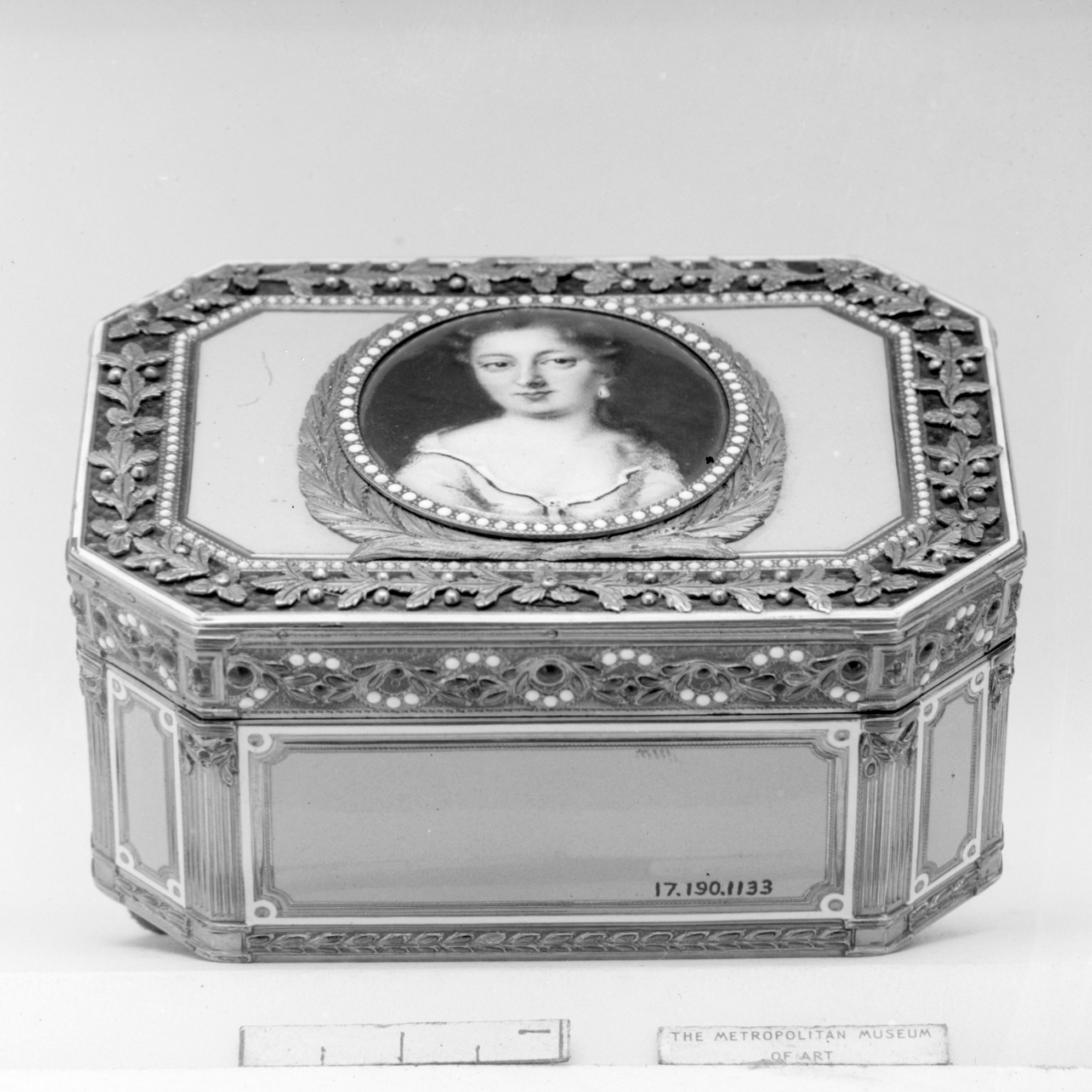
The Object as Artifact: Deconstructing the Snuffbox with Portrait of a Woman
In the rarefied sphere of haute couture and luxury heritage, the snuffbox occupies a paradoxical space: it is at once a utilitarian object, a miniature canvas, and a profound statement of social currency. The Snuffbox with Portrait of a Woman, a piece from the Global Heritage collection at Katherine Fashion Lab, transcends its eighteenth-century origins to become a masterclass in the interplay of materiality, identity, and craftsmanship. Crafted from gold and enamel, this object is not merely a container for powdered tobacco; it is a standalone study in how luxury goods encode narratives of power, intimacy, and aesthetic ambition. This analysis dissects the snuffbox through the lenses of material science, portraiture, and cross-cultural influence, revealing its enduring relevance to contemporary fashion and design thinking.
Material Alchemy: Gold and Enamel as Narrative Mediums
The choice of gold as the primary substrate is no accident. In the context of global heritage, gold has historically signified permanence, divinity, and unassailable wealth. For the snuffbox, the gold base is not merely a structural element but a luminous field that interacts with light to create a dynamic visual experience. The use of enamel, a vitreous substance fused to the metal at high temperatures, introduces a paradox of fragility and durability. Enamel requires exceptional precision; a single misstep in firing can crack the surface, rendering the piece irreparable. This technical risk elevates the snuffbox from a functional object to a testament of human skill, aligning it with the ethos of Katherine Fashion Lab’s commitment to artisanal mastery.
The enamel technique employed here—likely grisaille or en plein—allows for a monochromatic yet richly textured portrait. The woman’s face emerges from a dark, almost velvety background, her features rendered in subtle gradations of white and gray. This chiaroscuro effect, reminiscent of a miniature oil painting, creates an illusion of depth that belies the object’s compact scale. The gold rim and clasp, left partially exposed, serve as a frame that anchors the portrait within a context of opulence. In fashion terms, this is the equivalent of a bespoke gown where every seam and stitch is a deliberate choice, never arbitrary.
The Portrait as a Social and Psychological Document
The woman depicted in the snuffbox is anonymous, yet her portrayal is anything but generic. Her gaze is direct, her posture composed, her attire—likely a lace-trimmed bodice or a silk wrap—suggesting a status of privilege. In the eighteenth century, such portraits were often commissioned as tokens of affection or political alliance, exchanged between lovers, diplomats, or family members. The snuffbox, carried in a pocket or held in the hand, became a private theater for public display. To open the box was to reveal one’s allegiances, one’s heart, or one’s ambitions.
From a curatorial perspective, the absence of a known sitter amplifies the object’s universality. She becomes an archetype: the woman as muse, as patron, as subject of desire. This ambiguity invites the viewer to project their own narratives onto the piece, a quality that resonates with contemporary fashion’s turn toward personalization and storytelling. Katherine Fashion Lab’s Global Heritage collection often emphasizes this fluidity, treating historical artifacts not as static relics but as springboards for modern reinterpretation. The snuffbox’s portrait, therefore, is not a historical footnote but a mirror reflecting the enduring human need to be seen and remembered.
Cross-Cultural Threads: Global Heritage in Miniature
The designation Global Heritage is critical here. While the snuffbox’s form is quintessentially European—emerging from the courts of France, England, and Russia—its materials and techniques draw from a wider world. The gold may have originated in West Africa or the Americas, refined through colonial trade routes. The enamel technique owes debts to Chinese cloisonné and Persian miniature painting, adapted by European artisans who traveled or studied imported goods. Even the snuff itself, the box’s raison d’être, was a New World import, its consumption a ritual of cosmopolitan sophistication.
This hybridity challenges the notion of a singular “origin.” Instead, the snuffbox embodies a network of influences that prefigure today’s globalized fashion industry. Katherine Fashion Lab’s analysis underscores how luxury objects have always been sites of cultural exchange, where materials and motifs are borrowed, transformed, and recontextualized. The portrait’s style—perhaps echoing the work of Swiss-born miniaturist Jean-Étienne Liotard or the French court painter François Boucher—is itself a fusion of Rococo grace and emerging Neoclassical restraint, reflecting the cross-pollination of artistic schools across Europe.
Standalone Study: Implications for Contemporary Couture
To treat this snuffbox as a standalone study is to isolate its design principles from the clutter of historical context. What emerges is a blueprint for modern luxury: the integration of art and function, the valorization of handcraft, and the strategic use of scarcity. In an era of fast fashion and digital reproduction, the snuffbox’s insistence on uniqueness—its one-of-a-kind portrait, its irreproducible enamel—offers a counter-narrative. It reminds us that true luxury is not about volume but about depth; not about trend cycles but about timelessness.
For the fashion designer, the snuffbox teaches lessons in scale and proportion. The miniature format demands that every element—the curve of the lid, the thickness of the gold rim, the angle of the portrait—be balanced with mathematical precision. This discipline translates directly to couture, where a seam’s placement or a fabric’s drape can determine a garment’s success. The object also speaks to the power of containment: the snuffbox holds a substance that alters mood and social interaction, much like a garment shapes the wearer’s presence in the world.
Conclusion: The Enduring Allure of the Miniature
The Snuffbox with Portrait of a Woman is far more than a historical curiosity. It is a concentrated expression of human ambition, skill, and desire. Through its gold and enamel, it captures a moment of intimacy within a framework of global exchange. As a standalone study, it challenges us to see fashion as an act of curation—not just of clothes, but of values, histories, and identities. Katherine Fashion Lab’s analysis reaffirms that the smallest objects often carry the largest stories. In the snuffbox, we find a microcosm of the luxury industry’s past, present, and potential future: a relentless pursuit of beauty through mastery, a dialogue between the personal and the political, and a testament to the art of making something precious endure.