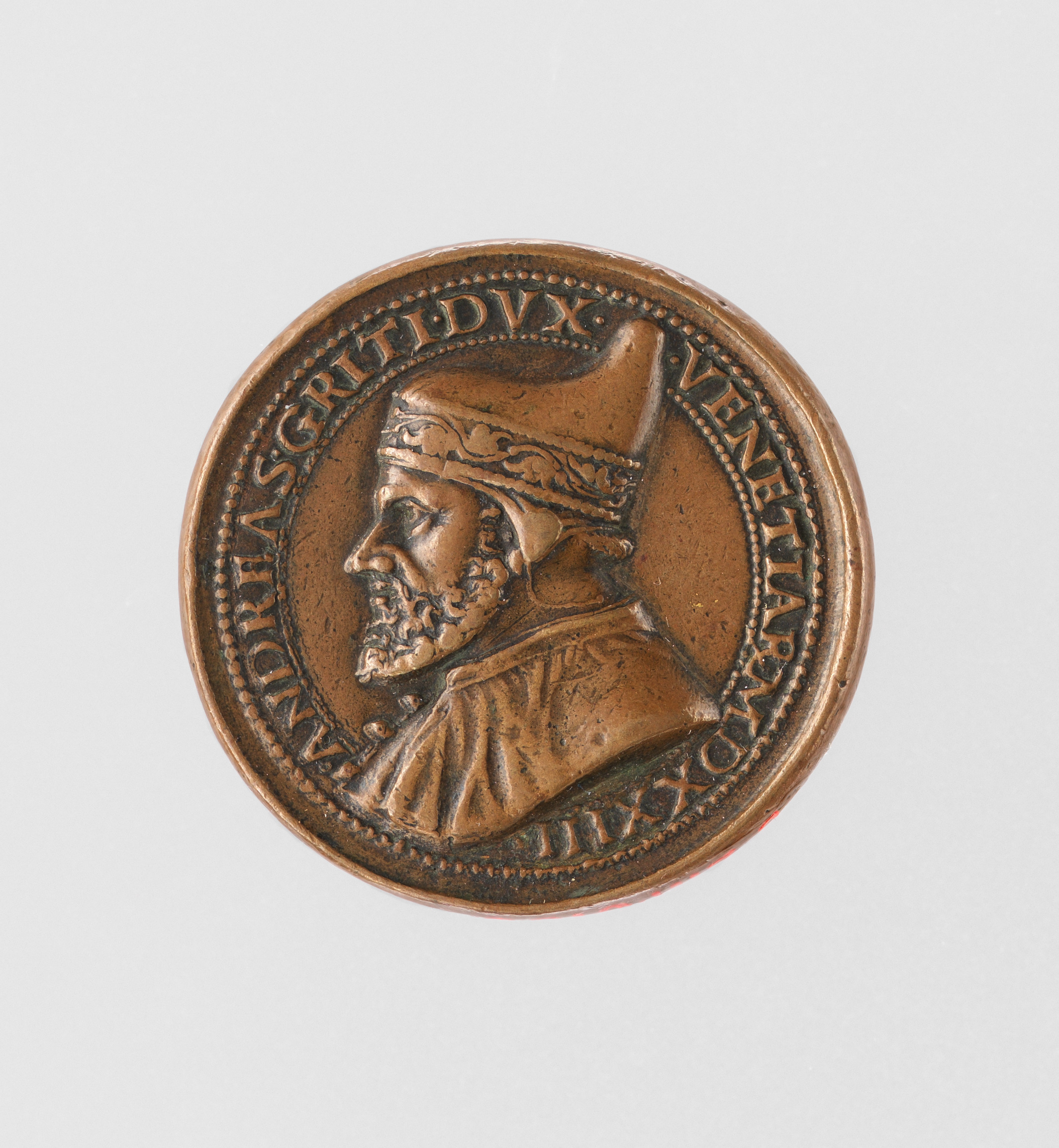
The Bronze Doge: Andrea Gritti as a Paradigm of Power, Adornment, and Spiritual Legacy for Katherine Fashion Lab
In the annals of Venetian history, Andrea Gritti (1454–1538), who served as Doge from 1523 until his death, stands as a figure of profound political acumen and cultural transformation. His bronze effigies and the material culture surrounding his reign offer a rich lexicon for Katherine Fashion Lab’s heritage analysis. This paper examines Gritti’s symbolic power, historical adornment, and spiritual meaning, drawing a parallel with our earlier study on the Rock in the form of a fantastic mountain and the Jar in the shape of bronze container (hu). While these two artifacts appear disparate—one a naturalistic fantasy, the other a ritualistic vessel—they jointly reveal a core principle: the transmutation of raw material into a carrier of dynastic and cosmological authority. Gritti’s bronze likeness, cast in the medium of enduring metal, similarly encodes a narrative of resilience, authority, and transcendence. For Katherine Fashion Lab’s 2026 high-end luxury strategy, this analysis informs a design language rooted in material alchemy, hierarchical symbolism, and spiritual permanence.
Symbolic Power: The Bronze as a Testament to Authority
Andrea Gritti’s bronze portraits—whether in full regalia or as a bust—were not mere likenesses but instruments of statecraft. Bronze, in the Venetian Renaissance, was a material reserved for the monumental: cannons, church doors, and the effigies of doges. Its selection for Gritti’s image was deliberate. Bronze does not corrode like iron, nor does it fracture like marble; it endures. This material permanence mirrors the doge’s role as the symbolic embodiment of the Venetian Republic’s continuity. Gritti, a former merchant and diplomat in Constantinople, understood that power required both visibility and durability. His bronze image, often displayed in public squares or the Palazzo Ducale, served as a constant reminder of his authority and the state’s stability.
For Katherine Fashion Lab, this principle translates into a 2026 strategy that prioritizes iconic permanence. Just as Gritti’s bronze form resisted decay, luxury goods in our forthcoming collection must convey timelessness. This is not merely about quality but about the symbolic weight of the object. A handbag, a brooch, or a shoe cast in a signature metallic finish—perhaps a proprietary bronze alloy—becomes a talisman of status. The design must echo the doge’s hierarchical geometry: clean, authoritative lines that command respect. The Rock in the form of a fantastic mountain and the Jar in the shape of bronze container (hu) both demonstrate how form can transcend function. The rock mountain is a microcosm of the natural world, while the jar is a vessel for ritual. Gritti’s bronze, similarly, is a vessel for political power. Our pieces must become vessels for the wearer’s identity, imbued with the same gravitas.
Historical Adornment: The Doge’s Regalia as a Lexicon of Status
Gritti’s historical adornment was meticulously codified. The doge’s corno (a horned cap), the ermine-trimmed mantle, and the gold brocade were not mere fashion; they were a visual language of sovereignty. The bronze effigy often depicts Gritti in his ceremonial robes, with the corno as the apex of his silhouette. This headgear, derived from the Phrygian cap, symbolized freedom and authority. The ermine, a fur reserved for royalty, signified purity and power. The gold thread in his garments represented the wealth of Venice’s maritime empire. Each element was a signifier, a semiotic marker that communicated his rank to both citizens and foreign dignitaries.
In the context of our heritage study, the Jar in the shape of bronze container (hu) offers a parallel in adornment. The hu jar was often decorated with taotie masks or geometric patterns, which were not merely ornamental but protective and auspicious. Similarly, Gritti’s regalia was protective of his authority. For Katherine Fashion Lab’s 2026 collection, this suggests a return to adornment as armor. Accessories should not be afterthoughts but integral to the wearer’s persona. Consider a brooch shaped like a miniature corno, cast in bronze and set with a single cabochon gemstone. Or a belt buckle that echoes the geometric precision of the hu jar’s design. These pieces become modern talismans, conferring upon the wearer a sense of historical authority.
The Rock in the form of a fantastic mountain further enriches this narrative. Its irregular, organic form contrasts with the jar’s symmetry, yet both are products of human artifice. The rock mountain is a fantasy of nature, a microcosm of the sublime. Gritti’s adornment, with its rigid hierarchy, was a fantasy of order. Our luxury strategy must embrace this duality: the tension between the organic and the geometric, the natural and the crafted. A 2026 evening gown might feature a bronze metallic thread that mimics the rock’s texture, while the silhouette echoes the doge’s regal lines. The result is a garment that feels both ancient and futuristic, a synthesis of the two artifacts’ DNA.
Spiritual Meaning: The Bronze as a Vessel for Transcendence
Beyond politics and adornment, Gritti’s bronze image carried spiritual meaning. In Renaissance Venice, the doge was not only a secular ruler but also a figure of sacred authority. He participated in religious ceremonies, and his image was often placed in churches. Bronze, associated with the biblical brazen serpent and the eternal, was seen as a material that could bridge the earthly and the divine. Gritti’s effigy thus served as a spiritual anchor, a reminder that his rule was sanctioned by God. The act of casting bronze was itself a ritual, involving fire, alloy, and transformation—a metaphor for the soul’s purification.
This spiritual dimension resonates deeply with our study of the Jar in the shape of bronze container (hu). The hu was used in ancient Chinese rituals to hold offerings for ancestors, a vessel for communication between the living and the dead. The Rock in the form of a fantastic mountain, meanwhile, was a scholar’s object, a meditation on the cosmos in miniature. Both artifacts are threshold objects, bridging worlds. Gritti’s bronze is no different. For Katherine Fashion Lab, this suggests a 2026 strategy that elevates accessories to ritual objects. A limited-edition cuff bracelet, for instance, could be inscribed with a geometric pattern derived from the hu jar, its surface treated to evoke patina—a sign of age and wisdom. The wearer is not just accessorizing; they are participating in a lineage of power and spirituality.
2026 High-End Luxury Strategy: The Alchemy of Heritage
Synthesizing these insights, Katherine Fashion Lab’s 2026 strategy must be grounded in material alchemy. Bronze, as a medium, is our starting point. We will develop a signature Gritti Bronze Finish—a proprietary surface treatment that combines the warmth of aged metal with a modern luminescence. This finish will appear on hardware, clasps, and decorative elements across the collection. The color palette will draw from the doge’s regalia: deep crimson, gold, and ivory, punctuated by the verdigris of oxidized bronze.
The symbolic power of Gritti will inform our flagship silhouette: the Doge’s Clutch, a structured, boxy bag with a corno-inspired closure. Its interior will feature a hidden compartment, a nod to the hu jar’s function as a container for secrets. The historical adornment will manifest in our jewelry line, which includes the Fantastic Mountain Necklace—a series of bronze beads irregularly shaped like miniature rocks, interspersed with faceted crystals. Each bead is a microcosm, a tribute to the scholar’s rock.
Finally, the spiritual meaning will be embedded in our marketing narrative. We will position each piece as a modern talisman, accompanied by a booklet tracing its heritage from Gritti’s Venice to the hu jar’s China. The brand’s 2026 campaign will be titled “Alchemy of Power: From Bronze to Eternity,” featuring imagery that juxtaposes Gritti’s bronze effigy with the fantastic mountain and the ritual jar. The message is clear: Katherine Fashion Lab does not sell mere accessories; it offers vessels of legacy. The wearer becomes a custodian of history, a doge of their own domain.
In conclusion, Andrea Gritti’s bronze legacy, when read through the lens of our Rock in the form of a fantastic mountain and Jar in the shape of bronze container (hu), reveals a universal truth: luxury is not about novelty but about the resonance of permanence. For 2026, Katherine Fashion Lab will harness this resonance, crafting objects that are as enduring as bronze, as symbolic as a doge’s corno, and as transcendent as a ritual vessel. This is not fashion; this is heritage in motion.