The Armorer’s Art: Deconstructing the Combination Ax-Pistol of Grand Duke Ferdinand I de’ Medici
In the hallowed halls of European armories, few objects capture the intersection of martial necessity, technological innovation, and princely patronage as vividly as the combination ax-pistol crafted for Grand Duke Ferdinand I de’ Medici (1549–1609). This German-made artifact, forged from steel and gilded with gold, transcends its functional origins to become a profound statement of power, identity, and the Renaissance fascination with hybridity. As a standalone study, this analysis dissects the object not merely as a weapon but as a couture-like embodiment of strategic design, material opulence, and the Medici dynasty’s relentless pursuit of differentiation in a volatile political landscape.
Form Follows Function: The Architectural Logic of Hybrid Design
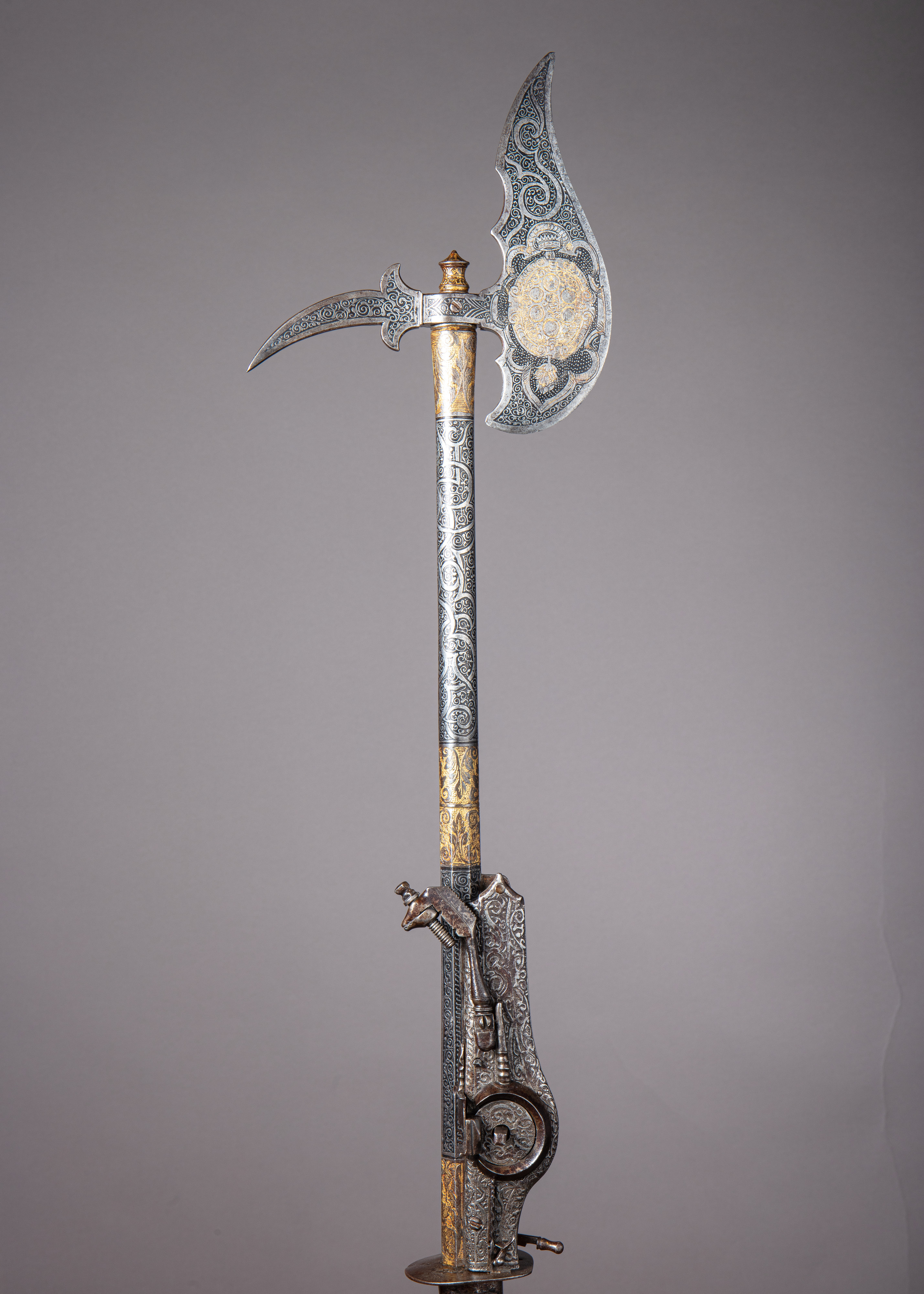
The combination ax-pistol is a masterpiece of mechanical ingenuity, marrying a single-shot wheellock pistol with a battle ax in a seamless, ergonomic union. The steel shaft, extending from the ax head to the pistol grip, is not a mere appendage but a structural spine that distributes weight with precision. The ax blade, curved and sharpened to a razor’s edge, sits opposite the pistol’s barrel, creating a balanced fulcrum that allows for both slashing and firing without compromising stability. This duality is not accidental; it reflects the Renaissance armorer’s understanding of operational versatility—a concept that resonates with modern luxury goods where form must enhance function without sacrificing aesthetic integrity.
The wheellock mechanism, housed within the ax’s haft, is a marvel of miniaturization. Its complex spring-loaded wheel, which spins against a piece of pyrite to create sparks, required meticulous calibration. The integration of this mechanism into the ax’s body demanded that the armorer reconfigure traditional proportions. The result is a weapon that is neither purely a firearm nor a polearm but a third entity—a strategic hybrid designed for close-quarters combat where speed and surprise were paramount. This architectural logic mirrors the haute couture ethos of bespoke tailoring, where every seam and stitch serves a dual purpose: to enhance movement while asserting a unique silhouette.
Material Alchemy: Steel and Gold as Signifiers of Sovereignty
The choice of materials—steel and gold—elevates this object from a utilitarian tool to a ceremonial artifact. The steel, likely sourced from German foundries renowned for their metallurgical rigor, is not merely functional but symbolic. Its dark, burnished surface provides a stark canvas for the gilded accents that adorn the ax head, the trigger guard, and the pommel. These gold inlays, executed with chisel and hammer, depict intricate arabesques and Medici heraldic motifs—the palle (balls) and the Florentine lily. The gold is not applied as a veneer but embedded into the steel through a process of damascening, creating a tactile contrast that invites touch and scrutiny.
This material dialogue speaks to the Renaissance concept of sprezzatura—the art of making complexity appear effortless. The gold does not overwhelm the steel but rather accentuates its strength, much like a masterfully tailored jacket uses gold buttons to draw the eye to a lapel’s cut. For Ferdinand I, a patron of the arts and a collector of curiosities, the ax-pistol was a microcosm of his court’s values: power tempered with refinement. The gold’s luminescence, when caught in candlelight, would have projected an aura of divine right, reminding viewers that the wielder was not just a soldier but a sovereign whose authority was as enduring as the metal itself.
The Medici Signature: Politics, Prestige, and the Art of Differentiation
To understand this object fully, one must consider the Medici dynasty’s precarious position in the late 16th century. Ferdinand I, a cardinal who renounced his ecclesiastical titles to assume the Grand Duchy of Tuscany, faced the challenge of legitimizing his rule amid the shadow of his more famous predecessors, Cosimo I and Francesco I. The combination ax-pistol served as a portable manifesto of his adaptability and foresight. By commissioning a weapon that fused German engineering with Italianate elegance, Ferdinand signaled his ability to synthesize diverse cultural and technological currents—a trait essential for a ruler navigating the shifting alliances of the Habsburg and Valois courts.
The ax-pistol also functioned as a tool of political theater. In an era where gift-giving was a cornerstone of diplomacy, such objects were often presented to visiting dignitaries or displayed in the Medici armory to awe guests. The hybrid nature of the weapon—neither purely offensive nor defensive—mirrored the Medici’s own hybrid identity: bankers turned aristocrats, patrons turned rulers. This object was not merely a weapon but a statement of brand identity, much like a contemporary luxury house’s signature handbag or watch. It declared that the Medici were not content to follow tradition; they redefined it.
Couture Parallels: Craftsmanship, Exclusivity, and the Wearable Artifact
The ax-pistol’s construction process—involving master smiths, goldsmiths, and engravers—mirrors the atelier model of high fashion. Each component was hand-forged, fitted, and finished over months, if not years. The wheellock alone required the skills of a specialist who understood the delicate interplay of springs, sears, and tumblers. The gold inlays demanded a jeweler’s precision, while the ax blade’s curvature was calibrated by a weaponsmith. This division of labor is akin to the collaborative creation of a couture gown, where pattern cutters, embroiderers, and seamstresses each contribute their expertise to a singular vision.
Moreover, the ax-pistol exemplifies the concept of wearable technology avant la lettre. Just as a modern smartwatch integrates communication and fitness tracking into a wrist accessory, this weapon integrated ranged and melee capabilities into a single, portable form. The user, likely a bodyguard or the Grand Duke himself, could transition from firing to striking in a fluid motion, exploiting the element of surprise. This ergonomic intelligence—where the weapon becomes an extension of the body—is a principle that couture designers apply when crafting garments that move with the wearer, not against them.
Legacy and Contemporary Resonance
Today, the combination ax-pistol of Ferdinand I de’ Medici resides in museums and private collections as a testament to Renaissance ingenuity. Yet its influence extends beyond historical curiosity. In the realm of luxury design, hybrid objects—from convertible handbags to multifunctional jewelry—continue to captivate consumers who value versatility as a form of exclusivity. The ax-pistol’s balance of power and elegance offers a blueprint for how heritage can inform innovation. It reminds us that true craftsmanship is not about simplicity but about mastering complexity to create something that is both beautiful and brutally effective.
For Katherine Fashion Lab, this artifact serves as a case study in strategic differentiation. In a market saturated with offerings, the ability to combine disparate elements—steel and gold, function and ornament, tradition and modernity—into a cohesive narrative is the hallmark of enduring relevance. The Grand Duke’s ax-pistol was not just a weapon; it was an argument for why the Medici mattered. In the same vein, every piece in a couture collection must argue for its own necessity, its own unique place in the wearer’s life. The ax-pistol, with its silent steel and gleaming gold, continues to make that argument across centuries.