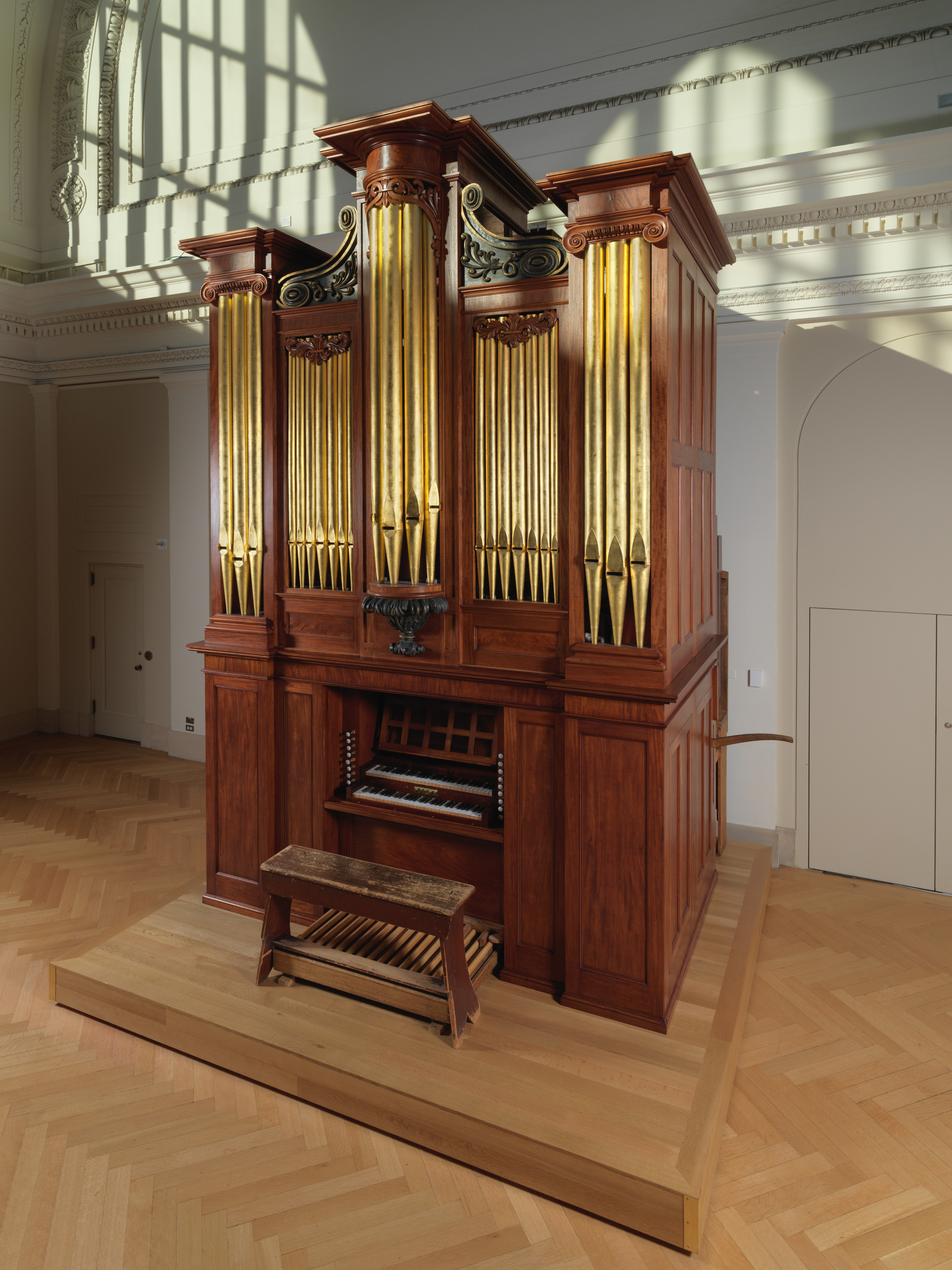
Heritage Analysis: The American Pipe Organ as a Strategic Archetype for 2026 Luxury
The pipe organ, particularly in its American manifestation of the 19th and early 20th centuries, represents a pinnacle of material ambition, spiritual resonance, and architectural integration. For Katherine Fashion Lab, this instrument offers a profound strategic standalone research case. Its construction from a hierarchical palette of mahogany veneer, rosewood veneer, pine, gilt, ivory, ebony, maple, walnut, chestnut, and metal is not merely functional but a deliberate lexicon of symbolic power, historical adornment, and spiritual meaning. This analysis deconstructs these layers to inform a 2026 high-end luxury strategy that prioritizes depth over spectacle, and permanence over trend.
Symbolic Power: The Architecture of Authority and Transcendence
Verticality and the Material Hierarchy
The American pipe organ’s symbolic power is first articulated through its vertical scale. Rising from a base of dense, dark woods like walnut and chestnut—materials associated with earth and stability—the instrument ascends through lighter, more luminous elements: maple for structural ribs, pine for internal wind chests, and ultimately, gilt for the façade pipes. This vertical progression is a material metaphor for spiritual ascension. In the American context, this was not merely a European import but a declaration of civic and industrial might. The organ in a 19th-century urban church or concert hall was a physical embodiment of the community’s ability to command nature—harvesting rare tropical hardwoods like mahogany and rosewood—and to discipline them into a machine that could produce sound of overwhelming, almost divine, authority.
Ebony and Ivory: The Binary of Control
The keyboard, composed of ebony for the accidentals and ivory for the naturals, is a microcosm of this symbolic power. Ebony, a wood so dense it sinks in water, represents the immutable, the foundational. Ivory, a material of organic warmth and rarity, embodies the human touch. Together, they form a binary system of control: the player’s fingers mediate between the dark, eternal structure and the luminous, transient sound. For Katherine Fashion Lab, this duality offers a powerful metaphor for 2026 luxury: the interplay between absolute structural integrity (ebony) and sensual, human-centric experience (ivory). A luxury strategy must not choose one over the other but orchestrate their tension into a cohesive narrative of mastery.
Historical Adornment: Gilt, Veneer, and the American Guilded Age
Veneer as Strategic Opulence
The extensive use of mahogany and rosewood veneers over a pine or chestnut core is a critical lesson in historical adornment. Veneer, often misunderstood as a cost-saving measure, is in fact a technique of selective amplification. It allows the artisan to present the most exquisite figure of a rare wood—the flame of mahogany, the ribbon-stripe of rosewood—while using a structurally sound, less precious core. This is not deception; it is curation. For the American pipe organ builders of the late 1800s, this approach allowed for the creation of monumental, visually cohesive instruments that could be afforded by growing congregations. In 2026 luxury, this principle translates to strategic investment in visible surfaces—the areas of highest sensory impact—while ensuring the underlying architecture is robust but unostentatious.
Gilt and the Language of Light
Gilt, or gold leaf applied to the metal façade pipes, serves as the ultimate historical adornment. It is not structural; it is purely symbolic. The gold catches the light, drawing the eye upward and outward, transforming a functional object into a beacon. The American pipe organ’s use of gilt is particularly instructive because it is often applied to the largest, most visible pipes—the ones that produce the lowest, most fundamental frequencies. This is a profound strategic choice: adorn that which grounds the experience. For Katherine Fashion Lab, this suggests that high-end luxury in 2026 should not merely decorate the periphery but should elevate the core product. A garment’s foundational cut, a handbag’s structural seam—these should be the sites of the most deliberate, symbolic embellishment.
Spiritual Meaning: The Organ as a Collective Voice
The Materialization of the Sublime
Spiritually, the American pipe organ is unique in its ability to inhabit both the physical and the metaphysical. The wind, produced by bellows and channeled through miles of metal and wood pipes, is a controlled, industrial breath. The materials are not passive; they are resonant chambers. The pine of the wind chest vibrates sympathetically; the metal of the pipe—a complex alloy of tin and lead—colors the tone. This is a material theology: the sacred is rendered audible through the discipline of matter. The ivory keys, the ebony sharps, the rosewood stop knobs—each is a point of contact where the human hand negotiates with the divine. For a luxury brand, this underscores the necessity of tactile spirituality. The 2026 consumer does not seek passive objects but talismans that mediate between their interior world and a larger, transcendent order.
Community and the Monumental Scale
The American pipe organ’s spiritual meaning is also communal. Unlike a private piano, an organ is built for a public space. Its size—often requiring its own room or chamber—demands that the individual yield to the collective. The materials, sourced from across the globe (mahogany from the Americas, rosewood from Asia, ivory from Africa), are assembled into a single, coherent voice. This is a model of inclusive grandeur. For Katherine Fashion Lab, this suggests that 2026 luxury strategy must move beyond individual exclusivity toward shared, elevated experiences. The product becomes a vessel for community, not just a marker of personal status.
2026 High-End Luxury Strategy: Lessons from the Pipe Organ
Principle One: Hierarchical Material Storytelling
The pipe organ teaches that materials should be deployed in a clear hierarchy of symbolic weight. For Katherine Fashion Lab’s 2026 collection, this means identifying a primary symbolic material (akin to the gilt), a structural narrative material (the mahogany or rosewood veneer), and a foundational, unseen material (the pine or chestnut). The consumer should be able to read this hierarchy intuitively, understanding that the most precious materials are reserved for the most significant functions.
Principle Two: Adornment as Architecture
Gilt on the organ is not applied arbitrarily; it is integrated into the architecture. Similarly, 2026 luxury should reject decoration that is merely additive. Instead, ornamentation must arise from structural necessity. A gold thread is not a trim but a reinforcing stitch. An ivory inlay is not a pattern but a functional joint. This approach elevates adornment from superficial to essential, commanding the respect of a discerning clientele.
Principle Three: The Sensuality of the Sacred
The ivory and ebony of the keyboard are not cold; they are warm, smooth, and responsive. For Katherine Fashion Lab, this translates to a commitment to haptic excellence. Every surface that the consumer touches—a zipper pull, a clasp, a fabric edge—must be treated with the same reverence as an organist’s keyboard. The spiritual meaning of the object is communicated through the quality of its touch.
Principle Four: Scale as a Statement of Intent
The American pipe organ’s scale is not accidental; it is a declaration. For 2026, Katherine Fashion Lab should consider strategic monumentality in key pieces. This does not mean merely making larger products, but designing items whose physical presence commands a space, compelling the owner to arrange their environment around the object. This is the ultimate luxury: the object that dictates the terms of its own reverence.
Conclusion: The Organ as a Blueprint for Depth
The American pipe organ, constructed from a carefully orchestrated palette of woods, metals, and ivory, offers a masterclass in symbolic power, historical adornment, and spiritual meaning. Its lessons for Katherine Fashion Lab’s 2026 high-end luxury strategy are clear: prioritize material hierarchy, integrate adornment with structure, elevate the tactile to the sacred, and embrace scale as a statement of purpose. In an era of fleeting digital trends, the pipe organ stands as a monument to the enduring value of craft, community, and transcendence. Katherine Fashion Lab has the opportunity to translate this heritage into a new language of luxury—one that is as resonant, as commanding, and as spiritually profound as the instrument itself.