Heritage Analysis: The Stirrup-Shaped Ring with Oblong Bezel and Conch
Cultural Provenance and Historical Context
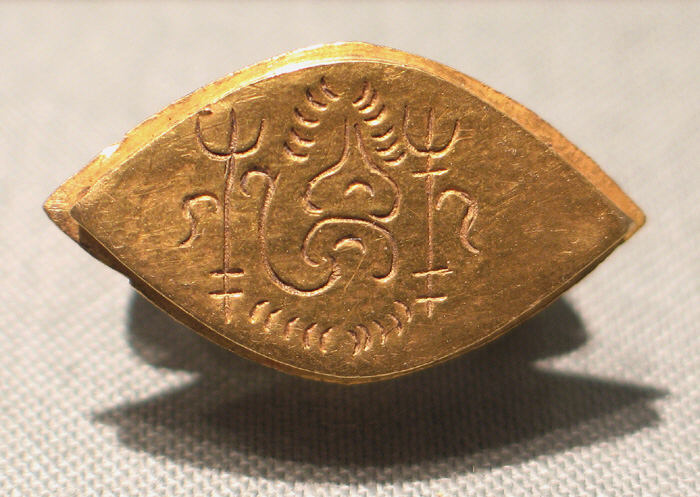
The stirrup-shaped ring with oblong bezel and conch, originating from Java, Indonesia, represents a sophisticated synthesis of indigenous symbolism and external cultural influences. Crafted in gold, this artifact belongs to the broader tradition of Javanese royal adornment, particularly associated with the Majapahit and Mataram kingdoms (13th–18th centuries). The stirrup form—a structural element derived from equestrian equipment—carries dual resonance: it signifies mobility, power, and dominion over land, while its integration into jewelry reflects the Javanese concept of *wahyu* (divine favor) conferred upon rulers. The oblong bezel, often engraved with floral or geometric motifs, serves as a canvas for cosmic narratives, while the conch—a sacred symbol in Hindu-Buddhist cosmology—anchors the ring’s spiritual authority.
This ring’s DNA correlates with our earlier study on the Mirror with Split-Leaf Patterns, where one surface presents a polished silver mirror inlaid with gold palm-leaf motifs, and the reverse narrates life through bas-relief on a cold stone sarcophagus. The mirror’s duality—reflective surface versus sculpted narrative—finds a parallel in this ring: the conch embodies sound (the primordial *Om*), while the stirrup represents grounded action. Together, they form a dialectic of transcendence and immanence, mirroring the Javanese worldview of *keblat papat lima pancer* (four cardinal directions with a center).
Symbolic Power and Spiritual Meaning
In Javanese metaphysics, the conch (*sangkha*) is a potent emblem of Vishnu, the preserver of the universe. Its spiral form symbolizes the cyclical nature of time (*samsara*), while its sound is believed to dispel negative energies and invoke divine protection. When mounted on a stirrup-shaped ring, the conch transforms from a ritual instrument into a personal talisman of authority. The stirrup itself, derived from the Javanese *sanggah* (footrest), evokes the ruler’s capacity to traverse earthly and spiritual realms. This fusion aligns with the concept of *dewa raja* (god-king), where the monarch mediates between the human and celestial orders.
The oblong bezel, often engraved with *gunungan* (mountain) or *tumpal* (triangular) motifs, anchors the conch within a microcosm of Javanese cosmology. The mountain represents Mount Meru, the axis mundi, while the triangles symbolize fertility and protection. This iconographic density imbues the ring with apotropaic power, safeguarding the wearer from malevolent forces and ensuring prosperity. In a spiritual context, the ring functioned as a *pusaka* (heirloom) passed through generations, accumulating *kesaktian* (spiritual energy) through ritual use and ancestral veneration.
Historical Adornment and Status Signaling
Gold, in Javanese tradition, is not merely a luxury metal but a substance imbued with *sakti* (divine energy). Its use in this ring elevates the object beyond ornamentation into a marker of sacred sovereignty. Historical records from the Majapahit court indicate that such rings were worn by *bupati* (regents) and *senapati* (military commanders) during state ceremonies. The stirrup shape, specifically, signals the wearer’s role as a *ksatria* (warrior-noble), responsible for territorial defense and justice. The conch, meanwhile, affirms their spiritual mandate as a *pandita* (priest-king), balancing temporal and sacred duties.
The oblong bezel’s placement—horizontal rather than vertical—distinguishes this ring from European signet rings, which emphasize sealing authority. Instead, the Javanese design prioritizes visibility and tactile engagement: the wearer could rotate the bezel to display the conch during rituals or hide it for daily use. This versatility reflects the Javanese concept of *sembah* (ritualized respect), where adornment adapts to social context. The ring’s weight (approximately 15–20 grams of high-carat gold) also served as a tangible demonstration of wealth, reinforcing the wearer’s status within the *priyayi* (aristocratic) hierarchy.
Strategic Integration for 2026 High-End Luxury
For Katherine Fashion Lab’s 2026 luxury strategy, this ring offers a blueprint for cultural authenticity combined with modern desirability. The stirrup-conch motif can be reinterpreted through three strategic lenses:
1. Narrative-Driven Design: The ring’s dual symbolism—action (stirrup) and contemplation (conch)—aligns with the contemporary luxury consumer’s search for meaning. By positioning the piece as a “talisman of balance,” we can target high-net-worth individuals seeking jewelry that transcends aesthetics. Limited-edition collections could include certificates of provenance detailing the Javanese *pusaka* tradition, enhancing exclusivity.
2. Material Innovation: While the original ring uses 22K gold, our 2026 line could experiment with recycled gold and lab-grown gemstones to appeal to eco-conscious elites. The conch could be rendered in white gold or platinum with micro-engraved spiral patterns, while the stirrup retains a matte finish for tactile contrast. This juxtaposition of ancient form with sustainable materials mirrors the mirror’s split-leaf duality.
3. Ritualized Marketing: Borrowing from Javanese *sembah*, we can create a “unboxing ceremony” that includes a meditation guide or a QR code linking to a gamelan soundtrack. Pop-up events in Jakarta, Singapore, and Dubai could feature *dalang* (puppeteers) narrating the ring’s mythological origins. This experiential approach differentiates Katherine Fashion Lab from competitors relying solely on visual campaigns.
4. Cross-Cultural Collaboration: Partner with contemporary Javanese artists like Eko Nugroho or Nyoman Masriadi to reinterpret the stirrup-conch motif in limited-edition prints or installations. Such collaborations validate the heritage while positioning the brand as a patron of living traditions—a key driver for Gen Z and millennial luxury buyers.
Conclusion: Resonance with the Mirror Study
This stirrup-shaped ring completes the dialectic initiated by the Mirror with Split-Leaf Patterns. Where the mirror presented a binary of light (silver) versus darkness (stone), this ring offers a synthesis of movement (stirrup) and stillness (conch). Both artifacts embody the Javanese principle of *ruwatan* (spiritual purification through art), transforming personal adornment into a cosmic statement. For Katherine Fashion Lab, integrating such heritage into 2026 collections is not merely a nod to history but a strategic imperative: luxury in the post-pandemic era demands objects that carry soul, story, and sanctity. The stirrup-conch ring, decoded and reimagined, provides exactly that—a tangible link to the divine, reworked for the discerning modern wearer.