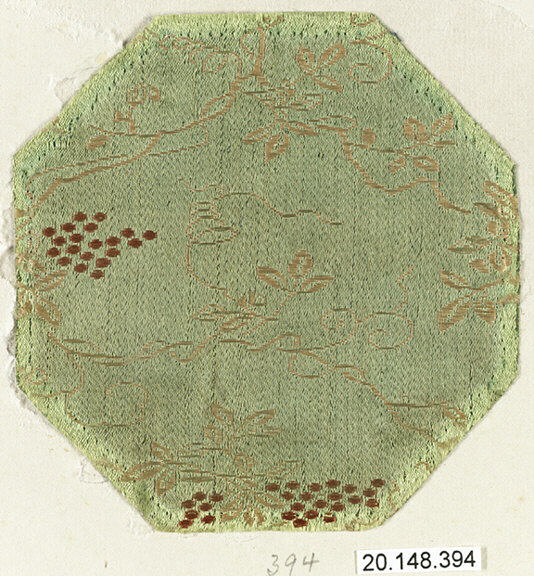
Deconstructing the Kimono: A Couture Analysis of a Japanese Compound-Weave Silk Masterpiece
In the rarefied world of haute couture, where fabric is not merely a medium but a manifesto, the Japanese kimono stands as an enduring archetype of sartorial philosophy. The piece under analysis—a late-Edo period uchikake (an outer robe worn over a kimono, often for ceremonial occasions) crafted from a compound-weave silk—transcends its historical origins to function as a standalone study in textile engineering, cultural semiotics, and aesthetic restraint. For the contemporary couturier, this garment offers a masterclass in how structure, texture, and symbolism converge to create a piece that is both a relic and a revelation. The analysis herein will dissect the garment’s materiality, its constructional logic, and its silent narrative, drawing parallels to modern luxury fashion’s pursuit of timelessness.
Material Alchemy: The Compound-Weave Silk
The foundation of this piece’s prestige lies in its compound-weave structure, a technique that elevates silk from a simple textile to a three-dimensional tapestry. Unlike a plain weave, where warp and weft interlace in a single plane, a compound weave incorporates multiple warp or weft systems—often with supplementary threads—to create intricate patterns, raised textures, and a play of light that shifts with movement. In this specific garment, the compound weave is achieved through a double-faced technique, where the obverse and reverse present distinct visual languages. The exterior is a lustrous, deep indigo silk, woven with gold-wrapped threads (kinran) that form stylized chrysanthemums and flowing water motifs. The interior, conversely, reveals a matte, unadorned surface of raw silk, dyed in a subtle shade of persimmon (kaki).
This duality is not merely decorative but functional. The compound weave provides structural integrity without sacrificing drape, allowing the garment to hold its silhouette while cascading fluidly. The silk itself, sourced from the cocoons of Bombyx mori, is of the highest denier, with a filament length that minimizes breakage and ensures a smooth, continuous surface. The use of gold thread—itself a compound of paper-thin gold leaf adhered to washi (Japanese paper) and then cut into filaments—introduces a metallic stiffness that contrasts with the silk’s softness, creating a tactile dialogue between rigidity and fluidity. For the modern luxury designer, this material choice underscores a critical lesson: texture is a narrative device. The interplay of light-catching gold against the absorbent indigo transforms the kimono into a living canvas, one that changes character under different lighting conditions—a quality that contemporary brands like Loewe or The Row have sought to emulate through artisanal jacquards and hand-embroidered surfaces.
Construction as Philosophy: The Uncut Form
Perhaps the most radical aspect of this kimono, from a Western couture perspective, is its construction. The garment is composed of four rectangular panels—two for the body and two for the sleeves—cut with no curves, darts, or seams that follow the body’s contours. Instead, the kimono relies on the wearer’s body to give it form, a principle that challenges the Eurocentric obsession with tailoring and fit. The panels are sewn together with a running stitch that is intentionally visible, a technique known as nui-haku, where the stitching becomes part of the design. The sleeves, wide and flowing, are attached at the shoulder with a slight drop, creating a “winged” silhouette that allows for air circulation and graceful movement.
This constructional philosophy—what Japanese textile scholar Yoshiko Iwamoto Wada calls “the logic of the straight line”—is a manifestation of wabi-sabi, the aesthetic appreciation of imperfection and transience. The kimono is not designed to be a second skin but a separate, living entity that coexists with the body. The compound-weave silk is cut with the grain, ensuring that the fabric’s natural tension and fall remain unaltered. This approach has profound implications for contemporary couture: it suggests that luxury is not about constraining the body but about liberating it through fabric. Designers such as Issey Miyake and Rei Kawakubo have famously drawn from this ethos, creating garments that are “pre-constructed” in the loom, where the weaving itself dictates the final shape. In this piece, the compound weave is not just a surface treatment; it is the structural blueprint.
Semiotics of Motif: The Chrysanthemum and Water
The motifs woven into the compound weave are not arbitrary embellishments but a codified visual language. The chrysanthemum (kiku), depicted with sixteen petals in a symmetrical arrangement, is the imperial crest of Japan, symbolizing longevity, rejuvenation, and the sun. Its presence on this uchikake suggests that the garment was likely worn by a woman of high-ranking samurai or courtly lineage, possibly for a wedding or a coming-of-age ceremony. The flowing water (ryusui) patterns, rendered as undulating lines in gold thread, represent purification and the passage of time—a reminder of the Buddhist concept of impermanence (mujo).
The combination of these motifs within a compound-weave structure creates a layered reading. The gold chrysanthemums, raised slightly above the indigo ground, catch light and cast shadows, giving the illusion of movement—as if the flowers are floating on the water. This optical effect is intentional, rooted in the Japanese aesthetic principle of yūgen, or “mysterious depth.” The viewer is invited to look beyond the surface, to perceive the unseen currents of meaning. For the modern couturier, this semiotic richness offers a template for how pattern can carry cultural weight. In an era of fast fashion and logo-driven branding, this kimono reminds us that true luxury communicates through symbolism, not signage. The chrysanthemum and water are not logos; they are stories woven into the very structure of the fabric.
The Standalone Study: Lessons for the Modern Atelier
As a standalone study, this Japanese compound-weave silk kimono challenges the contemporary fashion industry to rethink its relationship with material, construction, and narrative. The garment’s longevity—having survived over 150 years with its colors and weave intact—is a testament to the durability of artisanal techniques. The compound weave, with its multiple thread systems, is inherently more resilient than a simple print or embroidery, which can fade or fray. This piece is not a disposable trend; it is an heirloom, designed to be passed down through generations. For the luxury market, this suggests a pivot from seasonal turnover to permanent collections, where a single garment is an investment in craft.
Furthermore, the kimono’s modularity—its ability to be worn in different ways (folded, tied, or layered)—challenges the rigid sizing and fit of Western couture. In the atelier of Katherine Fashion Lab, this principle can be adapted into “transformative” pieces: a coat that can be worn as a dress, a skirt that converts into a cape, all leveraging the compound-weave silk’s inherent versatility. The textile itself becomes the protagonist, not the pattern. The gold thread, rather than being a mere accent, is a structural element that defines the garment’s movement and light play.
Finally, the piece’s silent, unassuming presence—its refusal to shout for attention—is a lesson in quiet luxury. In a fashion landscape dominated by logos and instant recognition, this kimono whispers. It demands a connoisseur’s eye, one that appreciates the subtle shift of indigo to navy under candlelight, the tactile pleasure of running a hand over the raised gold chrysanthemums, the weight of history in every thread. For Katherine Fashion Lab, this standalone study is a call to elevate the compound-weave silk from a material to a philosophy: one that values depth over display, permanence over performance, and craft over commerce. In the end, this Japanese masterpiece is not just a piece of clothing; it is a treatise on what fashion can be when it dares to be still, to be silent, and to be truly woven with intention.