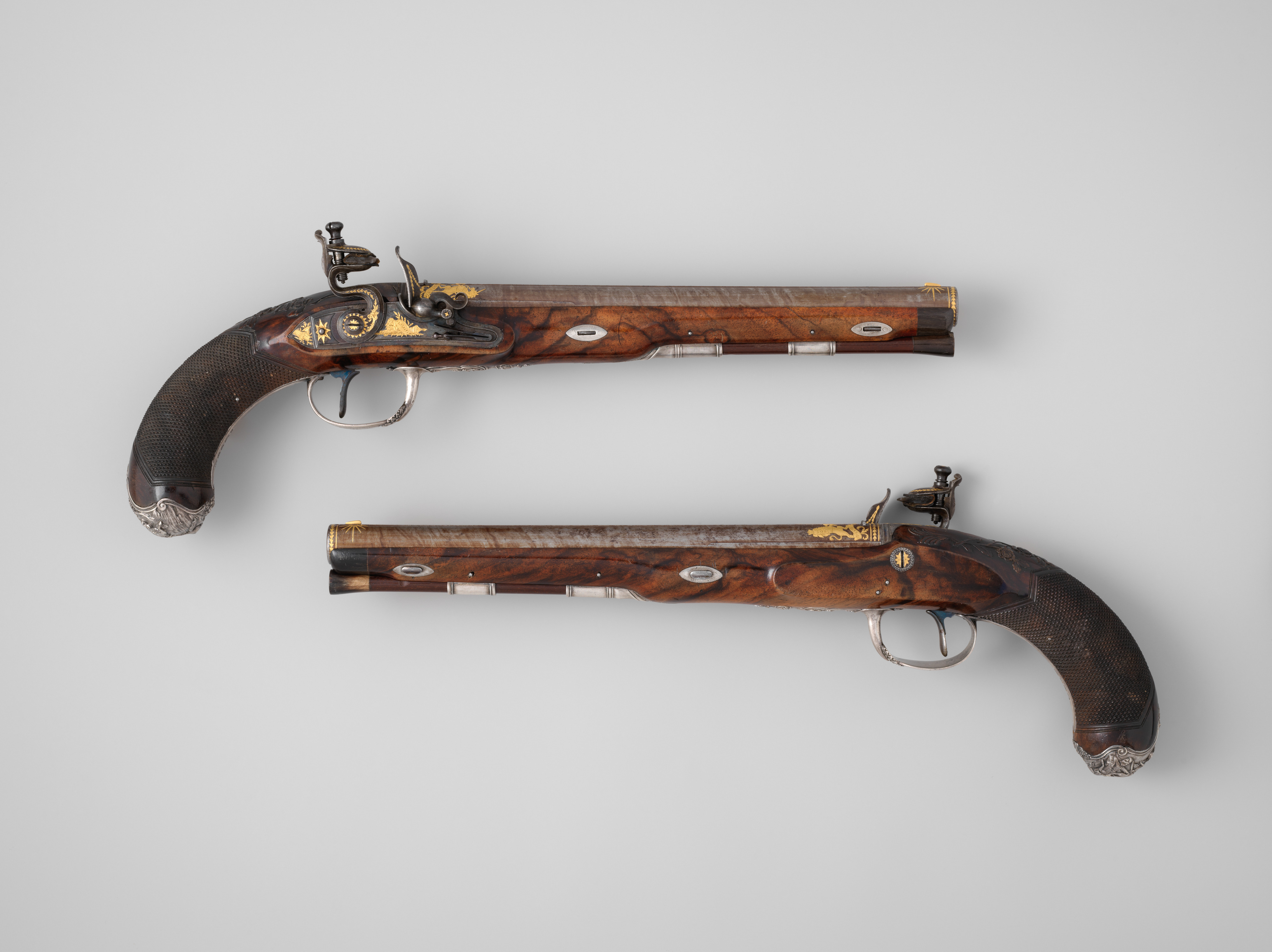
Heritage Analysis: The Flintlock Pistols of George IV
In the annals of British regalia, few objects embody the confluence of martial authority, personal vanity, and spiritual symbolism as profoundly as the paired flintlock pistols crafted for George IV, then Prince of Wales. These are not mere weapons; they are meticulously engineered artifacts of power, designed to project an image of sovereign invincibility while simultaneously serving as exquisite objects of personal adornment. For Katherine Fashion Lab, a deep-dive into this heritage object reveals a masterclass in symbolic storytelling, material hierarchy, and the construction of an elite identity—a blueprint for 2026 high-end luxury strategy.
Symbolic Power: The Sovereign as Divine Protector
At its core, the flintlock pistol pair functions as a potent symbol of sovereign authority and the right to enforce order. In the late 18th and early 19th centuries, the Prince of Wales was a figure of immense public scrutiny, his personal conduct often at odds with his future constitutional role. The pistols, therefore, served a dual purpose: they were practical tools for the hunt and personal defense, but more importantly, they were objects of performative power. The very act of commissioning a matched pair—identical in form and function—signifies a duality of control: the ability to both judge and execute, to protect and to punish.
This duality is critical for modern luxury. A 2026 strategy must move beyond mere product features to embrace narratives of guardianship and legacy. Katherine Fashion Lab can draw inspiration by positioning its collections as "armor for the modern era"—garments and accessories that provide not just physical covering, but a symbolic shield of status, lineage, and uncompromising authority. The pistol pair teaches us that true power is not loud; it is calibrated, precise, and held with the quiet confidence of one who owns the room.
Historical Adornment: The Language of Material Hierarchy
The construction of these pistols is a lesson in strategic material selection. The steel barrels, while functional, are masterpieces of blueing and engraving, transforming a utilitarian surface into a canvas for artistry. The stocks are a symphony of woods: walnut for the grip, rosewood for the ramrod, and mahogany for the case—each chosen for its specific grain, density, and symbolic resonance. Walnut, historically associated with strength and resilience, forms the core of the weapon, while the precious metals—silver mounts, gold inlays—are reserved for the most visible, tactile points: the trigger guard, the butt cap, the escutcheon bearing the Prince of Wales’s feathers.
This material hierarchy is a direct precursor to the principles of high-end luxury. Katherine Fashion Lab can adopt a similar philosophy: the most intimate, high-touch elements of a garment—the lining of a jacket, the clasp of a bag, the interior of a shoe—should be crafted from the most precious, unexpected materials. The visible exterior may be understated, but the hidden details reveal the wearer’s true status. This is not ostentation; it is a code understood by the initiated. The 2026 luxury consumer does not seek logo-covered visibility; they seek the quiet, almost secret, language of material excellence.
Spiritual Meaning: The Ritual of Preparation and Readiness
Beyond their martial and aesthetic functions, these pistols carry profound spiritual weight. The case and accessories—powder flasks, bullet molds, cleaning rods—are not mere storage; they are the accoutrements of a sacred ritual. The act of loading, priming, and aiming a flintlock is a deliberate, meditative process. It demands focus, patience, and an almost sacerdotal respect for the object’s potential. For George IV, owning such a piece was a statement of readiness—not just for physical conflict, but for the spiritual battle of maintaining one’s place in the cosmic order of monarchy.
This concept of ritual readiness is a powerful vector for modern luxury. In an age of digital distraction and instant gratification, the 2026 consumer craves objects that demand a slower, more intentional relationship. Katherine Fashion Lab can create collections that are not simply worn, but "prepared." A coat with a hidden, ritualistic fastening. A bag with a specific, meditative opening sequence. The spiritual meaning lies not in the object itself, but in the ceremony of its use. The pistols remind us that luxury is not about speed; it is about the sacred quality of time spent with an object of profound significance.
2026 High-End Luxury Strategy: The Heirloom Paradox
Translating this heritage into a viable 2026 strategy requires navigating a paradox: the object is an antique, yet its principles are timeless. The pistols of George IV were not mass-produced; they were a bespoke commission from the finest craftsmen of London. For Katherine Fashion Lab, this dictates a shift toward hyper-personalization and limited editions. The 2026 client does not want a product; they want a commission. They want to participate in the creation of an object that is, in its very DNA, an heirloom.
Furthermore, the pistols teach us about the power of the ensemble. The case, the accessories, the tools—each component is essential to the whole. A 2026 luxury strategy must therefore embrace holistic ecosystems. A garment should be sold with its ritual accessories: a specific cleaning cloth, a case crafted from a material that ages beautifully, a certificate of provenance that tells the story of its creation. This transforms a purchase into an inheritance.
Finally, the pistols are a testament to the enduring value of craft. The steel is not merely steel; it is the result of a specific forging process. The wood is not just wood; it is selected from a specific forest, cured for a specific period. Katherine Fashion Lab must champion radical transparency in craftsmanship. For every piece, the brand should publish a "maker’s note"—detailing the origin of materials, the hands that shaped them, and the hours of labor invested. This is the 2026 equivalent of the royal armorer’s signature.
Conclusion: The Blueprint for Sovereign Luxury
The paired flintlock pistols of George IV are far more than historical curiosities. They are strategic artifacts that codify the principles of symbolic power, material hierarchy, spiritual ritual, and heirloom value. For Katherine Fashion Lab, they offer a clear, actionable blueprint for 2026: create objects that are not merely consumed, but inherited, ritualized, and revered. In a market saturated with the transient, the truly luxurious will be the timeless, the precise, and the sacred. The Prince of Wales understood this. The modern luxury house must, too.