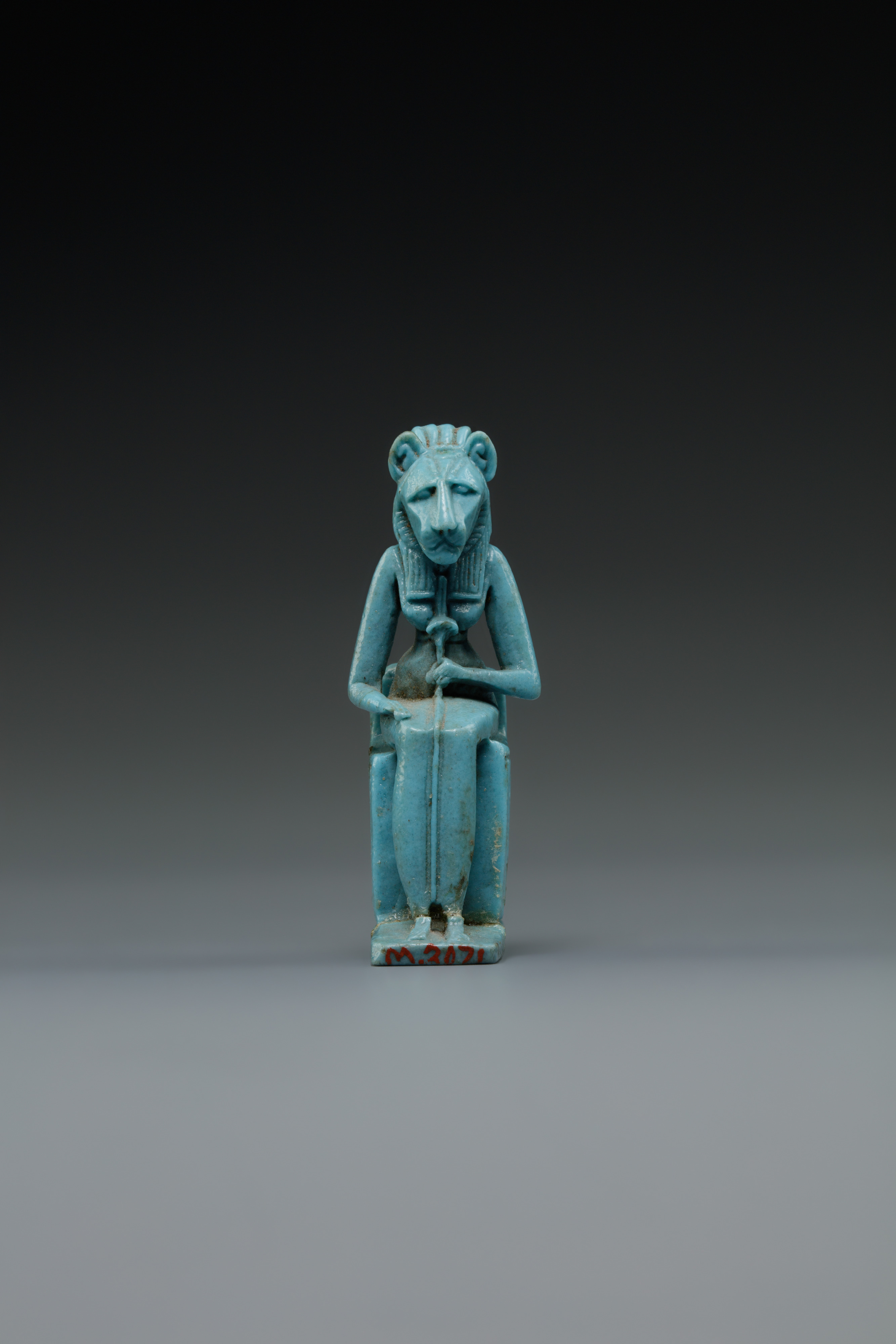
Strategic Heritage Analysis: The Sakhmet Amulet in Faience
The Sakhmet amulet, rendered in brilliant blue-green faience, represents a profound intersection of spiritual authority, historical adornment, and material innovation from the ancient civilization of Egypt. As a Lead Heritage Curator for Katherine Fashion Lab, this analysis examines the amulet’s symbolic power, its role in historical adornment practices, its deep spiritual meaning, and a forward-looking strategy for positioning this artifact within the 2026 high-end luxury market. The objective is to extract strategic value from this heritage object, transforming its ancient resonance into a contemporary luxury narrative that commands desirability and cultural capital.
Symbolic Power: The Lion-Headed Goddess as Authority and Protection
The Sakhmet amulet embodies the dual nature of the goddess Sakhmet, whose name translates to “the powerful one.” In ancient Egyptian cosmology, Sakhmet was both a warrior deity of destruction and a goddess of healing, wielding the scorching heat of the sun as a force for purification. The amulet, typically worn around the neck or incorporated into broad collars, served as a talisman that channeled this volatile power. The faience medium—a self-glazing, quartz-based ceramic—was not merely decorative; its luminous blue-green hue symbolized rebirth, the Nile’s fertility, and the sun’s regenerative energy. For the wearer, the amulet was a portable source of divine authority, capable of warding off malevolent forces, disease, and chaos. In a strategic context, this symbolic duality—destruction and healing, chaos and order—offers a rich narrative for luxury branding. Modern high-end consumers seek objects that convey both strength and protection, a sense of invincibility that aligns with personal sovereignty. The Sakhmet amulet’s symbolic power can be reframed as a “shield of authority” for the contemporary elite, merging ancient warrior energy with modern self-empowerment.
Historical Adornment: Faience as the Jewel of the Afterlife and Elite Status
Historically, faience amulets were not casual accessories but integral components of funerary and ceremonial adornment. The ancient Egyptians believed that amulets like the Sakhmet figure, when placed on the mummy or worn in life, ensured safe passage through the underworld and provided protection in the afterlife. The faience medium was particularly significant: its production required sophisticated kiln technology and precise control of copper and cobalt oxides to achieve the characteristic turquoise or deep blue glazes. This technical mastery was reserved for elite artisans working in temple workshops, making faience amulets markers of social status and access to sacred knowledge. In the context of historical adornment, the Sakhmet amulet was not merely decorative but a statement of spiritual literacy and material wealth. For Katherine Fashion Lab’s 2026 strategy, this historical precedent offers a compelling blueprint. The amulet can be positioned as a “legacy talisman”—an object that transcends fashion cycles and becomes a heirloom-worthy investment. The faience medium, with its ancient manufacturing complexity, can inspire a limited-edition material palette (e.g., glazed ceramics, enameled metals, or high-fired porcelain) that signals exclusivity and craftsmanship. The narrative should emphasize that owning such a piece is an act of cultural preservation, connecting the wearer to a lineage of elite adornment that predates modern luxury houses.
Spiritual Meaning: The Amulet as a Conduit for Divine Energy
The spiritual meaning of the Sakhmet amulet extends beyond simple protection. In Egyptian theology, amulets were considered living objects, infused with the ka (life force) of the deity they represented. The faience material itself was thought to possess magical properties, its glassy surface reflecting light in a way that mimicked the sun’s rays—the very element Sakhmet commanded. Wearing the amulet was an act of alignment with cosmic order (Ma’at), a daily ritual of invoking divine energy to maintain balance in one’s life. The amulet’s placement on the body—often near the heart or throat—was deliberate, channeling Sakhmet’s power to protect vital organs and the wearer’s spiritual essence. For the 2026 luxury market, this spiritual dimension is a potent differentiator. Contemporary high-net-worth individuals increasingly seek objects with metaphysical resonance—items that offer not just aesthetic pleasure but a sense of grounding, intention, and connection to ancient wisdom. The Sakhmet amulet can be marketed as a “power object” for the modern spiritual seeker, with a narrative that emphasizes ritualistic use: a piece to be worn during moments of decision-making, meditation, or personal transformation. Katherine Fashion Lab can develop a companion experience—perhaps a digital ritual guide or a physical ceremony—that deepens the wearer’s engagement with the amulet’s spiritual legacy, creating a holistic luxury ecosystem that transcends the material object.
2026 High-End Luxury Strategy: From Artifact to Icon
Strategic Positioning: The Amulet as a Symbol of Controlled Power
For the 2026 luxury landscape, the Sakhmet amulet must be positioned not as a mere historical replica but as a “curated icon” that bridges ancient authority and modern aspiration. The strategy should emphasize three core pillars: exclusivity, narrative depth, and material innovation. Exclusivity is achieved through limited production runs, perhaps numbering the amulets in reference to ancient Egyptian numerology (e.g., 42 amulets, referencing the 42 principles of Ma’at). Narrative depth is cultivated through partnerships with Egyptologists, digital storytelling campaigns, and immersive exhibitions that transport clients to the temple of Karnak, where Sakhmet was venerated with thousands of statues. Material innovation involves reinterpreting faience through a contemporary lens: using high-fire ceramics, lab-grown gemstones, or recycled precious metals to evoke the original turquoise hue while adhering to sustainable luxury standards. The amulet should be offered as a “bespoke talisman”—customizable with personal inscriptions or birthstone accents—allowing the client to imprint their own narrative onto the ancient form.
Market Segmentation and Client Experience
The target client for this amulet is the “Cultural Connoisseur”—an individual aged 35–60 with a net worth exceeding $10 million, who values heritage, craftsmanship, and spiritual authenticity over trend-driven consumption. This client seeks objects that confer status through knowledge, not just price. The purchasing experience should be elevated to a ritual: private consultations in heritage-inspired spaces, with a curator (similar to this role) explaining the amulet’s symbolic power, historical context, and spiritual meaning. The amulet can be presented in a handcrafted box made of Egyptian sycamore wood or linen, echoing ancient funerary containers. Post-purchase, the client receives a digital archive of the amulet’s provenance, including high-resolution scans of original artifacts and a certificate of cultural authentication. This transforms the amulet from a luxury accessory into a “cultural asset”—an object that appreciates in symbolic and monetary value over time.
Pricing and Scarcity Strategy
Pricing should reflect the amulet’s dual value as art and talisman. A suggested retail price of $25,000–$45,000 positions it within the “accessible heritage” tier of luxury, below high jewelry but above ready-to-wear. Scarcity is enforced through an annual release of 100 units globally, with a waitlist that prioritizes existing clients of Katherine Fashion Lab. Collaborations with contemporary artists—perhaps those working in ceramic or glass—can produce unique iterations of the amulet, each with a distinct glaze or patina, turning each piece into a numbered artwork. This strategy aligns with the 2026 luxury trend of “permanence over novelty,” where clients invest in objects that endure physically and culturally.
Conclusion: The Sakhmet Amulet as a Blueprint for Heritage-Driven Luxury
The Sakhmet amulet in faience is not a relic of the past but a strategic template for the future of high-end luxury. Its symbolic power as a protector, its historical role as a marker of elite status, and its spiritual meaning as a conduit for divine energy offer a multidimensional narrative that resonates deeply with contemporary desires for authority, authenticity, and transcendence. By positioning this amulet as a curated icon for the 2026 market, Katherine Fashion Lab can establish a new paradigm in luxury: one that values cultural depth over surface aesthetics, ritual over consumption, and legacy over trend. The Sakhmet amulet is more than an adornment—it is a statement of controlled power, a bridge between ancient wisdom and modern ambition, and a testament to the enduring human need to carry the divine with us.