The Rapier with Scabbard: A Study in Italian Couture and Martial Elegance
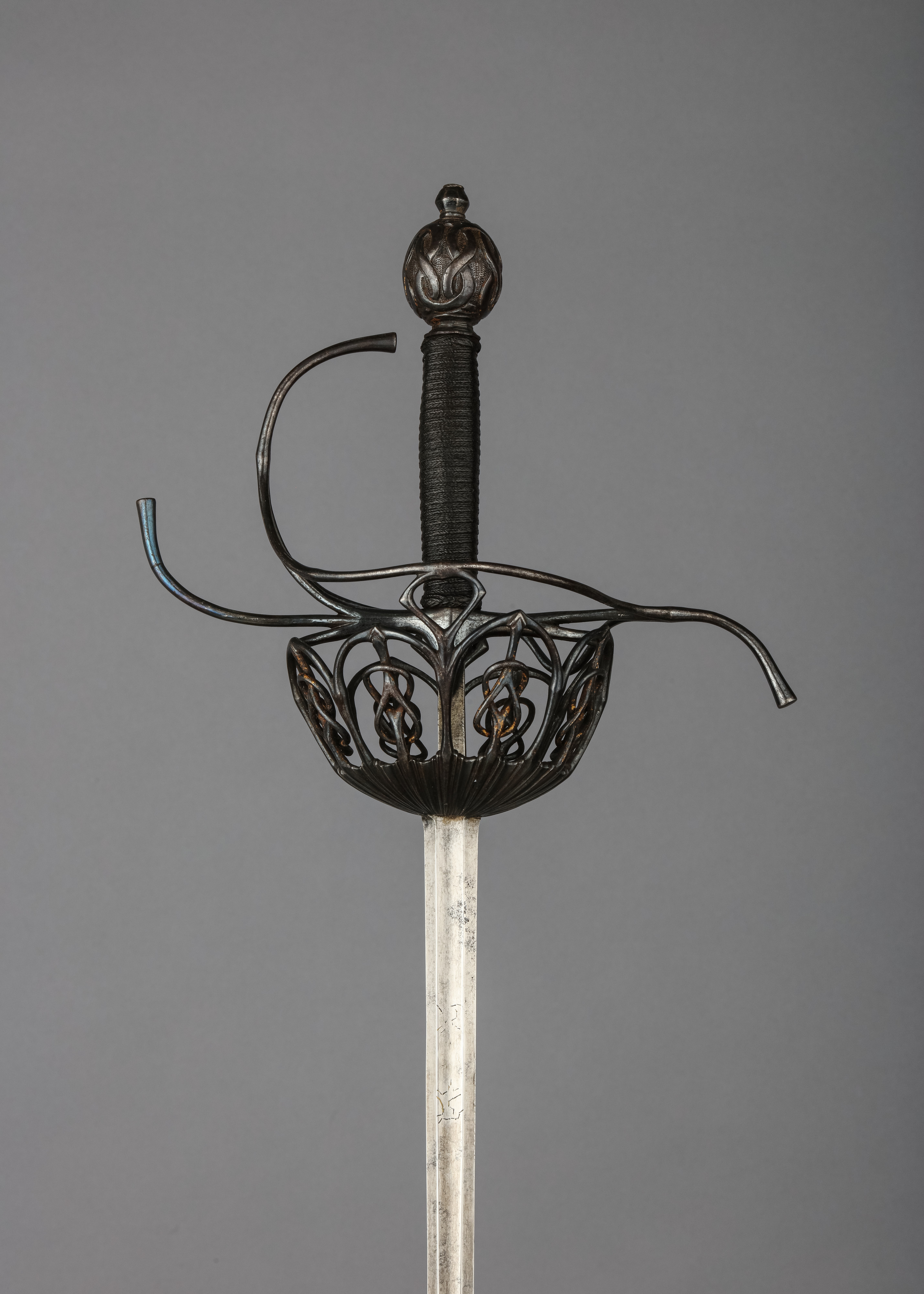
At Katherine Fashion Lab, we approach historical artifacts not merely as relics of the past but as profound expressions of material culture, craftsmanship, and aesthetic philosophy. The Italian rapier, complete with its scabbard, represents a pinnacle of Renaissance design—a synthesis of lethal functionality and courtly elegance. This standalone analysis dissects the rapier as a couture object, examining its materials, construction, and cultural resonance through the lens of high fashion and luxury studies.
Materiality and Mastery: The Foundation of Couture
The rapier’s composition—steel, leather, velvet, brass, and gold—immediately elevates it beyond mere weaponry. In couture, material selection is paramount; each element must serve both structural integrity and aesthetic narrative. The steel blade, forged with precision, embodies strength and fluidity. Its polished surface reflects light with a mirror-like quality, akin to the sheen of a silk satin gown. This is not accidental: Italian smiths of the 16th and 17th centuries understood that the visual allure of steel could captivate as much as its cutting edge. The blade’s subtle taper and hexagonal cross-section are not just functional but sculptural, echoing the clean lines of a tailored doublet.
The scabbard, clad in leather and velvet, introduces a tactile contrast. Leather provides durability and a grounded, organic texture, while velvet—a fabric synonymous with nobility—offers a plush, sensuous surface. This pairing mirrors the fashion principle of juxtaposition: the hard versus the soft, the martial versus the refined. The brass fittings, often intricately chiseled, serve as the jewelry of the piece. They bind the scabbard together, much like couture clasps or brooches, and their gilded finish catches the eye, drawing attention to the rapier’s silhouette. Gold accents, whether in the hilt or as inlay, are the ultimate signifier of luxury. Gold is not merely decorative; it signals status, permanence, and a connection to divine or royal favor—qualities that define haute couture’s aspirational essence.
Silhouette and Structure: The Rapier as a Wearable Artifact
In fashion, silhouette dictates the viewer’s first impression. The rapier’s profile is elongated and linear, designed to hang gracefully at the hip. Its total length—typically 100 to 130 centimeters—creates a vertical line that elongates the wearer’s form, akin to the effect of a floor-length coat or a trailing gown. The hilt, with its complex guard, forms the focal point. The quillons (cross-guards) sweep outward like the wings of a bird, while the pommel provides a counterbalance. This structure is not arbitrary; it is a carefully engineered balance of weight and proportion, much like the shoulder padding of a tailored jacket or the boning of a corset.
The scabbard mirrors the blade’s geometry, sheathing it in a protective second skin. Its slight curvature accommodates the natural swing of the body, ensuring that the rapier moves with the wearer, not against them. This ergonomic consideration is a hallmark of couture: garments and accessories must adapt to human motion. The leather and velvet covering of the scabbard also introduces a textural rhythm; the smoothness of the velvet contrasts with the rigidity of the steel, creating a visual and tactile dialogue that engages the observer.
Cultural Context: The Rapier in Renaissance Society
To understand the rapier as couture, one must situate it within the social rituals of Renaissance Italy. The rapier was not a battlefield weapon but a civilian sidearm, worn by gentlemen as a mark of status and education. It was a tool of personal defense and, more importantly, of dueling—a theater of honor where style and skill were inseparable. In this context, the rapier’s design was subject to the same scrutiny as a nobleman’s attire. A finely crafted rapier announced its owner’s wealth, taste, and sophistication, much as a bespoke suit does today.
The choice of materials reinforced this message. Steel from Brescia or Milan was renowned for its quality, while velvet from Genoa or Florence signaled access to the finest textile markets. Brass and gold were not only costly but also required specialized artisans—goldsmiths, chasers, and engravers—who worked in parallel with tailors and embroiderers. The rapier thus became a collaborative masterpiece, uniting metalworkers, leatherworkers, and textile artisans in a single object. This interdisciplinary collaboration is a defining feature of couture, where ateliers of different specialties converge to produce a harmonious whole.
Artisanal Techniques: A Couture-Level Labor
The creation of an Italian rapier demanded a level of handcraft that parallels the most rigorous couture techniques. The blade was forged through repeated heating, hammering, and quenching—a process requiring years of apprenticeship. The hilt was often cast in brass or steel, then chased, engraved, or gilded. The scabbard’s leather was hand-cut and stitched, while the velvet was applied with precise tension to avoid wrinkles. Gold was applied through fire-gilding or inlay, a hazardous and delicate art.
These techniques are echoed in couture’s own traditions: hand-stitching, beading, embroidery, and draping. Each requires a master’s touch, a willingness to spend hours on a single detail. The rapier’s guard, for example, might feature intricate scrollwork or mythological scenes, rendered with the same patience as a lace pattern or a floral appliqué. The result is an object that cannot be mass-produced—a unique piece that bears the soul of its maker.
Contemporary Resonance: The Rapier in Modern Fashion
While the rapier is no longer a daily accessory, its aesthetic DNA persists in modern fashion. Designers regularly draw on its lines and motifs. The elongated silhouette appears in evening gowns and tailored coats. The hilt’s guard inspires jewelry and belt buckles. The juxtaposition of hard and soft materials—steel against velvet—is a recurrent theme in avant-garde collections. Brands like Gucci, Dolce & Gabbana, and Versace have all referenced Renaissance weaponry, often incorporating sword-like details into their garments.
Moreover, the rapier’s association with honor and personal style resonates in an era where fashion is increasingly about identity and self-expression. Just as a Renaissance gentleman chose his rapier to project confidence and refinement, today’s consumer selects a handbag, watch, or pair of shoes to communicate their values. The rapier, in this sense, is a precursor to the luxury accessory—a statement piece that transcends utility.
Conclusion: The Rapier as a Timeless Couture Object
The Italian rapier with scabbard is far more than a historical weapon. It is a testament to the power of materials, the precision of craftsmanship, and the cultural significance of adornment. At Katherine Fashion Lab, we see in its steel and velvet, brass and gold, a blueprint for understanding how objects can embody both function and beauty. Its study offers invaluable lessons for contemporary designers: that true couture lies in the marriage of form and purpose, and that the most enduring creations are those that speak to the human desire for elegance, even in the most unexpected forms.