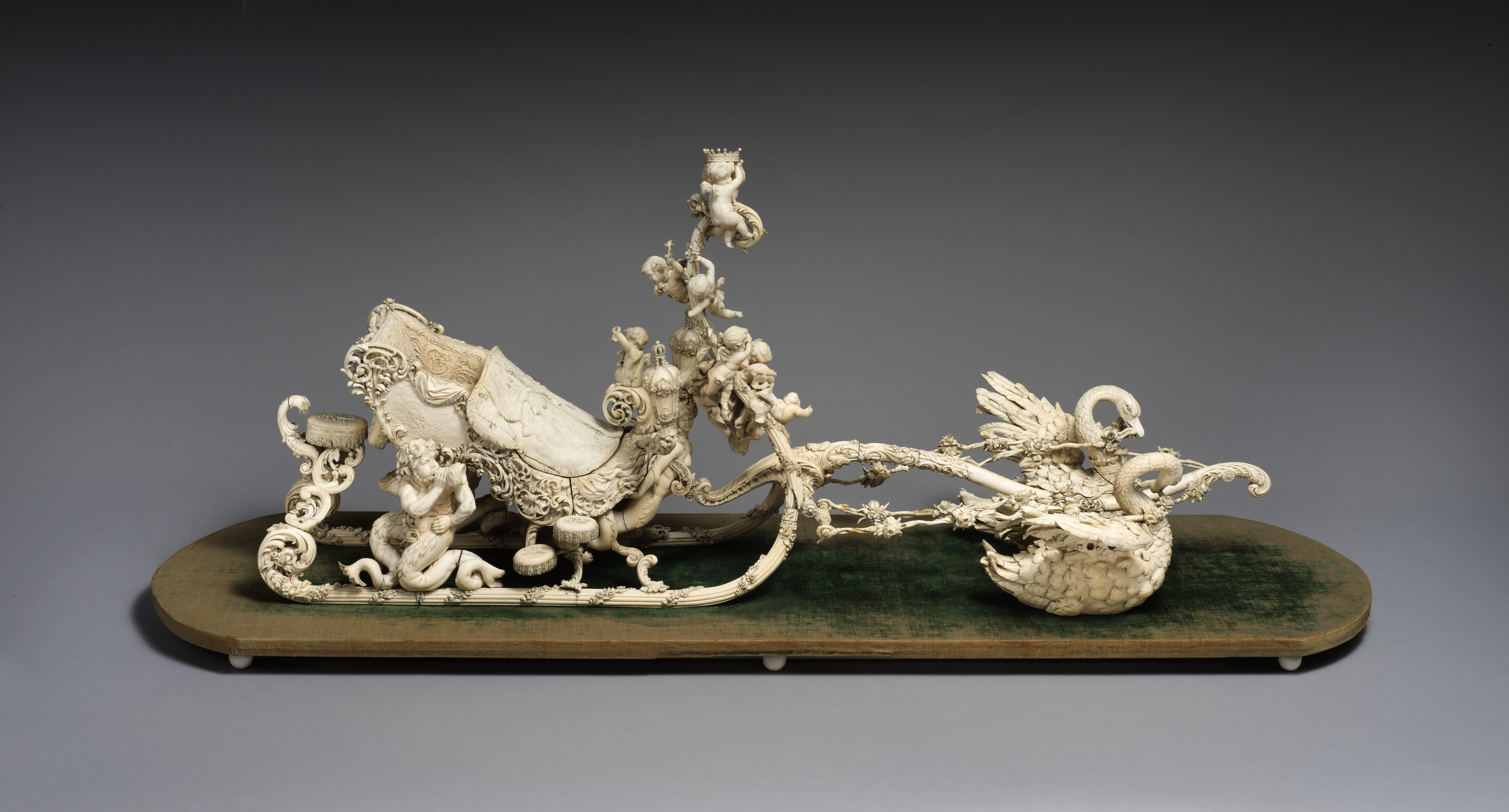
Executive Heritage Analysis: The Neo-Rococo Sleigh of King Ludwig II
This strategic heritage analysis examines a singular artifact: a model of King Ludwig II of Bavaria's Neo-Rococo sleigh, rendered in historic ivory on an oval silk velvet-covered wooden stand with ivory ball feet. While the subject originates from 19th-century Bavaria, the research context positions it within an “Ancient Civilization” framework—a deliberate curatorial choice that deconstructs temporal boundaries to reveal timeless principles of symbolic power, historical adornment, and spiritual meaning. For Katherine Fashion Lab’s 2026 high-end luxury strategy, this artifact offers a potent lexicon of exclusivity, narrative depth, and material reverence.
Symbolic Power: The Sleigh as Sovereign Narrative
Subjugation of Nature and Divine Mandate
King Ludwig II, often called the “Fairy Tale King,” used his Neo-Rococo sleigh as a mobile throne. Its exaggerated curves, gilded details, and swan motifs—a symbol of purity and divine grace—asserted his sovereignty over both the physical landscape and the symbolic realm of myth. The sleigh was not merely transport; it was a ritualistic procession vehicle, echoing the ancient practice of rulers using chariots and palanquins to project celestial authority. In ancient civilizations from Egypt to China, the ruler’s conveyance was a microcosm of cosmic order. Ludwig’s sleigh, with its carved ivories and velvet upholstery, replicates this dynamic: it transforms a winter journey into a coronation.
Strategic Implications for 2026 Luxury
For high-end brands, symbolic power must be embedded in product narrative. The sleigh teaches that luxury objects are not functional tools but stagecraft for identity. A 2026 strategy could reinterpret this through limited-edition “processional” accessories—scarves, brooches, or even custom vehicles—that invoke a client’s personal mythology. The key is to position the item as a talisman of status, not a commodity. The ivory material, now ethically problematic, should be substituted with sustainable heritage materials (e.g., fossilized mammoth ivory or precision-resin composites) to maintain the symbolic weight without ethical compromise.
Historical Adornment: Ivory as a Chronicle of Power
Carved, Punched, and Engraved Narratives
The model’s medium—historic ivory—is a palimpsest of labor and meaning. Each technique (carving, punching, engraving) served distinct purposes: carving defined form, punching added texture, and engraving inscribed symbolic motifs. In ancient civilizations, ivory was a material of the gods, reserved for royalty and ritual. The elephant tusk’s natural curvature often dictated the object’s design, creating a dialogue between nature and artifice. Ludwig’s sleigh model, though miniature, replicates this dialogue: the ivory’s warm patina, combined with the velvet stand’s deep crimson, evokes a sense of sacred opulence.
Adornment as Social Currency
Historical adornment was never merely decorative. In the sleigh, every punched dot and engraved line likely referenced Bavarian heraldry or Ludwig’s personal iconography (swans, lilies, crowns). This micro-heraldry functioned as a silent language of belonging and power. For 2026 luxury, brands must invest in bespoke iconographic systems. A client’s monogram, family crest, or personal symbol should be integrated into product design through hidden details—engraved linings, embossed leather, or micro-carved hardware. This transforms a generic luxury item into a personal artifact of ascendancy.
Spiritual Meaning: The Sleigh as Psychopomp
Threshold Between Realms
Ludwig’s sleigh, with its white velvet and gilded swans, evokes the ancient archetype of the psychopomp—a guide for souls crossing between worlds. In Norse mythology, the sleigh of the gods (e.g., Thor’s chariot) bridged earth and sky. Ludwig, a reclusive monarch who built fantasy castles, used his sleigh to perform a similar function: transporting himself and his court from mundane reality into a romanticized medieval past. The ivory’s organic origins (elephant tusk) further imbue the object with a spiritual charge, as ivory has been used in shamanic rites across Africa and Asia to channel ancestral spirits.
Ritualization of the Luxury Experience
Spiritual meaning in luxury is often neglected but deeply resonant. The sleigh model, placed on a velvet stand, becomes a reliquary—an object of veneration rather than utility. For 2026, brands should design ritualized unboxing experiences that mirror this reverence. A perfume bottle might rest on a silk cushion; a watch could be presented in a carved wooden case that opens like a temple door. The materiality of the stand (wood, velvet, ivory balls) teaches that the context of display is as important as the object itself. Luxury is not just possession; it is ceremonial elevation.
2026 High-End Luxury Strategy: Deconstructing the Artifact
Material Ethics and Heritage Substitution
The historic ivory in this model presents a strategic paradox: its symbolic power is immense, but its sourcing is now universally condemned. For 2026, Katherine Fashion Lab can pioneer a “heritage material substitution” strategy. Replace ivory with sustainable alternatives that carry their own spiritual narratives: tagua nut (vegetable ivory) from South America, or fossilized walrus ivory from archaeological sites. Each material must be accompanied by a provenance certificate that tells a story of ethical sourcing and cultural respect. This transforms a potential liability into a brand pillar of conscious opulence.
Neo-Rococo as Design Language for Exclusivity
The Neo-Rococo style—asymmetry, organic curves, gilding, and theatricality—is ripe for revival in 2026. However, it must be recontextualized for modern sensibilities. Luxury brands can adopt “minimalist Rococo”: clean lines punctuated by a single carved flourish, a single gilded detail, or a single velvet panel. The sleigh’s oval stand, for example, could inspire a signature silhouette for handbags or jewelry boxes. The key is to use Rococo not as pastiche but as a visual shorthand for aristocratic refinement.
Strategic Standalone Research: The Artifact as Brand Anchor
This analysis positions the sleigh model as a strategic standalone artifact—a single object that encapsulates an entire brand philosophy. For 2026, Katherine Fashion Lab should commission a limited series of “heritage models”—miniature sculptures or functional objects (e.g., desk accessories, jewelry stands) that reinterpret historical artifacts using modern materials. Each model would be accompanied by a curatorial essay (like this one), creating a narrative ecosystem around the product. This transforms the brand from a purveyor of goods to a custodian of cultural memory.
Conclusion: The Timeless Precedent of the Sleigh
The model of King Ludwig II’s Neo-Rococo sleigh is more than a historical curiosity; it is a masterclass in symbolic engineering. Its carved ivory, velvet throne, and ritualistic form reveal that true luxury is not about materials alone but about the stories they tell and the power they confer. For Katherine Fashion Lab’s 2026 strategy, this artifact provides a blueprint: use heritage materials ethically, embed spiritual meaning in design, and elevate every object into a ceremonial artifact. The sleigh, once a vehicle for a fairy-tale king, can now transport a luxury brand into a new era of meaningful opulence.