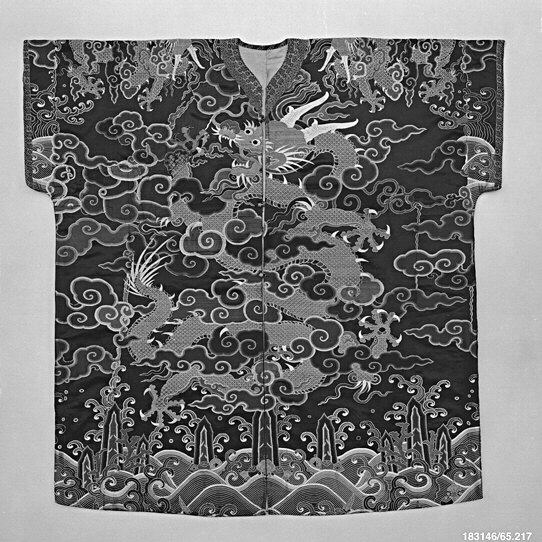
The Daoist Overrobe: A Study in Spiritual Silhouette and Symbolic Splendor
Introduction: Garment as Cosmic Cartography
The Daoist Priest's or Woman's Overrobe stands as a singular artifact within the lexicon of global couture—a garment where the metaphysical and the material converge. At Katherine Fashion Lab, we approach this piece not merely as historical costume but as a living text of celestial order, ritual authority, and artisanal mastery. Crafted from lustrous silk, plush satin, and shimmering metallic threads, this overrobe transcends its functional origins to become a portable universe, encoding Daoist cosmology in every fold and stitch.
In the context of standalone study, this garment demands an analytical lens that respects its sacred provenance while interrogating its construction as a pinnacle of textile engineering. The overrobe is not a passive object; it is an active participant in ritual, a declaration of status, and a canvas for philosophical expression. For the modern connoisseur, it offers a profound lesson in how clothing can articulate the ineffable—a principle that resonates deeply with Katherine Fashion Lab’s commitment to narrative-driven design.
Materiality: The Alchemy of Silk, Satin, and Metal
The choice of materials in this overrobe is neither arbitrary nor merely aesthetic. Silk, revered in Chinese culture as the fiber of emperors and immortals, provides a foundation of fluidity and luminosity. Its natural sheen mimics the ethereal quality of qi, the vital life force central to Daoist belief. When draped, silk creates a continuous, unbroken line—a visual metaphor for the Dao itself, which flows without interruption through all existence.
Satin, woven into the robe’s structural elements, introduces a dimension of weight and opulence. Unlike the airy silk, satin’s dense weave offers a tactile reminder of earthly substance. This duality—lightness and gravity, spirit and matter—is a deliberate dialectic. The satin panels, often reserved for the robe’s borders or cuffs, anchor the garment in the physical world while allowing the silk to float as a celestial aura.
The metallic threads are the most arresting component. Gilded or silvered, these threads are embroidered into intricate patterns that catch and scatter light, creating an effect of perpetual motion. In Daoist ritual, such shimmering is not decorative but functional: it represents the stars, constellations, and the divine radiance of the Jade Emperor. The threads are often worked in a technique known as jinxiu—a form of tapestry weaving that interlocks metal with silk to create raised, three-dimensional motifs. This process requires immense skill, as the metallic filaments are brittle and unforgiving, demanding precision that borders on the meditative.
Symbolic Architecture: Decoding the Embroidery
The overrobe’s surface is a dense lexicon of symbols, each stitch a word in a silent liturgy. The most prominent motifs include the Eight Trigrams (Bagua), the Yin-Yang symbol (Taijitu), and celestial figures such as cranes, clouds, and dragons. These are not mere ornaments; they are visual incantations meant to align the wearer with cosmic forces.
The Bagua—eight trigrams composed of broken and unbroken lines—are typically arranged around the robe’s hem or shoulders. Each trigram corresponds to an element, direction, or natural phenomenon (e.g., ☰ for Heaven, ☷ for Earth). When worn, the priest becomes a living compass, orienting the ritual space toward harmony. The Taijitu, often centered on the chest, serves as a focal point for meditation. Its interlocking black and white teardrops symbolize the interdependence of opposites—light and dark, male and female, action and stillness—a core tenet of Daoist philosophy.
Dragons, embroidered in metallic thread, are not the fire-breathing beasts of Western lore but benevolent guardians of water and wisdom. Their coiled forms suggest the cyclical nature of time. Cranes, symbols of longevity and transcendence, are frequently depicted in flight, their wings tipped with gold. Clouds, rendered as swirling spirals, represent the boundary between the mortal and immortal realms. Together, these motifs create a protective field around the wearer, rendering the robe a portable temple.
Construction and Cut: The Art of Draping the Divine
The overrobe’s silhouette is deceptively simple: a wide-sleeved, cross-collared garment that falls to the ankles. Yet its construction reveals a sophisticated understanding of volume, weight, and movement. The sleeves, often measuring over a meter in width, are not designed for practicality but for ritual gesture. When the priest raises his arms, the sleeves unfurl like wings, creating a visual echo of the crane motif. This theatricality is intentional; the robe transforms the human form into a vessel for divine energy.
The cross-collar (known as jiaoling youren) is a hallmark of Han Chinese clothing. The left side wraps over the right, a subtle asymmetry that mirrors the Daoist principle of non-duality. The closure is secured with fabric knots or jade buttons, materials chosen for their symbolic resonance—jade, in particular, is associated with purity and immortality. The robe’s length is calibrated to brush the ground, grounding the wearer even as the upper body reaches toward the heavens.
Internally, the garment is lined with a contrasting silk, often in deep indigo or cinnabar red. This hidden layer is a secret signature of the tailor, a private conversation between the maker and the wearer. The lining also serves a practical purpose: it protects the delicate embroidery from friction while adding insulation for cold temple halls.
Cultural and Ritual Context: The Overrobe in Action
To understand this overrobe is to see it in motion—during a jiao (offering ritual) or a gongde (merit-making ceremony). The priest dons the robe over a white inner garment, symbolizing purity, and a black outer vestment, representing the void. The overrobe is the outermost layer, the final veil between the human and the divine.
During rituals, the metallic threads catch the flickering light of candles and incense, creating a halo of shimmering energy. The priest’s movements—slow, deliberate, circular—are choreographed to align with the patterns on the robe. When he bows, the Bagua on his back faces the altar; when he turns, the Taijitu on his chest reflects the moon. The robe is not just worn; it is performed. This performative aspect elevates the garment from costume to instrument, a tool for shaping reality.
For women, the overrobe served a slightly different function. In some Daoist sects, female practitioners wore similar robes during rites of passage or as a symbol of spiritual attainment. The embroidery often included peonies or lotuses, flowers associated with feminine vitality and enlightenment. The cut remained androgynous, however, emphasizing the Daoist belief that the spirit transcends gender.
Conclusion: The Overrobe as Couture Archetype
As a standalone study, the Daoist overrobe offers Katherine Fashion Lab a blueprint for how fashion can embody philosophy. Its materials are not chosen for trend but for truth; its symbols are not decorative but declarative; its silhouette is not a product of ergonomics but of ecstasy. In an era of fast fashion and fleeting aesthetics, this garment stands as a testament to the enduring power of intentional design.
For the contemporary designer, the overrobe challenges us to ask: What values do our clothes encode? Are we dressing for utility or for meaning? The Daoist answer is clear—garments are the outermost expression of the inner self, a bridge between the mundane and the magnificent. To wear such a robe is to accept the responsibility of becoming a living symbol, a point where heaven and earth converge. In the hands of Katherine Fashion Lab, this ancient artifact becomes a timeless lesson in the art of dressing the soul.