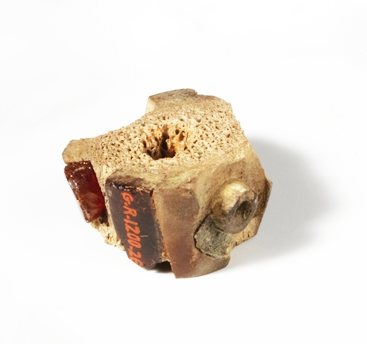
Heritage Analysis: The Etruscan Bone and Amber Fibula Segment
Introduction: A Fragment of Etruscan Cosmology
The bone and amber segment from a bronze fibula, originating from the Etruscan civilization (circa 8th–3rd century BCE), represents a profound intersection of material culture, spiritual belief, and social status. As a Lead Heritage Curator at Katherine Fashion Lab, this analysis examines the symbolic power, historical adornment practices, and spiritual meaning embedded within this artifact. Furthermore, this paper proposes a strategic framework for translating these ancient values into a high-end luxury strategy for 2026, aligning with contemporary consumer desires for authenticity, heritage, and transcendental meaning.
Symbolic Power: Materiality as a Conduit for Status and Protection
The fibula, a functional safety pin used to fasten garments, was far more than a utilitarian object in Etruscan society. It served as a visible marker of identity, wealth, and social hierarchy. The inclusion of amber—a fossilized resin prized for its golden translucence and electrostatic properties—imbued the fibula with potent symbolic power. Amber was believed to possess apotropaic qualities, warding off evil spirits and protecting the wearer from harm. Its warm, light-catching appearance also signified solar energy, linking the wearer to celestial cycles and divine favor.
The bone segment, often sourced from domesticated animals, introduced a contrasting materiality. Bone represented mortality, the organic cycle of life and death, and the tangible connection to the natural world. When combined with bronze—a metal associated with strength, durability, and military prowess—the fibula became a microcosm of Etruscan cosmology: a fusion of earth (bone), sky (amber), and human artifice (bronze). This tripartite symbolism reinforced the wearer’s authority, spiritual protection, and ancestral lineage.
Historical Adornment: The Fibula as a Social and Ritual Object
Etruscan adornment was deeply intertwined with ritual and daily life. Fibulae were not merely decorative; they were essential for securing garments such as the himation or chiton, particularly among the elite. The placement of the fibula—often at the shoulder or chest—drew attention to the wearer’s posture and status. The bone and amber segment, likely positioned at the clasp or as a decorative pendant, would have caught light during movement, signaling the wearer’s wealth and access to exotic trade goods.
Amber was imported from the Baltic region via extensive Etruscan trade networks, making it a luxury commodity accessible only to the upper echelons of society. The bone segment, while more humble in origin, was often carved with intricate geometric or zoomorphic motifs, reflecting the artisan’s skill and the patron’s taste. Together, these materials created a tactile and visual dialogue between the ephemeral (amber’s warmth) and the enduring (bone’s solidity), embodying the Etruscan belief in the duality of existence—life and death, light and shadow.
Spiritual Meaning: The Fibula as a Talisman and Funerary Object
The spiritual significance of the fibula is most evident in its frequent inclusion in Etruscan tombs. Archaeological excavations have uncovered fibulae placed on the chests of the deceased, suggesting they served as protective amulets for the journey to the afterlife. Amber’s association with the sun and its ability to generate static electricity—perceived as a life force—made it a conduit for spiritual energy. The bone segment, representing the mortal body, reminded the living of the cyclical nature of existence.
Etruscan religion emphasized the importance of maintaining harmony between the earthly and divine realms. The fibula, as a fastening device, metaphorically “bound” the wearer to the gods, securing their spiritual integrity. The combination of amber, bone, and bronze thus created a hierarchical cosmology: amber as the divine light, bone as the earthly vessel, and bronze as the human craft that united them. This triadic symbolism resonates with contemporary spiritual trends, where consumers seek objects that connect them to deeper, transcendent narratives.
Strategic Implications for 2026 High-End Luxury
Katherine Fashion Lab’s 2026 luxury strategy can draw profound inspiration from the Etruscan fibula’s symbolic and material complexity. The modern luxury consumer increasingly values heritage storytelling, artisanal craftsmanship, and spiritual resonance over ostentatious display. The following strategic pillars are proposed:
1. Material Narrative: The Power of Contrast
The fibula’s juxtaposition of amber (warm, luminous, rare) with bone (organic, humble, mortal) offers a blueprint for material innovation. In 2026, Katherine Fashion Lab should explore hybrid materiality—combining precious and ephemeral elements (e.g., fossilized resins with ethically sourced bone or ceramic) to evoke a sense of timelessness and fragility. This approach aligns with the growing demand for sustainable luxury that honors natural cycles.
2. Symbolic Layering: Talismanic Design
Luxury consumers increasingly seek objects that offer protection, meaning, and connection. The fibula’s apotropaic function can be reinterpreted through talismanic design—incorporating semiprecious stones, engraved symbols, or hidden compartments within accessories. Katherine Fashion Lab could develop a “Guardian Collection” that embeds protective motifs (e.g., sunbursts, geometric labyrinths) into brooches, clasps, or belt buckles, echoing the Etruscan belief in wearable spirituality.
3. Ritualized Adornment: The Art of Fastening
The fibula’s functional role as a fastener can be elevated into a ritual of dressing. In 2026, Katherine Fashion Lab should design pieces that require deliberate, mindful engagement—such as magnetic clasps that “seal” the garment or adjustable pins that allow the wearer to customize their silhouette. This transforms the act of dressing into a personal ceremony, aligning with the luxury market’s shift toward experiential consumption.
4. Heritage as Authority: The Etruscan Provenance
Authenticity is a cornerstone of high-end luxury. Katherine Fashion Lab should emphasize the provenance of materials and techniques, collaborating with archaeologists, artisans, and historians to recreate ancient methods of amber carving and bone inlay. Limited-edition pieces could include certificates of origin and scholarly essays, positioning the brand as a custodian of cultural heritage. This strategy appeals to discerning clients who value intellectual depth alongside aesthetic beauty.
Conclusion: Weaving Ancient Wisdom into Modern Luxury
The Etruscan bone and amber fibula segment is not merely a historical artifact; it is a masterclass in symbolic communication, material alchemy, and spiritual resonance. By decoding its layers of meaning—protection, status, mortality, and divinity—Katherine Fashion Lab can craft a luxury strategy that resonates with the 2026 consumer’s yearning for authenticity, depth, and transcendence. The fibula teaches us that true luxury lies not in excess, but in the intentional fusion of material, meaning, and memory. As we move toward an era of conscientious consumption, the Etruscan legacy offers a timeless template: adornment as a vessel for the soul.