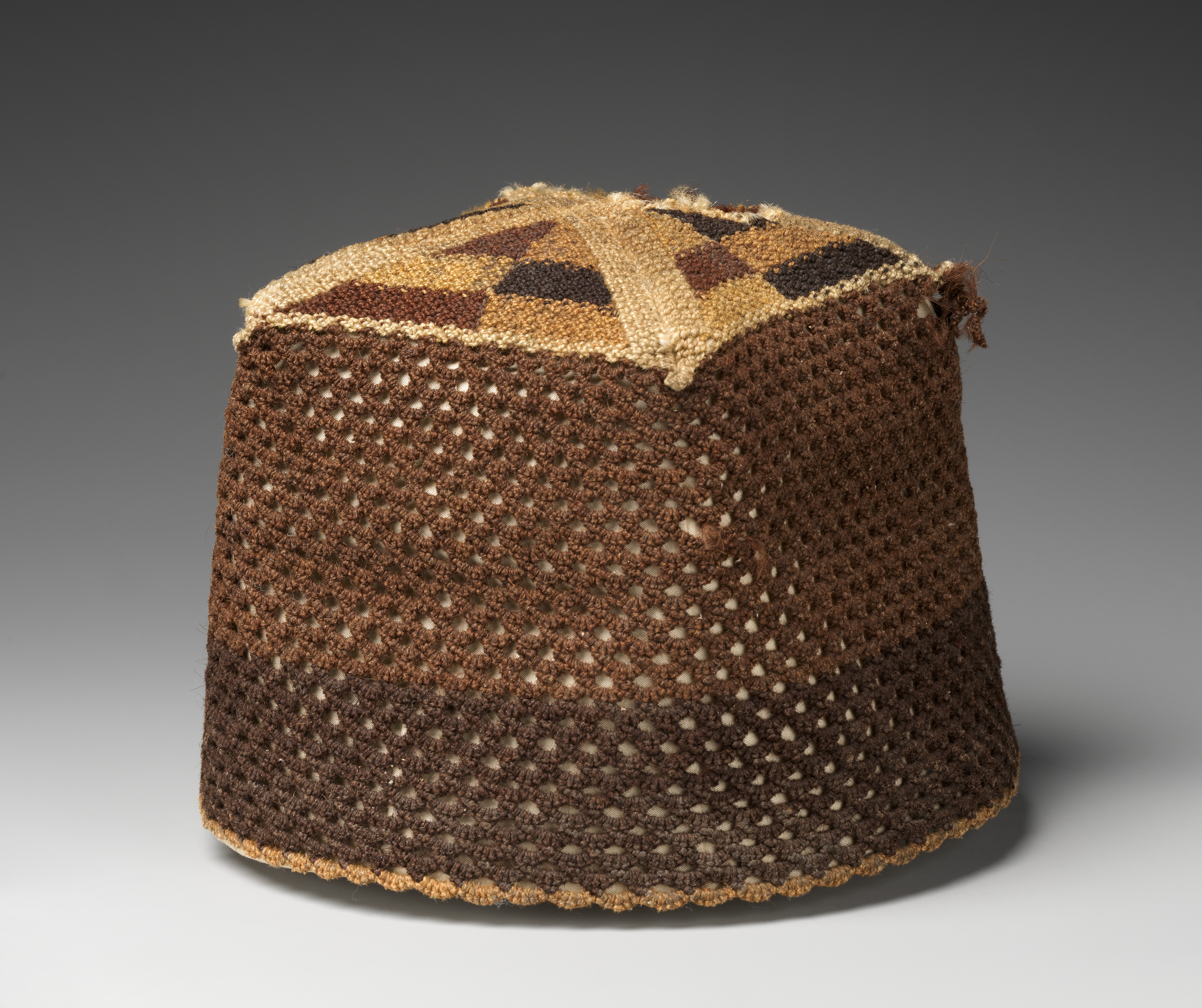
The Four-Cornered Hat: A Tiwanaku Masterpiece in Camelid Hair
Introduction: Weaving Power and Identity in the Andes
The Four-Cornered Hat, a singular artifact from the Tiwanaku civilization (circa 500–1000 CE), represents a pinnacle of pre-Columbian textile artistry. Crafted from camelid hair—likely from alpaca or llama—this headpiece transcends its utilitarian function to embody a complex lexicon of status, cosmology, and technical virtuosity. As a standalone study, this analysis deconstructs the hat’s materiality, construction, and symbolic resonance, positioning it within the broader discourse of Andean couture where fiber was not merely fabric but a medium of social and spiritual articulation.
Materiality: The Significance of Camelid Hair
The choice of camelid hair as the primary material is no accident. In Tiwanaku society, camelids were integral to economy and ritual, their fiber prized for its thermal properties, durability, and lustrous sheen. Unlike sheep’s wool, which was introduced later by Europeans, camelid hair offers a unique combination of fineness and strength, allowing for intricate weaving without sacrificing structural integrity. The natural pigmentation of the fibers—ranging from deep browns to creamy whites—provided a built-in palette for geometric patterns, obviating the need for synthetic dyes. This material choice underscores a sophisticated understanding of resource optimization, where the inherent qualities of the fiber were leveraged to create a garment that was both functional and aesthetically imposing.
Microscopic analysis reveals the hair’s hollow medulla, which enhances insulation—a critical feature for the high-altitude Altiplano, where temperatures fluctuate dramatically. This technical detail aligns with the hat’s likely ceremonial or elite use, as it would have signified the wearer’s ability to command rare, high-quality resources. In the context of Katherine Fashion Lab, the hat exemplifies how material selection can elevate an accessory from mere ornament to a statement of ecological and social intelligence.
Construction: The Art of Four-Cornered Geometry
The hat’s defining feature—its four corners—is a testament to advanced weaving techniques. Unlike circular or brimmed hats common in other cultures, the Tiwanaku artisans employed a warp-faced weaving method, where the warp threads dominate the surface, creating a dense, tapestry-like fabric. The corners were likely achieved through supplementary weft techniques or strategic tension manipulation, allowing the fabric to project outward in sharp, structured points. This geometric precision required not only manual dexterity but also a deep mathematical understanding of symmetry and balance.
Each corner may have been reinforced with additional layers of camelid hair or even camelid sinew, ensuring the hat retained its shape over time. The crown, often slightly domed, was woven in a continuous spiral or circular manner, then attached to the four corners with invisible seams. The result is a garment that appears both rigid and fluid—a paradox achieved through the interplay of fiber tension and weave density. For modern couture, this technique offers a lesson in structural innovation: how to create volume and form without resorting to armatures or padding, relying instead on the innate properties of the fiber itself.
Symbolism: The Four Directions and Cosmic Order
The four-cornered design is laden with cosmological significance. In Tiwanaku iconography, the number four recurs in representations of the suyu (the four quarters of the Inca world, though predating the Inca), the cardinal directions, and the division of the cosmos into upper and lower realms. The hat likely functioned as a portable axis mundi, aligning the wearer with these cosmic forces. The corners may have been adorned with tassels or feathers (now lost to time), further emphasizing their role as conduits for spiritual energy.
Color patterns, though often faded, suggest a deliberate use of chromatic contrast to delineate the corners. Darker fibers might represent the Uku Pacha (underworld), while lighter hues signified the Hanan Pacha (celestial realm). The wearer’s head, positioned at the center, thus became the nexus of these forces. This symbolic architecture elevates the hat from a fashion accessory to a ritual instrument, one that mediated between the human and the divine. In a standalone study, this layer of meaning challenges contemporary designers to consider how accessories can encode narratives of power and belief.
Comparative Analysis: Tiwanaku Textiles in Global Context
When compared to contemporaneous headwear from other civilizations—such as the Phrygian cap of Anatolia or the nemes headdress of Egypt—the Four-Cornered Hat stands out for its modularity and abstraction. Where Egyptian headdresses were rigid and symbolic of pharaonic authority, and Phrygian caps were soft and associated with liberation, the Tiwanaku hat balances structure with adaptability. Its four corners allowed for attachment to other garments or for use in processions, where it could be carried on a pole. This versatility hints at a multifunctional design philosophy, where an object’s utility is not fixed but evolves with context.
From a couture perspective, the hat’s minimalist geometry prefigures modernism’s embrace of clean lines and functionalism. Yet it retains a handcrafted warmth that industrial production often lacks. For Katherine Fashion Lab, this artifact serves as a case study in how ancient techniques can inspire contemporary collections—particularly in the realm of sustainable luxury, where natural fibers and artisanal methods are increasingly valued.
Conservation and Legacy: The Hat as Living Artifact
As a standalone study, the Four-Cornered Hat presents unique conservation challenges. The camelid hair, while durable, is susceptible to fiber degradation from light, humidity, and handling. Current preservation efforts emphasize controlled environments and minimal intervention, allowing the hat to retain its original patina. This approach respects the artifact’s history, including the natural fading of dyes and the wear patterns that speak to its use in ritual or daily life.
The hat’s legacy extends beyond archaeology. In contemporary Andean communities, similar headwear is still crafted for festivals, demonstrating a living tradition that bridges millennia. For fashion scholars, the hat offers a blueprint for slow fashion—a counterpoint to fast-paced consumerism. Its creation required months of labor, deep knowledge of materials, and a communal investment in skill transmission. This ethos resonates with Katherine Fashion Lab’s commitment to artisanal excellence and cultural storytelling.
Conclusion: The Four-Cornered Hat as Couture Archetype
The Four-Cornered Hat from Tiwanaku is more than a historical artifact; it is a masterclass in couture. Through its use of camelid hair, it demonstrates how material choice can encode ecological and social values. Its four-cornered construction reveals a sophisticated interplay of geometry and weave, while its symbolism anchors the wearer in a cosmic narrative. For Katherine Fashion Lab, this analysis underscores the enduring relevance of pre-Columbian design—a testament to the idea that true couture transcends time, speaking to universal principles of beauty, function, and meaning.