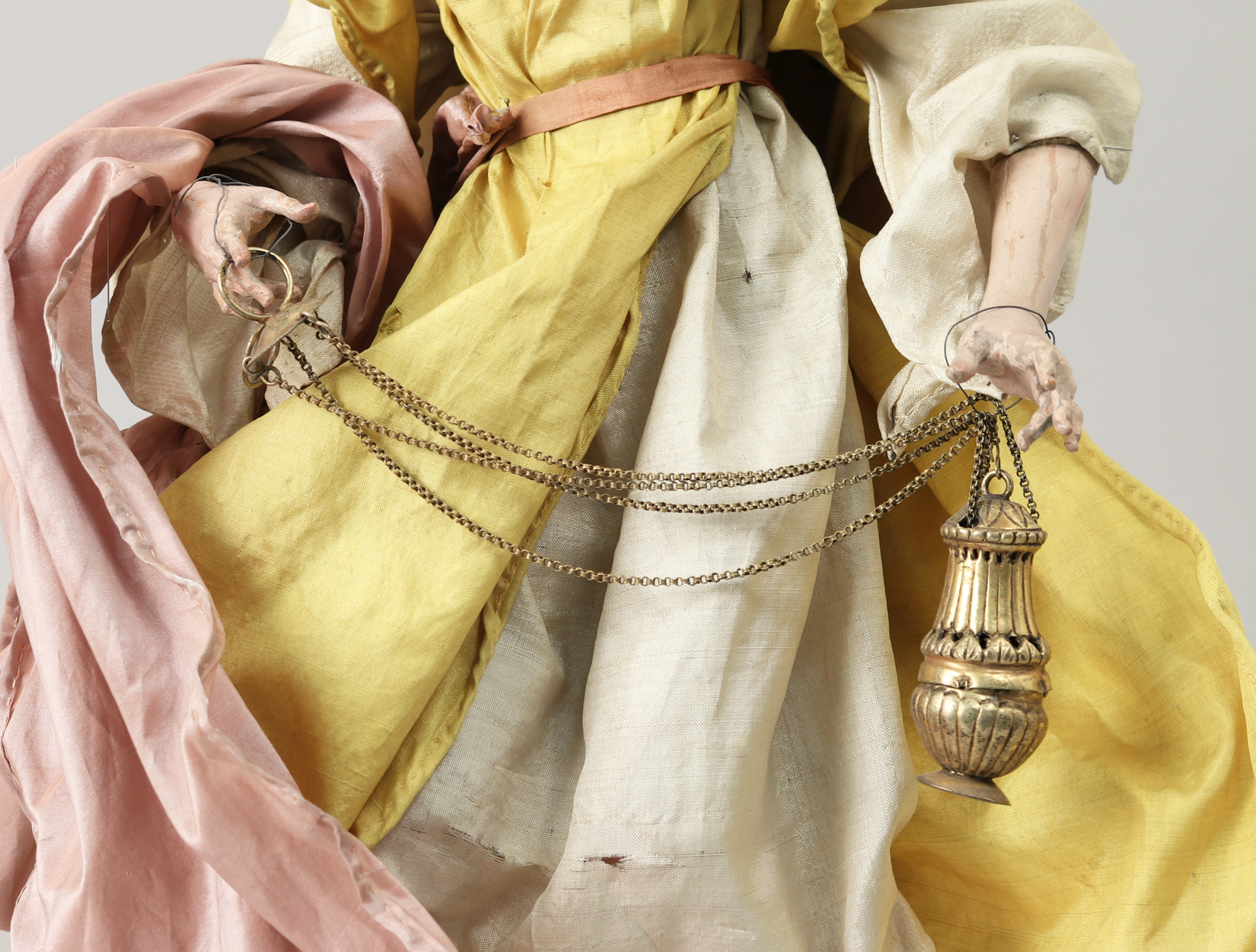
The Censer: An Object of Ritual and Refinement
In the rarefied world of haute couture, inspiration often draws from the most unexpected sources. At Katherine Fashion Lab, our latest standalone study transcends the conventional boundaries of textile and silhouette to explore an object of profound historical and aesthetic significance: the censer. Crafted from silver gilt and rooted in a global heritage of ritual and ceremony, this incense burner is not merely an accessory but a narrative vessel. Its form, function, and materiality offer a lexicon of design principles that challenge and enrich contemporary fashion discourse. This analysis deconstructs the censer’s architectural poise, its alchemical interplay of light and shadow, and its cultural resonance, positing it as a masterclass in the fusion of luxury and symbolism.
Architectural Silhouette and Structural Integrity
The censer’s form is a study in controlled asymmetry and volumetric precision. Typically comprising a domed lid, a perforated body, and a sturdy base, its silhouette evokes both the celestial and the terrestrial. The dome, often crowned with a finial, suggests a microcosm of the heavens—a motif repeated in haute couture through structured shoulders or exaggerated headpieces. The perforations, whether geometric or floral, are not merely decorative; they are functional apertures that allow the escape of smoke, analogous to the deliberate cutouts and laser-etched details in a gown that reveal layers of fabric or skin. The base, broad and grounded, anchors the piece, much like a couture skirt’s train or a tailored jacket’s hemline. In fashion, this translates to a silhouette that balances upward aspiration with downward stability—a principle visible in Katherine Fashion Lab’s signature architectural gowns, where stiffened silks and metallic threads create a sculptural rigidity that mimics the censer’s metallic stance.
The materiality of silver gilt further informs structural choices. Silver, a metal of high tensile strength, allows for intricate filigree without compromising form. Gilding adds a layer of warmth, softening the metal’s cool reflectivity. In couture, this duality is achieved through the use of metallic brocades woven with gold or silver threads, or through the application of liquid metal finishes on structured fabrics like duchesse satin. The censer’s ability to maintain its shape while offering delicate detailing is a lesson in engineering elegance—a challenge that designers address through boning, corsetry, and precision draping.
Alchemy of Light, Shadow, and Texture
Perhaps the most compelling aspect of the censer is its relationship with light. The silver gilt surface reflects and refracts ambient illumination, creating a dynamic interplay of highlights and shadows. When swung during ritual, the censer’s movement transforms these reflections into a dance of luminosity, while the perforations cast intricate patterns onto surrounding surfaces. This phenomenon is directly translatable to haute couture through the manipulation of fabric texture and embellishment. A gown that incorporates sequins, paillettes, or mirrored embroidery can achieve a similar effect, catching light with every movement. The censer’s perforations inspire negative-space design, where cutouts, sheer panels, or latticework allow skin or underlayers to become part of the visual narrative.
Texture, too, plays a critical role. The smooth, polished areas of the censer contrast with its engraved or repoussé details, creating a tactile hierarchy. In fashion, this is mirrored by juxtaposing matte and sheen, such as a velvet bodice against a lamé skirt, or combining coarse jacquard with fine silk chiffon. The censer teaches us that texture is not merely a surface quality but a tool for storytelling, guiding the eye and the hand across the garment’s topography.
Global Heritage and Cultural Resonance
As a global heritage object, the censer transcends any single tradition. From the thuribles of Christian liturgy to the incense burners of Buddhist temples and the koudounia of Greek Orthodox rites, its form is universal yet locally inflected. This globalized symbolism offers a rich palette for fashion’s contemporary language of inclusivity and cross-cultural dialogue. Katherine Fashion Lab’s approach honors this heritage by decontextualizing the censer’s form without appropriating its sacred meaning. For instance, a necklace designed as a miniature censer, complete with a hinged lid and dangling chains, can evoke ritual without being liturgical. Similarly, a dress that mimics the censer’s silhouette—with a fitted bodice (the base), a perforated midriff (the body), and a flared, dome-like skirt (the lid)—references the object’s architecture while remaining a secular statement of elegance.
The material choice of silver gilt is itself a nod to historical luxury. In many cultures, gold and silver were reserved for objects of divine or royal significance, imbuing them with an aura of exclusivity. In fashion, this translates to the use of precious metals in embroidery, hardware, or even woven into fabric. The censer’s patina, which develops over time, also suggests a narrative of aging and preservation—a concept that resonates with the slow-fashion movement and the value of heirloom garments.
Function and the Art of Performance
The censer is not a static object; it is meant to be swung, carried, and animated. Its function is performative, releasing fragrance and smoke as part of a ritual. This kinetic quality is a direct parallel to haute couture’s emphasis on movement. A gown that rustles, swishes, or billows is not merely a garment but a performance piece. The censer’s chains, often linked to a central ring, create a sense of suspension and fluidity—a design principle that can be adapted through the use of dangling elements like fringe, tassels, or articulated panels. The act of swinging the censer also implies a rhythm, a choreography that can inspire the cut of a dress’s hem or the placement of a train.
In this standalone study, the censer becomes a metaphor for the designer’s role: to transform the mundane into the sacred, to imbue fabric with meaning, and to create objects that are both functional and transcendent. Katherine Fashion Lab’s exploration of this subject challenges us to see fashion not as mere adornment but as a ritualistic art form, where every stitch, every seam, and every embellishment carries the weight of history and the promise of transformation.
Conclusion: The Censer as Couture Archetype
The silver gilt censer, drawn from global heritage, offers a comprehensive framework for couture analysis. Its architectural silhouette informs structural design; its alchemical play of light guides embellishment; its cultural resonance enriches narrative depth; and its performative function elevates fashion from static object to living art. For Katherine Fashion Lab, this study is a testament to the power of interdisciplinary inspiration, proving that the most profound design lessons often lie in the objects we least expect. As we continue to push the boundaries of couture, the censer stands as a beacon of refined luxury, reminding us that true elegance is found in the marriage of form, material, and meaning.