Deconstructing the Sacred: A Couture Analysis of Saint Barbara Holding a Tower
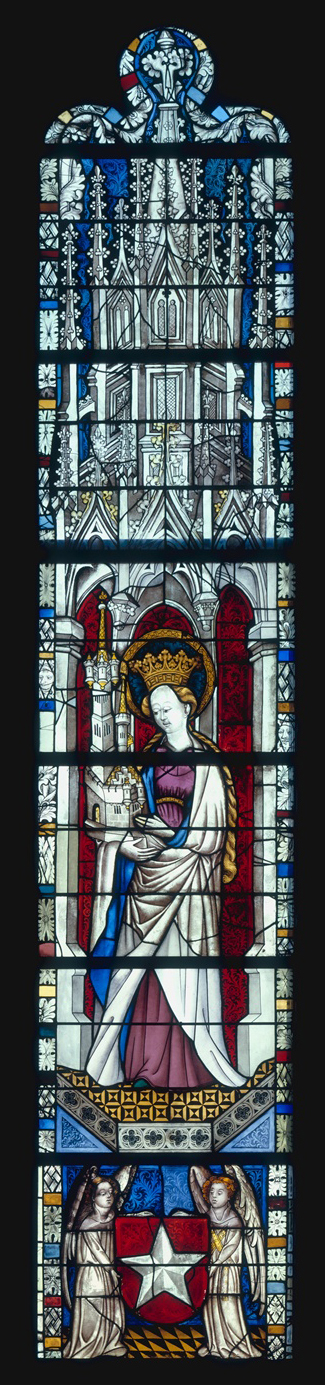
In the rarefied world of haute couture, the dialogue between historical artifact and contemporary design is not merely an academic exercise; it is a vital source of inspiration that redefines the boundaries of textile art and narrative expression. At Katherine Fashion Lab, we approach this dialogue with the rigor of a forensic curator and the vision of a master tailor. The subject under analysis—Saint Barbara Holding a Tower, with the Arms of the City of Maastricht below (circa 1500, German, from a series with The Virgin Mary and Five Standing Saints)—is a masterwork of stained glass, executed in pot-metal glass, white glass, vitreous paint, and silver stain. This standalone study is not merely a religious icon; it is a blueprint for a collection that fuses architectural strength, spiritual transcendence, and the precision of medieval craftsmanship into a modern couture narrative.
Materiality as a Couture Vocabulary
The foundation of this analysis rests on the extraordinary materiality of the artifact. The use of pot-metal glass—where the color is integral to the glass itself, not applied superficially—parallels the couture principle of fabric integrity. In a Katherine Fashion Lab collection, this translates to fabrics that are dyed in the fiber, such as double-faced cashmere or jacquard weaves where color and pattern are structurally embedded. The white glass, often used for flesh tones and halos, suggests a base of unbleached silk or organza, providing a luminous, ethereal ground. The vitreous paint, a mixture of ground glass and metallic oxides fired onto the surface, becomes the equivalent of hand-embroidered metallic threads or appliquéd leather panels. The silver stain, a technique that produces a rich yellow or amber hue when fired, is the couture equivalent of gold leafing or hand-painted silk panels that catch light with shifting intensity.
This material hierarchy—integral color, luminous base, painted detail, and metallic accent—forms the structural DNA of the collection. Each garment must respect the weight and transparency of these elements, creating a visual tapestry that mimics the stained glass window’s interplay of opacity and light.
Iconography and Architectural Silhouette
Saint Barbara is depicted holding a tower, her primary attribute, symbolizing her imprisonment by her father and her subsequent martyrdom. The tower is not a mere prop; it is an architectural statement. In the stained glass, it is rendered with geometric precision—vertical lines, crenellations, and a fortified base. For Katherine Fashion Lab, this tower becomes the silhouette anchor of the collection. We envision a series of sculptural gowns and structured jackets that echo the tower’s verticality and strength. Think of a columnar evening gown in deep ruby pot-metal red, with a built-in architectural collar that rises like a battlement. Or a tailored blazer in charcoal wool, with seams that mimic the lead lines (calms) of the stained glass, creating a grid of reinforcement and visual tension.
The arms of the City of Maastricht—a five-pointed star on a shield—are positioned below the saint’s feet. This heraldic element introduces a localized, civic identity into a sacred narrative. In couture terms, this translates to a micro-embroidered motif on the hem of a skirt or the cuff of a sleeve, perhaps using silver thread on a dark ground. The star becomes a signature emblem, repeated in hardware (buttons, clasps) or as a laser-cut leather appliqué. The placement below the feet suggests a grounding force, a connection to earth and community, which we interpret as a weighted hem or a train that anchors the otherwise ethereal silhouette.
Color Palette and Light Dynamics
The stained glass medium is defined by its relationship with light. The colors—deep ruby, cobalt blue, emerald green, and amber yellow—are not static; they transform as daylight shifts. Katherine Fashion Lab’s collection must capture this dynamic luminosity. We propose a palette that moves from the saturated, jewel-toned pot-metal hues to the translucent whites and pale ambers of the silver stain. Fabrics are selected for their light-reactive properties: iridescent taffeta that shifts from blue to green, silk gazar that holds structure while allowing backlighting, and organza overlays that diffuse color like a stained glass window.
The vitreous paint details—the saint’s facial features, the folds of her gown, the architectural lines of the tower—are rendered in deep brown or black. In couture, this translates to graphic outlining: hand-stitched black cordonnet on a pale silk ground, or matte velvet panels inserted into glossy satin to create contrast and definition. The silver stain’s warm glow is echoed in gold lamé or metallic lace, used sparingly to highlight structural seams or as a halo-like collar.
Structural Construction: The Lead Line as Seam
The stained glass panel is held together by lead calms, which create a grid of dark lines that both separate and unite the colored glass pieces. This is the most direct couture translation: the lead line as a seam. We conceive of garments where every seam is a design element, not a hidden necessity. Imagine a gown constructed from multiple panels of contrasting fabrics—ruby silk, cobalt velvet, emerald charmeuse—joined by visible, hand-finished piping in black or silver. The seams become the narrative, tracing the lines of the saint’s figure, the tower’s architecture, and the heraldic shield below.
The standalone study nature of this artifact—a single saint from a larger series—suggests a modular approach to the collection. Each garment is a complete statement, yet it can be viewed as part of a larger narrative. This invites a collection of separates: a structured jacket (the tower), a flowing skirt (the saint’s gown), and a metallic belt (the heraldic shield), each independent yet harmonized by the material and color vocabulary.
Narrative and Wearability
Couture is not merely about spectacle; it is about the story the wearer embodies. Saint Barbara’s narrative of imprisonment and transcendence offers a powerful metaphor for the modern woman: strength within constraint, grace under pressure. The tower is not a prison but a fortress; the saint is not a victim but a martyr who chose faith over freedom. This duality is expressed through contrasting textures: hard, architectural structures (sculpted shoulders, corseted bodices) against soft, flowing fabrics (silk chiffon, pleated organza). The arms of Maastricht remind us of the importance of place and identity, grounding the collection in a specific heritage that can be adapted globally.
Wearability is paramount. The collection must move from the gallery to the gala, from the runway to the real world. This means translating the stained glass’s static beauty into garments that flow, drape, and respond to the body’s motion. A floor-length cape in pot-metal blue, with a silver-stain yellow lining, can be dramatic yet functional. A tailored jumpsuit with lead-line seams offers a contemporary silhouette that echoes the saint’s verticality without sacrificing comfort. The heraldic star becomes a discreet brooch or a bold, embroidered back panel, allowing for personalization.
Conclusion: The Sacred as Couture Architecture
Saint Barbara Holding a Tower, with the Arms of the City of Maastricht is more than a historical artifact; it is a masterclass in the integration of material, symbol, and structure. For Katherine Fashion Lab, this analysis yields a collection that is both reverent and revolutionary. The pot-metal glass teaches us the power of integral color; the silver stain, the magic of light-reactive detail; the lead lines, the beauty of visible construction. The saint’s tower becomes our silhouette; her story, our narrative; the city’s arms, our signature. This is not costume—it is couture architecture, where every seam is a lead line, every color a sacred glass, and every garment a window into a world where the divine and the designed are one.