Deconstructing the Informal: A Strategic Analysis of the Chinese Silk Robe
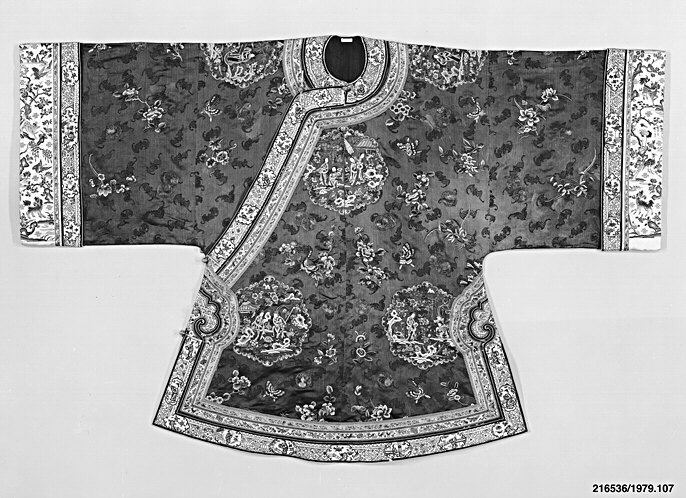
Within the curated archives of Katherine Fashion Lab, the informal Chinese robe stands as a paradigm of sartorial intelligence. Far from a mere garment of repose, this artifact—crafted from sumptuous silk and accented with metallic thread—represents a sophisticated negotiation between private comfort and public identity, between cultural codification and personal expression. As a standalone study, it offers a rich case study in non-Western fashion systems, where the dichotomy of "formal" and "informal" is delineated not by silhouette alone, but through a complex matrix of materiality, motif, and context. This analysis will dissect the robe as a strategic asset in the historical wardrobe, examining its supply chain (the silk trade), its value proposition (luxurious informality), and its unique brand positioning within the hierarchy of traditional Chinese dress.
Material Sovereignty: Silk as a Monopolistic Advantage
The foundational element of the robe's value is its material: Chinese silk was not merely a textile but a proprietary technology and a geopolitical instrument for centuries. The selection of silk for an informal robe immediately establishes a high barrier to entry, signaling the wearer's access to a controlled, luxury supply chain. Unlike formal court regalia, which might utilize heavier brocades or elaborate dragon-embroidered silks mandated by sumptuary laws, the informal robe leverages silk's inherent properties—its luminous sheen, fluid drape, and tactile sensuality—for personal, rather than purely institutional, appeal. The integration of metallic thread, likely fine gold or silver-wrapped silk, introduces a critical inflection point. This is not the overwhelming, status-proclaiming embroidery of a rank badge; instead, it is often deployed as subtle piping, delicate floral outlines, or understated geometric borders. This represents a capital-efficient application of a high-cost component, maximizing perceived value and aesthetic refinement while maintaining the garment's core function as leisurewear. The material choice thus communicates a powerful message: the wearer possesses the means to employ a nation's most coveted export for their private solace.
The Strategic Architecture of "Informal" Design
The term "informal" here is a deliberate misdirection that requires unpacking. In the context of traditional Chinese attire, particularly during the Ming and Qing dynasties, informal robes (such as the changshan for men or various forms of pao and ao for women) operated within a strict sartorial ecosystem. Their informality was relative, defined primarily by their liberation from the rigid, symbolic prescriptions of court dress. The Lab's specimen likely features a cross-over front (jiaoling youren), wide sleeves, and a loose, enveloping cut. This architecture prioritizes ease of movement and autonomous dressing, contrasting with the complex, multi-layer assemblies of formal wear that required assistance. However, this simplicity is deceptive. The cut is engineered to create elegant, continuous lines that flow with the body's kinetics, celebrating repose as an aesthetic state. The drape of the silk creates a dynamic canvas where light and shadow become active design elements. This is not a garment that abdicates design authority; it redefines it around the principles of fluid elegance and cultivated ease, targeting a consumer segment—the scholarly elite, the literati, the gentry—whose status was expressed through refined taste and intellectual leisure rather than overt bureaucratic display.
Symbolic Logistics: Motif and Meaning in a Private Context
The decorative scheme, executed in metallic thread, is where the robe's narrative is most precisely calibrated. Free from the mandatory iconography of state power (dragons, phoenixes), the embroidery enters a more personal, yet still highly codified, symbolic language. Common motifs for such garments include: delicate orchids (symbolizing refinement and humility), meandering vines (continuity and longevity), or stylized clouds (good fortune and the celestial). The application of these motifs is typically less dense and more lyrical than on formal wear. This represents a strategic shift in communication. The robe functions as a curated portfolio of personal values and aspirations, worn in the intimate settings of the home garden, study, or during gatherings of close associates. It engages in a form of quiet brand storytelling, where the wearer's character is alluded to through aesthetic references understood by a discerning peer group. The metallic thread ensures these symbols possess a subtle luminosity, catching the light intermittently, much like a whispered conversation. This transforms the private space into a stage for a more authentic, yet still meticulously managed, performance of self.
Contextual Valuation: The Robe as a Standalone Asset
As a standalone study, this artifact compels us to evaluate it outside of a complete ensemble. Its value is intrinsic and self-contained. The combination of premier silk and strategic metallic detailing establishes a high perceived quality and a compelling value proposition: exclusive comfort. It served as a tangible asset in a personal collection, an item of both emotional and material worth. In contemporary fashion strategy terms, it would occupy a position akin to an "ultimate luxury" casualwear product—the pinnacle of a brand's offering for off-duty moments. Its existence underscores a mature consumer market that recognized different product categories for different life modes. Furthermore, its standalone nature highlights its role in a global narrative. Such robes, when encountered by Western traders and diplomats, became fetishized objects that shaped Europe's imagination of the "Orient," influencing the development of the dressing gown and notions of exotic leisure. Thus, the robe operated in multiple markets: the domestic market of Chinese elite self-expression, and later, the external market of cross-cultural fantasy.
Conclusion: A Legacy of Calculated Ease
The Katherine Fashion Lab's informal Chinese robe is a masterclass in nuanced design strategy. It demonstrates how the levers of luxury—monopolized material, strategic embellishment, culturally intelligent design, and symbolic storytelling—can be pulled to create a product for a sophisticated, niche audience. It redefines informality not as a lack of rigor, but as a different, more personal framework for demonstrating wealth, taste, and cultural capital. In today's market, where the boundaries between formal and informal are increasingly blurred and the demand for "quiet luxury" and personalized meaning is paramount, this historical artifact offers profound insights. It teaches that true luxury in leisurewear lies not in the abandonment of code, but in the mastery of a subtler, more intimate language of excellence. The robe remains a potent symbol of how to build a commanding brand presence, even while ostensibly at rest.