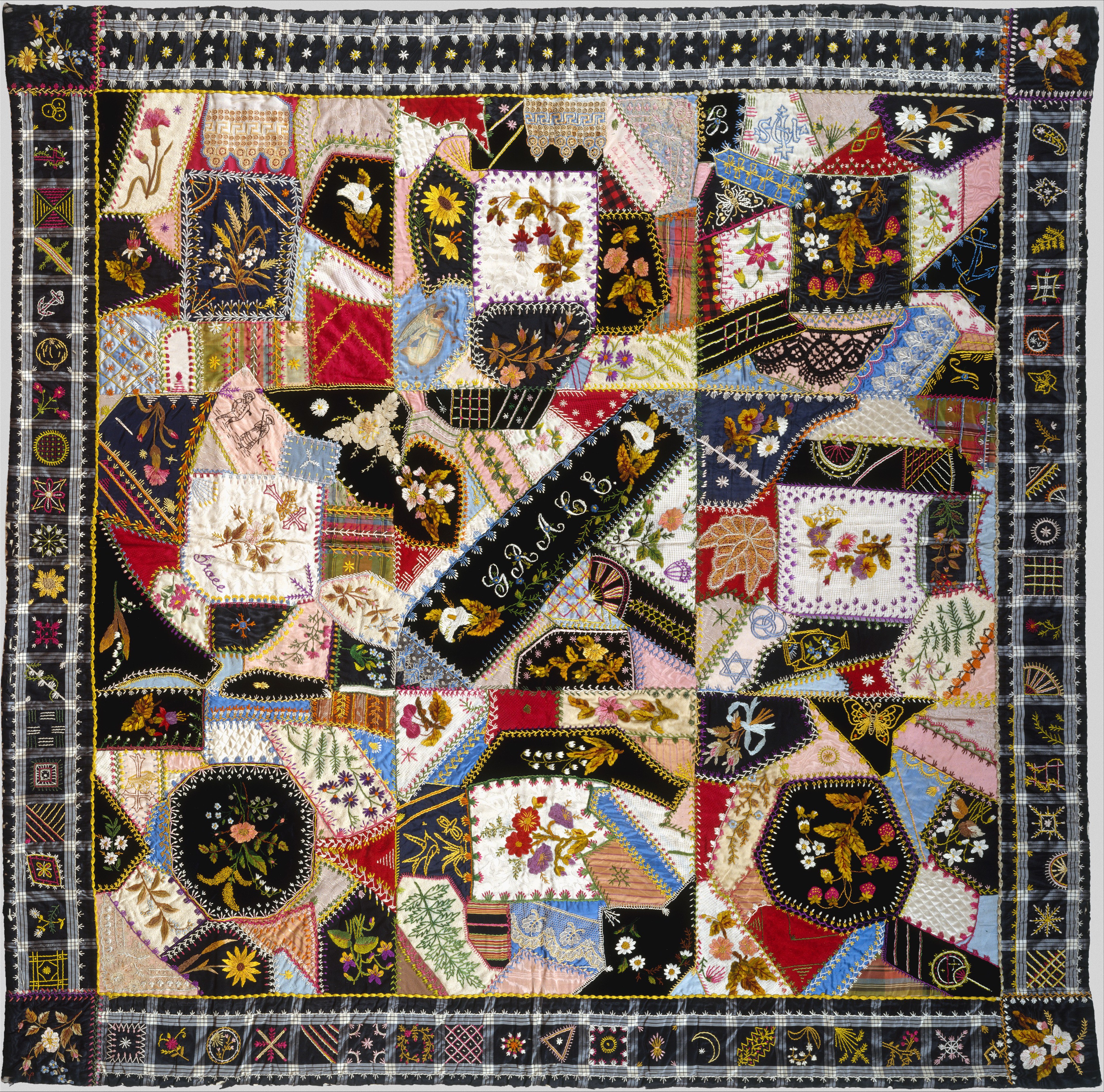
The Crazy Quilt: An American Tapestry of Textured Opulence
In the annals of American decorative arts, few objects capture the intersection of domestic craft, social history, and material excess quite like the "Crazy Quilt." At Katherine Fashion Lab, we approach this artifact not merely as a bed covering or decorative throw, but as a standalone study in couture-level composition—a tactile narrative woven from silk, silk velvet, cotton, and cotton lace. This analysis deconstructs the crazy quilt’s aesthetic DNA, its cultural resonance, and its profound relevance to contemporary fashion design.
Historical Context: From Parlor to Pinnacle
The crazy quilt emerged in the late 19th century, a product of the American Victorian era’s fascination with ornamentation and leisure. Unlike utilitarian patchwork quilts born of necessity, the crazy quilt was a statement piece—a showcase of a maker’s skill, wealth, and artistic sensibility. Its hallmark: an asymmetrical, seemingly chaotic arrangement of fabric scraps stitched together with elaborate embroidery. This was not a quilt for warmth; it was a quilt for display, often draped over a parlor sofa or hung as a wall tapestry. The materials—silk, velvet, lace—were luxury imports, signaling the owner’s access to global trade and refined taste. In this context, the crazy quilt becomes a precursor to modern couture’s emphasis on surface decoration, textural contrast, and narrative complexity.
Material Lexicon: Silk, Velvet, Cotton, Lace
The selection of materials in this particular crazy quilt is a masterclass in tactile hierarchy. Silk, with its natural sheen and fluid drape, forms the backbone of the composition. It reflects light unevenly, creating a shifting visual landscape that mimics the unpredictability of the pattern itself. Silk velvet introduces a counterpoint of depth and absorption. Its plush pile traps shadows, offering a velvety blackness or jewel-toned richness that anchors the lighter silks. Cotton, though less glamorous, provides structural integrity and a matte finish that prevents the piece from becoming visually overwhelming. Finally, cotton lace—often inserted as delicate insets or applied as trim—adds a layer of fragility and intricacy. The lace’s openwork creates negative space, allowing the eye to rest amid the density of the patchwork. Together, these materials form a textural symphony: smooth against plush, shiny against matte, solid against void.
Deconstructing the "Crazy" Pattern
The term "crazy" belies a sophisticated design logic. At first glance, the pattern appears random: irregular polygons of fabric stitched together without a repeating grid. However, a closer analysis reveals a deliberate rhythm. The patches are often arranged around a central motif—a star, a flower, or a monogram—with the "crazy" fragments radiating outward. This radial asymmetry creates a vortex of movement that draws the viewer’s gaze inward, then outward again. The seams themselves are a canvas for embroidery: feather stitches, herringbone, and cross-stitches in silk thread that echo the lace’s delicacy. These stitched lines serve as both structural seams and decorative borders, blurring the line between construction and embellishment. In fashion terms, this is couture-level finishing—each seam is a deliberate design element, not a mere necessity.
Cultural and Symbolic Resonance
The crazy quilt is a deeply American artifact, reflecting the nation’s immigrant heritage and its ethos of resourcefulness. Each scrap of fabric—a remnant of a silk dress, a velvet curtain, a lace collar—carries a personal history. The quilt becomes a memory palace, a textile archive of the maker’s life and social circle. This aligns with contemporary fashion’s turn toward upcycling and narrative design. Brands like Katherine Fashion Lab can draw inspiration from the crazy quilt’s ethos: that beauty emerges from the recombination of disparate elements, and that luxury is not in pristine uniformity but in curated fragmentation. The quilt’s "craziness" also subverts the rigid symmetry of European decorative arts, celebrating a distinctly American spirit of improvisation and boldness.
Couture Applications: Translating the Quilt to the Runway
For the modern designer, the crazy quilt offers a rich vocabulary of techniques and aesthetics. Consider a couture gown that mimics its patchwork: panels of silk charmeuse, velvet, and cotton lace assembled in an asymmetrical silhouette. The embroidery along the seams could be exaggerated—gold thread, beadwork, or even metallic foil—to echo the quilt’s ornamental excess. The silhouette itself could be voluminous, like a Victorian bustle, or deconstructed, with raw edges and hanging threads that recall the quilt’s handcrafted origins. The color palette, often jewel-toned in historical examples (ruby, sapphire, emerald), can be updated with neon accents or monochromatic gradients for a contemporary edge.
Another application lies in texture layering. The crazy quilt teaches us that luxury is not about a single expensive fabric but about the interplay of multiple textures. A Katherine Fashion Lab collection might feature a jacket with silk velvet sleeves, a cotton lace yoke, and a silk satin body—each fabric chosen for its specific visual and tactile effect. The "crazy" pattern can be translated into digital prints or laser-cut appliqués, maintaining the aesthetic of controlled chaos without the labor-intensive hand-stitching. Yet, the handcrafted element remains crucial: couture clients value the story of artisanship, and the crazy quilt’s embroidery is a testament to hours of meticulous work.
Standalone Study: The Quilt as Object
As a standalone study, this crazy quilt is more than a decorative throw; it is a three-dimensional textile sculpture. Its weight, drape, and size (typically 60 x 72 inches) make it a substantial object that commands space. The interplay of light on its varied surfaces—silk gleaming, velvet absorbing, lace casting shadows—creates a dynamic visual experience that changes with the viewer’s angle. This is a key lesson for fashion: garments are not static; they move, shift, and reveal themselves over time. The crazy quilt’s complexity rewards prolonged observation, much like a couture gown that unveils new details with each glance.
Conclusion: A Blueprint for Modern Luxury
The American crazy quilt, in its silk, velvet, cotton, and lace incarnation, is a forgotten masterwork of applied design. At Katherine Fashion Lab, we see it as a blueprint for modern luxury: a rejection of minimalism in favor of maximalist storytelling, a celebration of material diversity, and a tribute to the hands that stitch. By studying its pattern, its textures, and its cultural roots, we can reimagine couture as a living archive—one where every scrap, every seam, and every stitch carries meaning. The crazy quilt is not a relic; it is a manifesto for the future of fashion.