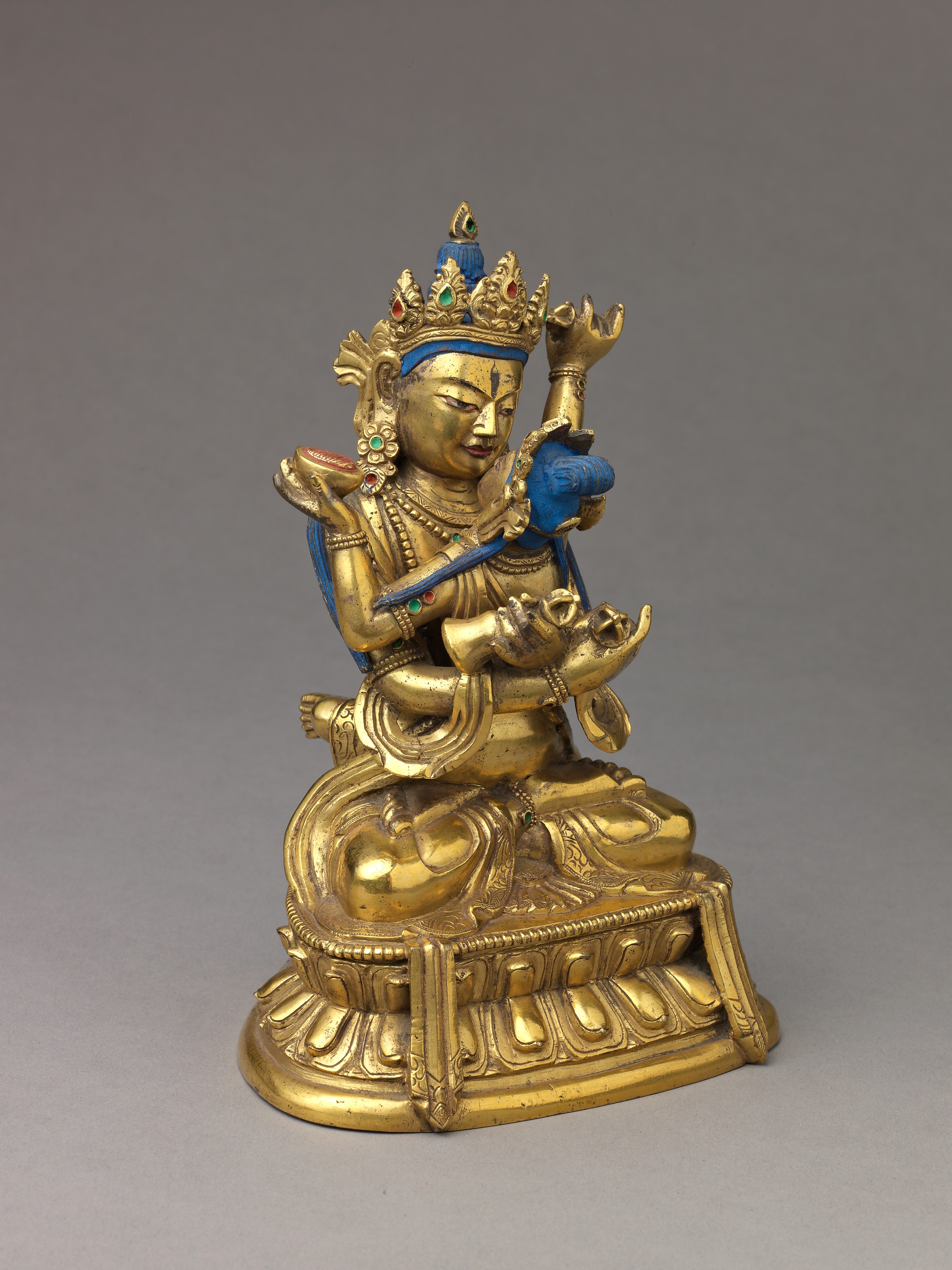
Heritage Analysis: Vajradhara in Union with Prajnaparamita
Subject Overview and Provenance
The object under analysis is a gilt brass sculpture, mounted on a copper base with applied color, depicting the Buddhist deity Vajradhara in yab-yum (father-mother) union with his consort, Prajnaparamita. Likely originating from either Chinese or Tibetan workshops, this piece represents the apotheosis of esoteric Buddhist iconography. The medium—gilt brass with copper and polychrome accents—places it within a tradition of Himalayan and Sino-Tibetan metalwork that flourished between the 15th and 18th centuries. For Katherine Fashion Lab, this artifact offers a profound case study in the intersection of spiritual symbolism, historical adornment, and the articulation of transcendent power through material form. As a strategic standalone research piece, it provides a template for a 2026 high-end luxury strategy rooted in sacred geometry, union, and enlightened authority.
Symbolic Power: The Iconography of Union
Vajradhara, the primordial Buddha of the Kagyu school, embodies the ultimate reality of enlightenment. In yab-yum, he sits in lotus posture, holding a vajra (thunderbolt scepter) and ghanta (bell), symbols of method and wisdom respectively. His consort, Prajnaparamita—the Perfection of Wisdom—wraps her legs around his waist, holding a curved knife and skull cup. Their union is not erotic but metaphysical: the indivisibility of compassion (upaya) and wisdom (prajna), the two essential forces that generate enlightened consciousness. The symbolic power here lies in the visual articulation of non-duality. For luxury strategy, this suggests a design language where opposites are synthesized—masculine and feminine, form and emptiness, tradition and innovation. The gilt surface acts as a metaphor for the luminous, untainted nature of mind, while the copper base grounds this radiance in earthly stability. Applied color—often red, blue, and green—accentuates the deities’ regal attire and ornaments, marking them as sovereigns of the spiritual realm.
Historical Adornment: Ornament as Dharma
The sculpture’s adornment is meticulously codified. Vajradhara wears a five-pointed crown, earrings, necklaces, armlets, bracelets, and anklets—the six ornaments of a bodhisattva. Prajnaparamita is similarly adorned, with additional floral garlands and a flowing scarf. These are not mere decoration; they represent the perfection of generosity, discipline, patience, effort, meditation, and wisdom. The materials—gilt brass and copper—reflect historical trade routes: brass from Nepal and Tibet, copper from Central Asia, and gilding techniques refined in Chinese imperial workshops. The applied color, often mineral-based (malachite for green, lapis for blue, cinnabar for red), signals the use of precious, imported pigments. For Katherine Fashion Lab, this offers a blueprint for adornment as narrative. Each ornament must carry meaning, not just aesthetic weight. In a 2026 luxury context, this translates to collections where every clasp, chain, or gemstone placement tells a story of spiritual or cultural significance. The historical practice of using gilding to denote sacredness can be reimagined as a signature finish—perhaps a proprietary gold alloy or a matte-gold treatment—that signals exclusivity and transcendence.
Spiritual Meaning: The Luxury of Enlightenment
At its core, this sculpture is a meditation aid, a thangka in three dimensions. The spiritual meaning is twofold: first, it reminds the practitioner of the ultimate goal—the union of wisdom and compassion; second, it serves as a field of merit, a visual focus for devotion. The yab-yum posture is a direct representation of mahamudra, the great seal of reality. For a high-end luxury brand, this suggests a shift from materialism to experiential transcendence. In 2026, the luxury consumer will seek not just objects but portals to meaning. The sculpture’s spiritual function—to elevate consciousness—parallels the aspirational promise of luxury: to elevate status, taste, and selfhood. However, the Buddhist context demands a deeper engagement. The emptiness at the heart of Prajnaparamita’s wisdom is a reminder that true luxury is not accumulation but liberation from attachment. This paradox can be the foundation of a new luxury ethos: one that values craftsmanship, heritage, and spiritual resonance over ephemeral trends.
2026 High-End Luxury Strategy: Sacred Synthesis
Drawing from this heritage analysis, Katherine Fashion Lab can develop a 2026 strategy around the concept of “Sacred Synthesis.” This strategy has four pillars:
1. Iconographic Collaboration: Partner with living masters of Tibetan or Nepalese metalwork to create limited-edition pieces that reimagine yab-yum symbolism in contemporary jewelry and accessories. For example, a ring set with two interlocking bands (vajra and ghanta) in gold and platinum, with a hidden compartment for a miniature scripture.
2. Material Alchemy: Develop a proprietary “Enlightenment Finish”—a gilding technique using ethically sourced gold and copper alloys, applied by hand over multiple layers. The base metal (copper) should be visible as a deliberate contrast, echoing the sculpture’s copper base. This finish signals both heritage and innovation.
3. Narrative Adornment: Each piece must include a “dharma card” explaining the spiritual meaning of its design elements—crowns, bells, or lotus motifs. This transforms the purchase into an educational experience, appealing to the discerning collector who values provenance and philosophy.
4. Experiential Retail: Launch the collection in a pop-up space designed as a meditation chamber, with scent, sound, and light evoking a Himalayan shrine. Offer private consultations with a Buddhist scholar or artisan to explain the symbolism. This positions Katherine Fashion Lab not just as a brand, but as a curator of sacred luxury.
Conclusion: From Artifact to Archetype
The Vajradhara-Prajnaparamita sculpture is more than a historical artifact; it is an archetype of enlightened union, materialized through exquisite craftsmanship. For Katherine Fashion Lab, it offers a roadmap to a 2026 luxury strategy that is symbolically dense, historically informed, and spiritually resonant. By embracing the sacred geometry of yab-yum, the material language of gilt and copper, and the narrative power of adornment, the lab can create a collection that transcends fashion and enters the realm of cultural legacy. The strategic standalone research confirms that the highest luxury is not ownership, but participation in a story of transformation. In a market saturated with the ephemeral, Katherine Fashion Lab can stand as a beacon of permanent value—gilt with meaning, grounded in wisdom, and united with the eternal.