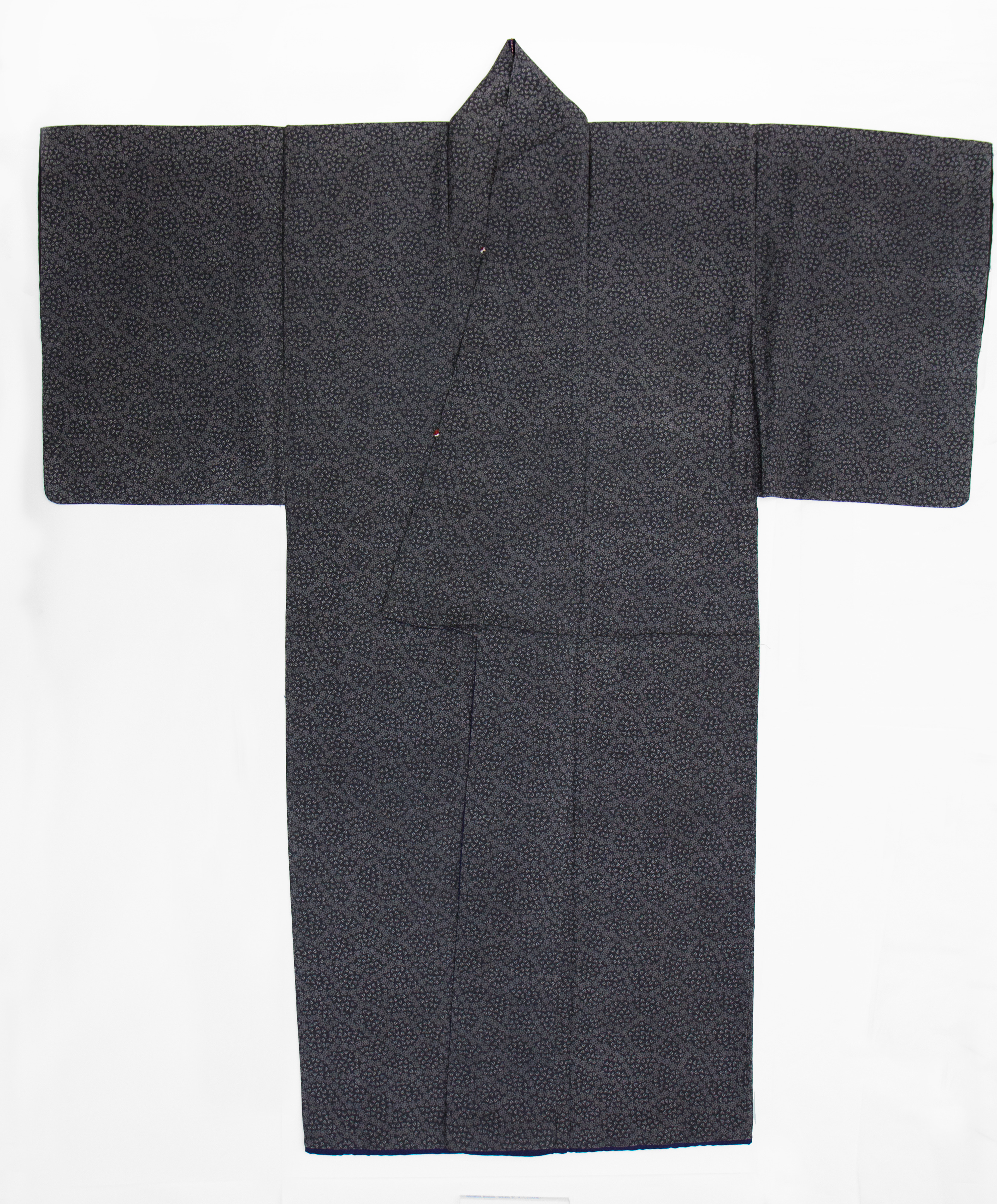
Deconstructing the Kosode: A Study in Stencil-Dyed Silk
In the annals of global fashion history, few garments possess the quiet, almost architectural eloquence of the Japanese kosode. As the precursor to the modern kimono, the kosode—literally meaning “small sleeve openings”—was not merely a piece of clothing but a canvas for profound artistic and cultural expression. The subject of this analysis, a Robe (Kosode) with Cherry Blossoms and Butterflies, crafted from plain-weave silk with stencil-dyeing, offers a singular opportunity to examine the intersection of technical mastery, natural symbolism, and sartorial restraint. This standalone study positions the garment not as a relic, but as a masterclass in haute craftsmanship, where materiality and motif converge to create a statement of quiet luxury.
At first glance, the kosode’s aesthetic is one of deliberate understatement. Yet, this simplicity is a façade for extraordinary complexity. The choice of plain-weave silk (often referred to as habutae or “silk habutai”) provides a luminous, tactile foundation. This weave, characterized by its smooth, untextured surface, is both a technical and strategic decision. It allows the stencil-dyeing process—known as katazome—to achieve a precision that would be obscured by more intricate weaves. The silk’s slight sheen catches ambient light, making the cherry blossoms and butterflies appear to float across the fabric, as if suspended in a perpetual spring breeze.
The Art of Katazome: Stencil-Dyeing as High Craft
The stencil-dyeing technique employed here is the backbone of the garment’s narrative. Unlike Western methods of applied decoration, such as embroidery or screen printing, katazome is a resist-dye process that demands an almost surgical level of precision. Artisans cut intricate patterns into multiple layers of treated paper stencils, each corresponding to a specific color or element. A rice-paste resist is then brushed through the stencil onto the silk, preventing dye from penetrating the covered areas. The result is a design that is not laid atop the fabric but fused into its very fibers.
This process imbues the kosode with a unique depth. The cherry blossoms (sakura) are rendered in a palette of soft pinks and whites, their petals slightly blurred at the edges—a deliberate effect that mimics the fleeting, ephemeral nature of the blossoms themselves. The butterflies (chō), in contrast, are depicted with sharper outlines and subtle gradations of gold and indigo, creating a visual tension between the transient and the eternal. In the context of fashion analysis, this juxtaposition is a strategic masterstroke: it elevates the garment from mere clothing to a wearable meditation on impermanence (mono no aware), a core tenet of Japanese aesthetics that resonates deeply with contemporary luxury consumers seeking meaning beyond brand logos.
Symbolic Resonance: Cherry Blossoms and Butterflies
To fully appreciate this kosode, one must decode its iconography. The cherry blossom is Japan’s unofficial national flower, symbolizing the beauty and fragility of life. Its brief blooming period—often just a week—serves as a poignant reminder of mortality. In a fashion context, this motif is not decorative; it is a philosophical statement. The butterfly, meanwhile, carries dual meanings: it represents transformation and joy, but also the soul’s journey. Together, these elements create a dialogue of renewal and transience, a narrative that aligns with the cyclical nature of fashion itself.
From a design perspective, the placement of these motifs is critical. The blossoms and butterflies are not randomly scattered but follow a dynamic asymmetrical composition, a hallmark of Japanese visual culture. The eye is drawn from the left shoulder, where a cluster of blossoms bursts forth, down to the lower right hem, where a solitary butterfly alights. This diagonal flow creates a sense of movement, as if the garment is caught in a gentle breeze. Such compositional intelligence is reminiscent of the iki principle—an understated yet sophisticated elegance that avoids overt symmetry in favor of organic balance.
Materiality and the Sensory Experience
Beyond visual analysis, the tactile and sensory dimensions of this kosode demand attention. Plain-weave silk is lightweight, breathable, and possesses a fluid drape that conforms to the body without constriction. The stencil-dyeing process does not compromise the fabric’s hand feel; the paste resist leaves no stiffness, ensuring the garment moves as a second skin. This is a critical point for modern connoisseurship: in an era where sustainability and comfort are paramount, the kosode’s construction embodies functional longevity. The dye is permanent, the silk durable, and the design timeless—qualities that challenge the disposable nature of fast fashion.
The color palette further enhances the sensory narrative. The base silk is a warm ivory, reminiscent of unbleached linen, providing a neutral ground that allows the cherry blossoms’ blush and the butterflies’ metallic accents to pop. The use of natural dyes—likely derived from plants and minerals—imparts a subtle variation in hue, a testament to the artisan’s skill. This is not the sterile, uniform color of industrial production but a living, breathing palette that shifts with the angle of light. For the wearer, this creates an intimate experience: the garment reveals itself slowly, rewarding close inspection.
Couture Implications: Lessons for the Global Luxury Market
This kosode stands as a powerful case study for contemporary fashion houses. Its success lies in its restraint. There is no embellishment for its own sake; every element—from the weave to the dye to the motif—serves a cohesive purpose. In an industry often defined by excess, the kosode’s quiet confidence offers a counterpoint. It demonstrates that true luxury is not about volume but about depth of craft. The garment’s narrative is not shouted but whispered, inviting the wearer and observer into a shared dialogue.
Moreover, the kosode’s modularity—its ability to be worn layered or as a standalone piece—anticipates modern trends in versatile dressing. The loose, T-shaped silhouette transcends gender and body type, a prescient nod to inclusive fashion. The stencil-dyeing technique, meanwhile, is a precursor to artisanal printing methods that today’s luxury brands champion under the banner of “heritage craftsmanship.” By studying this garment, designers can learn how to embed cultural authenticity into their collections without resorting to cultural appropriation, instead offering a respectful homage to a centuries-old tradition.
Conclusion: A Timeless Artifact of Fashion Intelligence
In final analysis, the Robe (Kosode) with Cherry Blossoms and Butterflies is far more than a historical artifact. It is a testament to the power of material and motif, a sartorial poem that speaks to the universal human experience of beauty and loss. Through its plain-weave silk and meticulous stencil-dyeing, it achieves a harmony that is both intellectually rigorous and emotionally resonant. For Katherine Fashion Lab, this garment serves as a benchmark for how fashion can transcend utility to become a form of cultural preservation and artistic expression. It challenges us to look beyond the surface, to find luxury in the subtle, and to recognize that the most profound statements are often those made in silence.