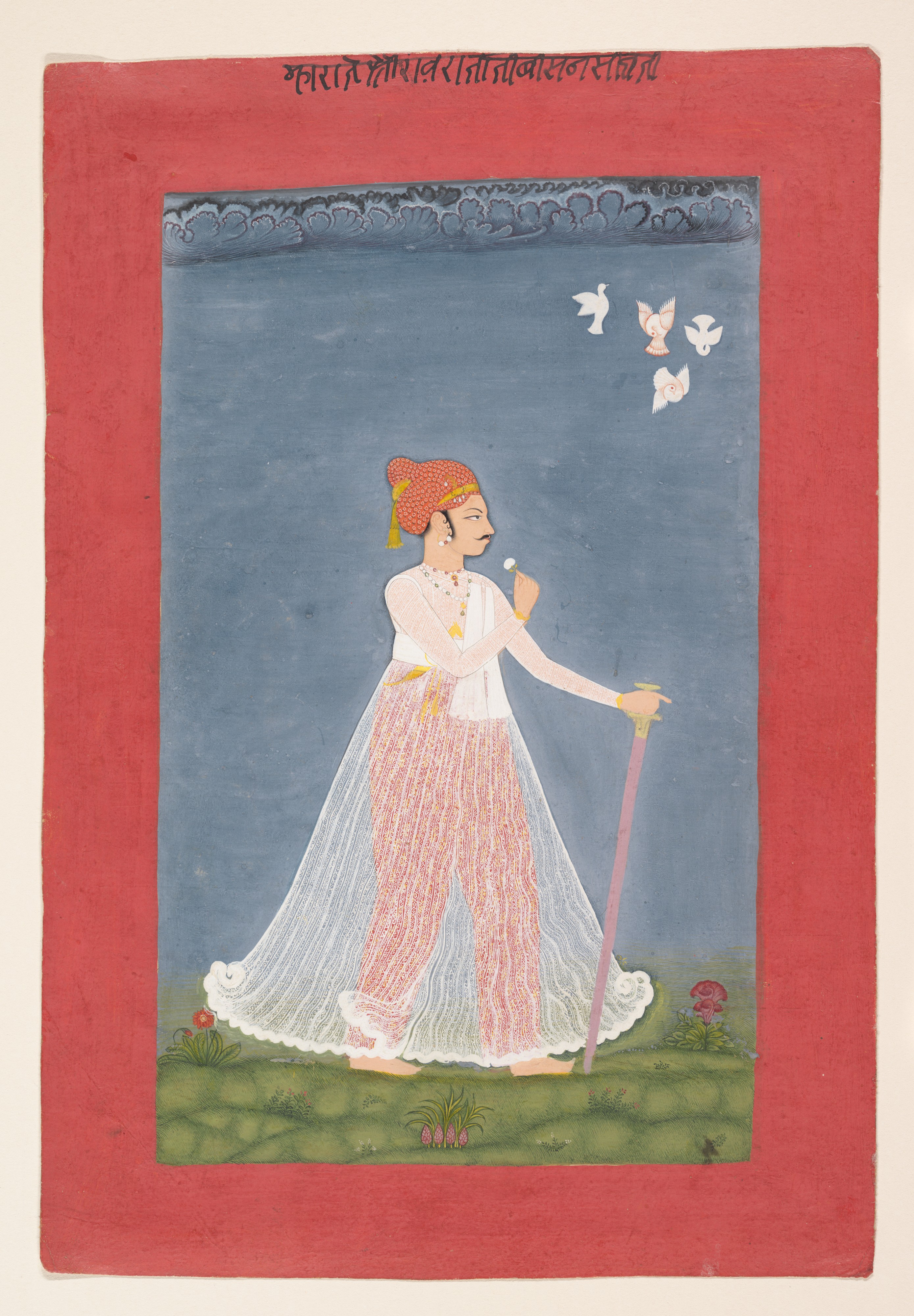
Bishen Singh as a Young Man: A Couture Analysis of Mughal-Rajput Elegance
Introduction: The Portrait as a Sartorial Document
In the annals of Indian courtly art, few works capture the intersection of power, youth, and textile opulence as vividly as the standalone study of Bishen Singh as a Young Man. Executed in ink and opaque watercolor on paper, this 18th-century portrait from Uniara, Rajasthan, transcends mere documentation to become a masterclass in the language of aristocratic dress. For Katherine Fashion Lab, this piece offers an unparalleled lens through which to deconstruct the couture sensibilities of the Rajput-Mughal synthesis—a fusion of indigenous craftsmanship and imperial influence that defined the sartorial identity of princely India. The young Singh, depicted with poised formality, is not merely a subject; he is a walking tableau of textile heritage, color theory, and symbolic adornment.
The Silhouette: Structure and Ceremony
The first point of analysis is the silhouette, which speaks to the era’s emphasis on ceremonial rigor. Bishen Singh is clad in a flowing jama—a courtly coat that flares from the waist, creating a bell-like shape that commands presence. This garment, typical of Rajput portraiture, is cinched with a sash that emphasizes the torso while allowing the skirt to sweep dramatically. From a couture perspective, the jama’s construction mirrors the modern bias-cut gown: it relies on gravity and fabric weight to achieve its drape. The ink outlines, precise yet yielding, suggest a lightweight cotton or silk muslin, likely hand-spun and block-printed. The cut is asymmetrical, with the front panels crossing left over right—a subtle nod to the wearer’s martial lineage, as this style allowed for ease of sword drawing. For Katherine Fashion Lab, this silhouette informs our structured drapery techniques, where volume is controlled through strategic pleating rather than rigid boning.
Color Palette: The Politics of Pigment
The opaque watercolor palette is a study in restrained opulence. Bishen Singh wears a deep saffron jama, a color reserved for royalty and spiritual authority, juxtaposed against a pale ivory undergarment visible at the collar and cuffs. This contrast is not accidental; saffron, derived from the Crocus sativus flower, was a costly import from Kashmir, symbolizing both wealth and asceticism—a duality central to Rajput identity. The sash, a vibrant emerald green, introduces a complementary tension, evoking the lush gardens of Rajasthan’s palaces. The watercolor’s opacity lends the hues a matte finish, akin to the natural dyes used in traditional bandhani and leheriya textiles. In contemporary couture, this palette translates to a color-blocking strategy where saturated earth tones are offset by neutral bases, creating visual hierarchy without overwhelming the wearer’s form.
Textile Details: Craftsmanship in Miniature
Although rendered on paper, the portrait contains micro-details that reveal the textile’s technical sophistication. The jama’s surface is adorned with a repeating floral motif, likely a buta pattern, executed in delicate gold paint. This references the zari work of Mughal brocades, where metallic threads were woven into silk to create shimmering patterns. The artist’s use of ink for the outlines and watercolor for the fill mimics the effect of kalamkari—a hand-painted textile tradition. Bishen Singh’s turban, a towering pagri, is wrapped in a crimson fabric with a gold sarpech (turban ornament) pinned at the front. The turban’s pleats are meticulously shaded, suggesting a stiff, starched cotton that holds its shape—a precursor to modern millinery. For Katherine Fashion Lab, these details inspire surface ornamentation techniques, such as hand-embroidered appliqué and metallic foil printing, that honor historical craft while adapting to contemporary wearability.
Accessories as Power Markers
Accessories in this portrait are not mere embellishments but semiotic tools of status. Bishen Singh wears a pearl necklace, its strands meticulously dotted in white watercolor, symbolizing purity and lunar association—a common Rajput trope. His ears are adorned with heavy gold rings, pulling the lobe downward, a practice that indicated nobility and connection to the divine (as Lord Krishna was often depicted with such adornment). A curved sword, its hilt visible at his waist, is sheathed in a scabbard wrapped in what appears to be velvet or brocade, its gold fittings echoing the turban ornament. The sword’s inclusion reinforces the warrior ethos, blending martial readiness with aesthetic refinement. In modern couture, these accessories translate to statement jewelry and functional hardware, where belts, brooches, and armlets serve both as decoration and as anchors for the garment’s silhouette.
Cultural Context: The Rajput-Mughal Sartorial Syncretism
To fully appreciate Bishen Singh’s attire, one must situate it within the socio-political fabric of 18th-century Uniara. The Rajput courts, while fiercely independent, were deeply influenced by Mughal aesthetics, particularly under Emperor Shah Jahan’s reign. The jama, for instance, originated in Persia but was adapted by Rajput nobility to incorporate local motifs and dyes. The portrait’s standalone nature—a study rather than a narrative scene—elevates the subject’s clothing to the primary focus. This suggests that sartorial display was a form of soft power, where clothing communicated alliances, wealth, and cultural literacy. The artist’s choice of ink and opaque watercolor on paper, a medium borrowed from Mughal manuscript painting, further underscores this syncretism. For Katherine Fashion Lab, this context informs our design philosophy of cross-cultural dialogue, where we blend Indian textile traditions with global silhouettes, creating garments that tell stories of heritage without being confined by them.
Conclusion: From Paper to Fabric
The portrait of Bishen Singh as a Young Man is a testament to the enduring power of dress as a narrative medium. Through its precise inkwork, luminous watercolor, and symbolic accessories, it offers a blueprint for couture that balances grandeur with intimacy. For Katherine Fashion Lab, this analysis informs our upcoming collection, where we will reinterpret the jama’s silhouette, the saffron-emerald palette, and the gold floral motifs into modular, gender-fluid designs. The young Singh’s gaze, direct and assured, reminds us that fashion is not merely fabric but a declaration of identity. In his stance, we find the eternal intersection of art and attire—a dialogue that Katherine Fashion Lab is committed to continuing, one stitch at a time.