Deconstructing Divinity: The Lambayeque Beaker as Proto-Couture Narrative
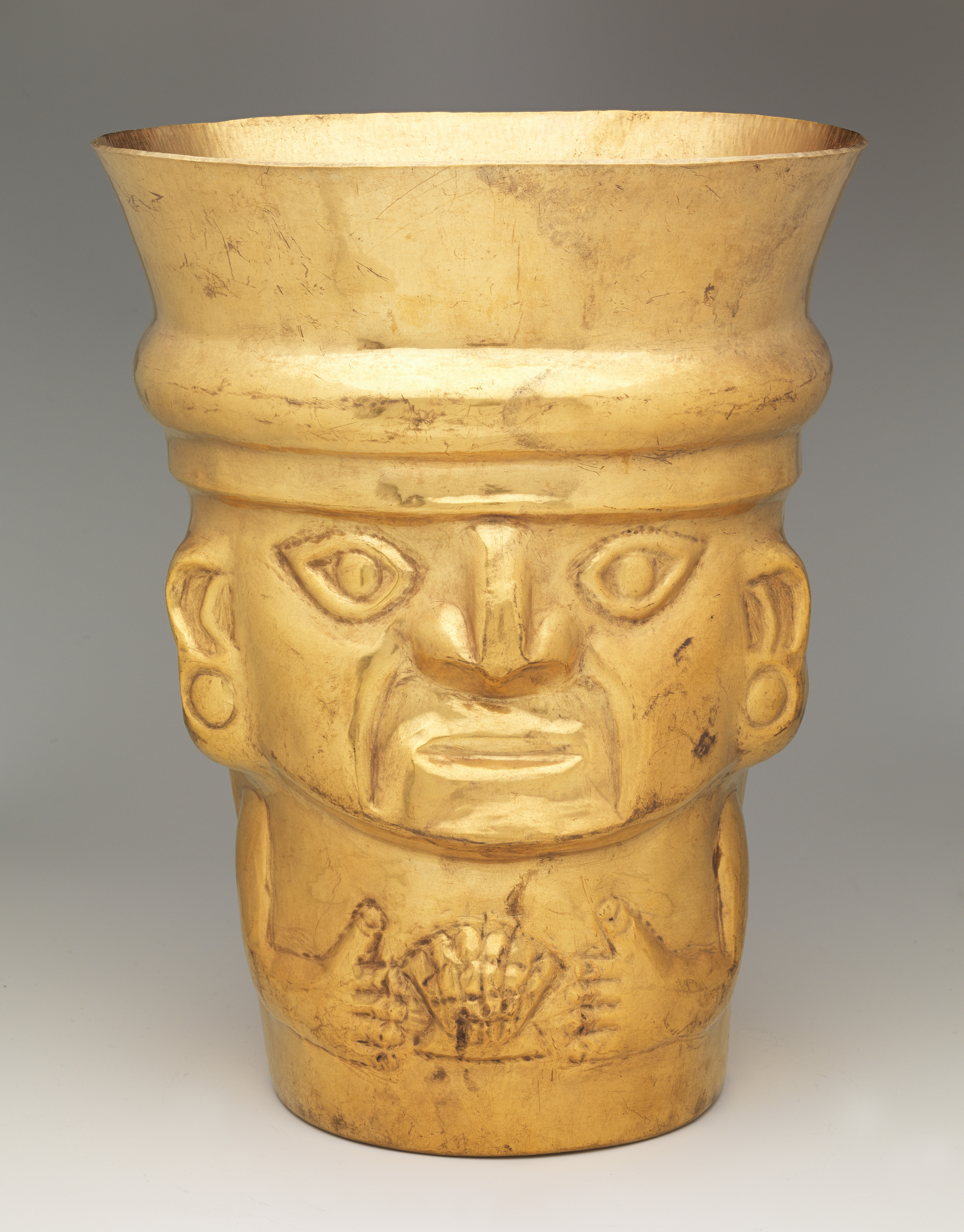
In the rarefied intersection of archaeology and haute couture, few artifacts command the contemplative reverence of the Lambayeque (Sicán) beaker, crafted from hammered gold and adorned with the spectral figure and the Spondylus shell. This vessel, emerging from the northern coast of Peru circa 900–1100 CE, is not merely a ceremonial object; it is a pre-Columbian manifesto of power, transcendence, and material alchemy. For Katherine Fashion Lab, this beaker serves as a profound muse—a relic whose design DNA resonates with the duality of the Mirror with Split-Leaf archive: one face a polished silver mirror inlaid with gold palm fronds, the other a cold sarcophagus lid narrating life through relief. This analysis dissects the beaker’s couture implications, revealing how its gold matrix, figural iconography, and shell symbolism inform a contemporary language of luxury and memory.
Gold as a Medium of Immortal Light
The beaker’s primary material—gold—is not a passive surface but an active participant in ritual performance. In Sicán metallurgy, gold was not merely mined; it was transubstantiated. Artisans hammered, annealed, and repousséd the metal to achieve a luminosity that mimicked the sun’s path across the coastal desert. This is not the polished, sterile gold of modern luxury; it is a living membrane that captures and refracts light, creating a dialogue between the vessel and its environment. For Katherine Fashion Lab, this suggests a fabric philosophy: textiles that breathe and shift under illumination. Imagine a gown woven with gold-wrapped threads, where each movement creates a cascade of light—a wearable beaker effect. The beaker’s surface is also a narrative canvas, where the figure—likely a Sicán deity or ruler—is rendered in low relief, emerging from the metal as if from a dream. This technique parallels the silver mirror of the archive: one side reflects the external world, the other reveals an internal, mythic reality. The couture equivalent is a garment that is opaque yet translucent, where layers of gold organza and silver lame reveal hidden motifs only under specific angles of light.
The Figure: Embodied Power and the Silhouette of Divinity
The central figure on the beaker—often identified as the Sicán Lord, or Naymlap—is depicted with winged headdresses, feline attributes, and a staff of authority. This is not a portrait but an archetype of dominion. The figure’s posture is frontal, symmetrical, and commanding, a visual grammar of absolute power. For a couture house, this translates into architectural silhouettes that assert presence. Shoulders are broadened, waists cinched, and hemlines grounded—a power suit of the divine. The figure’s headdress, with its layered feathers and geometric patterns, inspires millinery as sculpture: a crown of gold-wire feathers that tremble with the wearer’s breath. Yet, the beaker’s genius lies in its intimacy. This vessel was used to consume chicha (maize beer) during funerary rites, where the living communed with the dead. The figure, therefore, is not distant; it is a co-participant in the ritual. Katherine Fashion Lab can interpret this as wearable ritualism: garments that require the wearer’s active engagement—a dress with detachable panels that reveal hidden embroidery, or a cape that can be reversed to show a different narrative. The cold sarcophagus lid from the archive finds its echo here: the beaker’s figure is a life narrative in gold, a frozen moment of power that the living awaken through touch and use.
The Spondylus Shell: A Symbol of Transoceanic Luxury
No analysis of the beaker is complete without the Spondylus shell, often inlaid into the vessel’s rim or depicted as a pendant on the figure. The Spondylus princeps, or thorny oyster, was harvested from the warm waters of Ecuador and traded across the Andes. Its spiny, coral-like exterior and deep orange-red interior made it a symbol of fertility, blood, and the sea’s bounty. In Sicán cosmology, the shell was the food of the gods, a luxury that connected the earthly realm to the celestial. For Katherine Fashion Lab, this shell becomes a textile and embellishment metaphor. Its irregular, organic form challenges the symmetry of the gold figure, introducing a tension between order and chaos. In couture, this translates to asymmetric draping and iridescent beading that mimics the shell’s inner nacre. The shell’s color palette—deep crimson, burnt orange, and creamy white—informs a seasonal collection that moves from blood-warm hues to cool, oceanic tones. The beaker’s inclusion of Spondylus also speaks to sustainable luxury: the shell was a finite, precious resource, harvested with great risk. Today, Katherine Fashion Lab can honor this by using ethically sourced, repurposed materials—gold recovered from electronic waste, or synthetic Spondylus created from bio-resins—that carry the same narrative weight without ecological harm.
The Archive’s Duality: Mirror and Sarcophagus
The beaker’s resonance with the Mirror with Split-Leaf archive is uncanny. The mirror, with its polished silver face and gold palm fronds, represents surface and reflection—the external, performative self. The sarcophagus lid, with its relief narrative, represents depth and memory—the internal, ancestral self. The Lambayeque beaker, in its gold entirety, collapses this duality. It is both mirror and sarcophagus: a reflective surface that shows the user’s distorted, god-like visage, and a narrative vessel that tells the story of the Sicán Lord’s journey to the afterlife. For Katherine Fashion Lab, this synthesis is the ultimate couture statement. A garment must be both armor and diary. A hand-beaded gown, for instance, can have a mirror-like front that reflects the wearer’s present, while the back is embroidered with a personal or mythological narrative—a family crest, a poem, a map of a significant journey. The beaker teaches us that luxury is not about hiding but revealing—revealing the layers of identity, history, and power that reside beneath the surface.
Conclusion: The Beaker as a Blueprint for Temporal Couture
The Lambayeque beaker with figure and Spondylus shell is not an artifact of a dead civilization; it is a living blueprint for a couture that transcends time. Katherine Fashion Lab can draw from its gold luminosity, its figural authority, its shell symbolism, and its dualistic nature to create garments that are ritual objects for the modern age. In a world of fast fashion and disposable trends, the beaker reminds us that true couture is permanent, narrative, and transformative. It is a mirror that reflects not just the body, but the soul; a sarcophagus that holds not just bones, but stories. As we handle this vessel, we are not merely analyzing metal and shell—we are communing with the Sicán Lord, and through him, with the eternal human desire to be remembered, to be beautiful, and to be divine. This is the inheritance of Katherine Fashion Lab: to weave gold into fabric, history into silhouette, and the sacred into the everyday.