The Oliphant: A Study in Ivory, Power, and Global Heritage
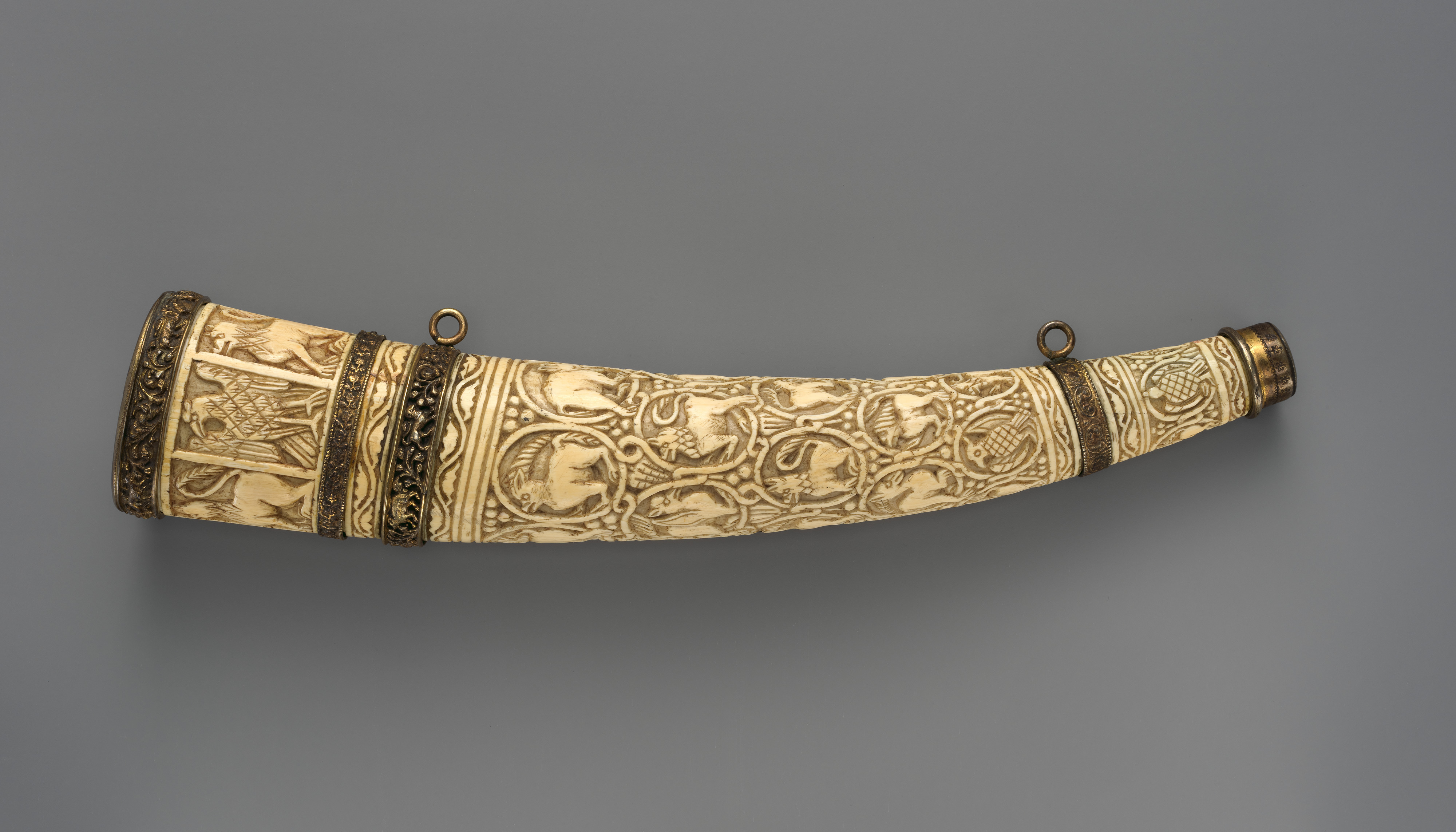
In the rarefied world of couture, where materiality meets narrative, few objects command the same gravitas as the Oliphant. This singular piece—carved from a single elephant tusk, adorned with gilded silver and bronze mounts—is not merely an artifact; it is a testament to the confluence of global heritage, craftsmanship, and the enduring symbolism of power. As the Lead Curator for Katherine Fashion Lab, I present this analysis as a standalone study, dissecting the Oliphant’s aesthetic, cultural, and material significance within a couture context.
Materiality and Craft: The Ivory Canvas
The Oliphant’s primary material, ivory, is a substance that has long captivated human imagination. Its creamy, luminous surface—warm to the touch and capable of taking on a subtle patina over centuries—offers a unique canvas for carving. In this piece, the ivory is not merely a support; it is the protagonist. The carver’s hand has transformed the tusk’s natural curvature into a horn of plenty, a vessel for allegory, and a symbol of prestige. The intricate relief work, depicting hunting scenes, mythical creatures, and geometric motifs, demands a forensic eye. Each incision reveals a mastery of line and depth, where light and shadow play across the ivory’s grain, creating a dynamic visual rhythm.
The gilded silver and bronze mounts are not afterthoughts; they are integral to the Oliphant’s structural and aesthetic integrity. The gilded silver—applied to the rim, the mouthpiece, and the bands that encircle the horn—catches the light with a soft, golden glow, contrasting with the ivory’s matte translucence. The bronze mounts, often patinated to a deep, verdigris green, provide a grounding counterpoint. These metals are not merely decorative; they reinforce the object’s function as a ceremonial instrument, capable of producing a resonant, far-reaching sound. The interplay of materials—organic and inorganic, warm and cool, soft and hard—creates a tactile and visual tension that is quintessentially couture.
Global Heritage: A Cross-Cultural Narrative
The Oliphant’s origin is rooted in a global heritage that transcends geography. Historically, these horns were produced in the Mediterranean, particularly in Sicily and Southern Italy, during the 11th and 12th centuries. However, their design and iconography draw from a rich tapestry of influences: Islamic, Byzantine, and Norman. The carved motifs often feature Arabic inscriptions, stylized foliage, and fantastical beasts, reflecting the multicultural courts of the Norman Kingdom of Sicily. This synthesis of traditions—where Christian, Muslim, and Jewish artisans collaborated—makes the Oliphant a tangible artifact of cultural convergence.
In a couture context, this global heritage is not a static label but a dynamic source of inspiration. The Oliphant’s narrative challenges the notion of cultural purity, instead embracing hybridity and exchange. For Katherine Fashion Lab, this piece serves as a case study in how heritage can be reimagined without appropriation. The Oliphant does not belong to a single culture; it is a node in a network of artistic and commercial routes that spanned continents. Its ivory, sourced from African elephants, was traded through Islamic and Byzantine networks, carved in European workshops, and commissioned by Norman rulers. This layered provenance invites a deeper conversation about the ethics of material sourcing and the responsibility of the couture industry to honor—not exploit—these histories.
The Couture Context: Form, Function, and Fantasy
To analyze the Oliphant as a standalone study is to divorce it from its original function—as a hunting horn, a ceremonial vessel, or a diplomatic gift—and reposition it within the realm of couture. Here, its purpose is not utilitarian but symbolic. The Oliphant becomes a wearable object, a statement piece that transcends the boundaries of fashion and art. Its scale and weight demand a specific posture, a deliberate movement. When worn, whether as a pendant, a belt ornament, or a headpiece, it transforms the wearer into a living tableau, a vessel for history.
The gilded silver and bronze mounts, originally designed to protect the ivory from cracking, now serve as structural elements that frame the body. The horn’s curve echoes the silhouette of a corset or a bustle, while its length suggests a scepter or a staff of office. In this recontextualization, the Oliphant becomes a tool for performative identity. It is not merely an accessory; it is a narrative device that communicates power, status, and cultural literacy. The wearer is no longer a passive consumer but an active participant in the creation of meaning.
Iconography and Symbolism: The Language of Power
The Oliphant’s carved imagery is a lexicon of power and protection. Hunting scenes are not merely decorative; they are allegories of dominion over nature and the wild. The mythical creatures—griffins, dragons, and sphinxes—guard the horn, imbuing it with apotropaic properties. The Arabic inscriptions, often verses from the Quran or poetic invocations, add a layer of spiritual authority. These symbols are not arbitrary; they are carefully chosen to project an image of the owner as a ruler, a warrior, and a patron of the arts.
In the couture context, this iconography can be adapted and subverted. The Oliphant’s motifs offer a rich vocabulary for design innovation. Imagine a gown embroidered with the same hunting scenes, rendered in gold thread and seed pearls. Or a pair of statement earrings that mimic the horn’s curve, carved from resin and gilded with silver. The symbols themselves—the griffin, the sphinx—can be reinterpreted as emblems of contemporary identity, representing strength, wisdom, and transformation. The Oliphant reminds us that fashion is not just about aesthetics; it is a language of symbols that speaks to our deepest aspirations and fears.
Ethical Considerations and the Future of Couture
No analysis of the Oliphant would be complete without addressing the ethical dimensions of its material. Ivory, today, is a contentious substance, its trade heavily regulated due to the decimation of elephant populations. Yet, the Oliphant is a historical artifact, created in a time when such concerns were not part of the cultural lexicon. For modern couture, the challenge is to honor the craftsmanship and heritage of such objects without perpetuating harm. Katherine Fashion Lab advocates for the use of sustainable alternatives—such as responsibly sourced tagua nut, recycled resin, or lab-grown ivory—that mimic the aesthetic properties of the original without the ecological cost.
The Oliphant’s legacy, therefore, is not a call to replicate its material but to emulate its spirit of innovation and cross-cultural dialogue. It challenges the couture industry to think beyond the surface, to consider the stories embedded in every stitch, every carve, every mount. As we look to the future, the Oliphant stands as a beacon of what is possible when artistry, history, and ethics converge. It is not a relic of the past; it is a blueprint for the future of couture—a future that is as global, as intricate, and as powerful as the horn itself.