The Sartorial Spectacle of Absence: Deconstructing the Tagasode Byōbu
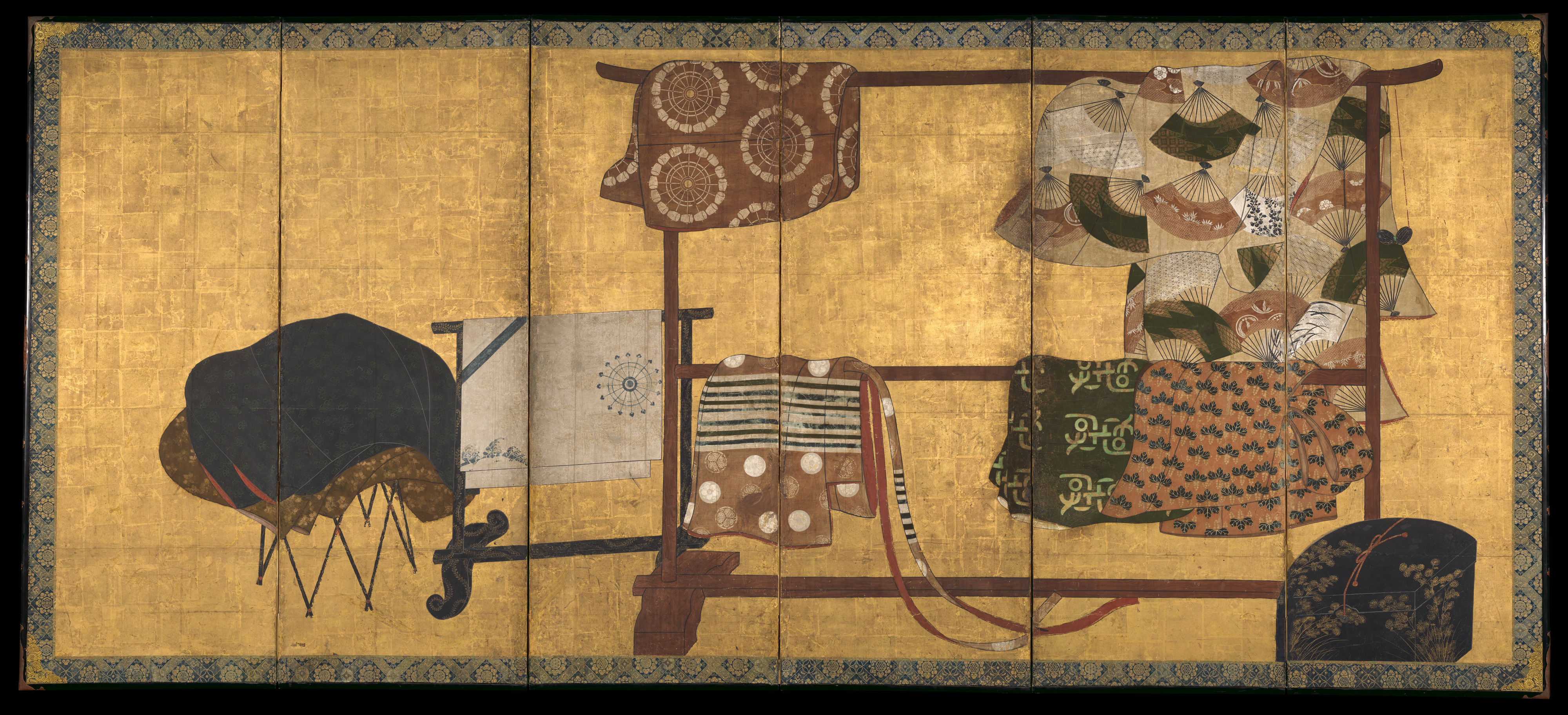
In the rarefied air of haute couture, where fabric is not merely material but narrative, the Tagasode (Whose Sleeves?) folding screens from Japan’s Momoyama or early Edo period represent a masterclass in the art of suggestion. At Katherine Fashion Lab, we approach this pair of six-panel byōbu—rendered in ink, color, and gold on gilt paper—not as mere decorative artifacts, but as a profound study in the semiotics of clothing. The screens depict a lavish array of kimono and obi draped over an ornate rack, conspicuously devoid of a wearer. This absence is not a void; it is a strategic, calculated silence that speaks volumes about status, desire, and the very essence of fashion as a performative act. For the modern couturier, the Tagasode offers a radical rethinking of the garment: not as a shell for a body, but as a protagonist in its own right, a ghostly presence that commands the gaze through its exquisite materiality.
Gold, Ink, and the Architecture of Luxury
The technical execution of the Tagasode screens is a testament to the Japanese aesthetic of tsuya (luster) and iki (refined chic). The application of gold leaf on gilt paper creates a luminous backdrop that elevates the depicted textiles from mere objects to sacred relics. This is not a casual wardrobe; it is a treasury. The gold functions as a spatial anchor, transforming the flat pictorial plane into a shimmering, infinite space where the kimonos float in a state of eternal display. For Katherine Fashion Lab, this use of precious metal resonates deeply with contemporary luxury branding, where the materiality of the surface is the primary carrier of value. The screens anticipate the modern concept of the "look book" or the "runway show"—a controlled environment where fabric is isolated, magnified, and fetishized. The gold ground is the ultimate catwalk, and the kimonos are the sole performers.
The Kimono as a Cartography of Self
Each kimono on the screen is a meticulously rendered map of social identity. The bold yūzen dye patterns, the intricate shibori tie-dye, and the luxurious rinzu silk weaves are not arbitrary decorations. They are coded signifiers of seasonality, rank, and occasion. A kimono with autumn grasses and chrysanthemums speaks to a specific cultural literacy, while the use of deep indigo or vermillion signals a particular echelon of the court or merchant class. The Tagasode invites the viewer to read these garments as a text. In the absence of a body, the patterns become the personality. The obi—the wide sash—is folded with geometric precision, its knot a sculptural element that dictates the silhouette even in its dormant state. For the contemporary designer, this teaches a crucial lesson: the garment must possess an internal logic, a structural integrity that is compelling even when unworn. The folds and drapes of the Tagasode kimonos are not accidental; they are choreographed to maximize the visual impact of the pattern, a principle we apply in our own draping ateliers.
The Erotics of Absence and the Gaze
The central provocation of the Tagasode is its titular question: "Whose Sleeves?" The sleeves—the sode—are the most expressive part of the kimono, flaring and flowing with the wearer’s movements. By displaying them empty, the screens create a powerful void of identity. This absence is deliberately erotic. It teases the viewer, forcing them to imagine the body that once inhabited these silks. The screens function as a form of mitate (allusive parody), a visual riddle that plays with the boundary between presence and absence. In the context of the 17th-century pleasure quarters, such screens were often associated with courtesans, whose elaborate robes were a form of advertisement and seduction. The empty sleeve becomes a proxy for the forbidden, the unseen, the desired. For Katherine Fashion Lab, this dynamic is the essence of couture allure. A dress is never just a dress; it is a promise of transformation, a vessel for a potential self. The Tagasode screens remind us that the most powerful fashion is that which leaves room for the imagination. The garment is the question; the wearer is the answer.
From Screen to Studio: A Blueprint for Modern Couture
Translating the Tagasode into a contemporary collection requires a shift in perspective. The screens offer a blueprint for a fashion of absence. Consider the following design principles derived from this analysis:
1. The Garment as a Standalone Object: Just as the screens present kimonos on a rack, our designs must be conceived as three-dimensional sculptures, not just flat patterns. The internal structure—the seams, the darts, the linings—must be finished to a level of perfection that rivals the exterior. A jacket should be as beautiful inside out as it is on a body.
2. Pattern as Narrative: The Tagasode kimonos use pattern as a primary storytelling device. In our collections, we must treat prints and embroideries not as decoration but as iconographic systems. A single floral motif can evoke an entire season, a cultural reference, or a personal memory. The surface is a canvas for coded meaning.
3. The Power of the Unseen: The empty sleeve is a direct challenge to the fashion industry’s obsession with the body. We can create designs that deliberately obscure or de-emphasize the wearer’s form, focusing attention on the fabric’s drape, the interplay of light and shadow, and the inherent drama of the cloth. Oversized silhouettes, asymmetric cuts, and voluminous sleeves can all evoke the Tagasode’s haunting emptiness.
4. Material as Prestige: The extensive use of gold leaf on the screens is a statement of absolute luxury. In a modern context, this translates to a relentless commitment to provenance and craftsmanship. The choice of a specific silk weave, a hand-applied bead, or a rare dye becomes the equivalent of the gold ground—a foundation that elevates the entire piece into the realm of art.
Conclusion: The Eternal Question
The Tagasode Byōbu is not a relic; it is a living dialogue between the creator and the beholder, the garment and its ghost. At Katherine Fashion Lab, we see these screens as a mirror held up to the very soul of couture. They ask us to consider: what is a garment without a wearer? It is a poem, a puzzle, a promise. It is a sleeve waiting for a hand, a fold anticipating a body. In our own work, we strive to capture this tension—the exquisite agony of the empty sleeve, the silent conversation between fabric and fantasy. The answer to the screen’s question, “Whose Sleeves?” is ultimately left to the viewer, the collector, the dreamer. And that, in the end, is the most potent luxury of all: the power to imagine the person who might wear them.