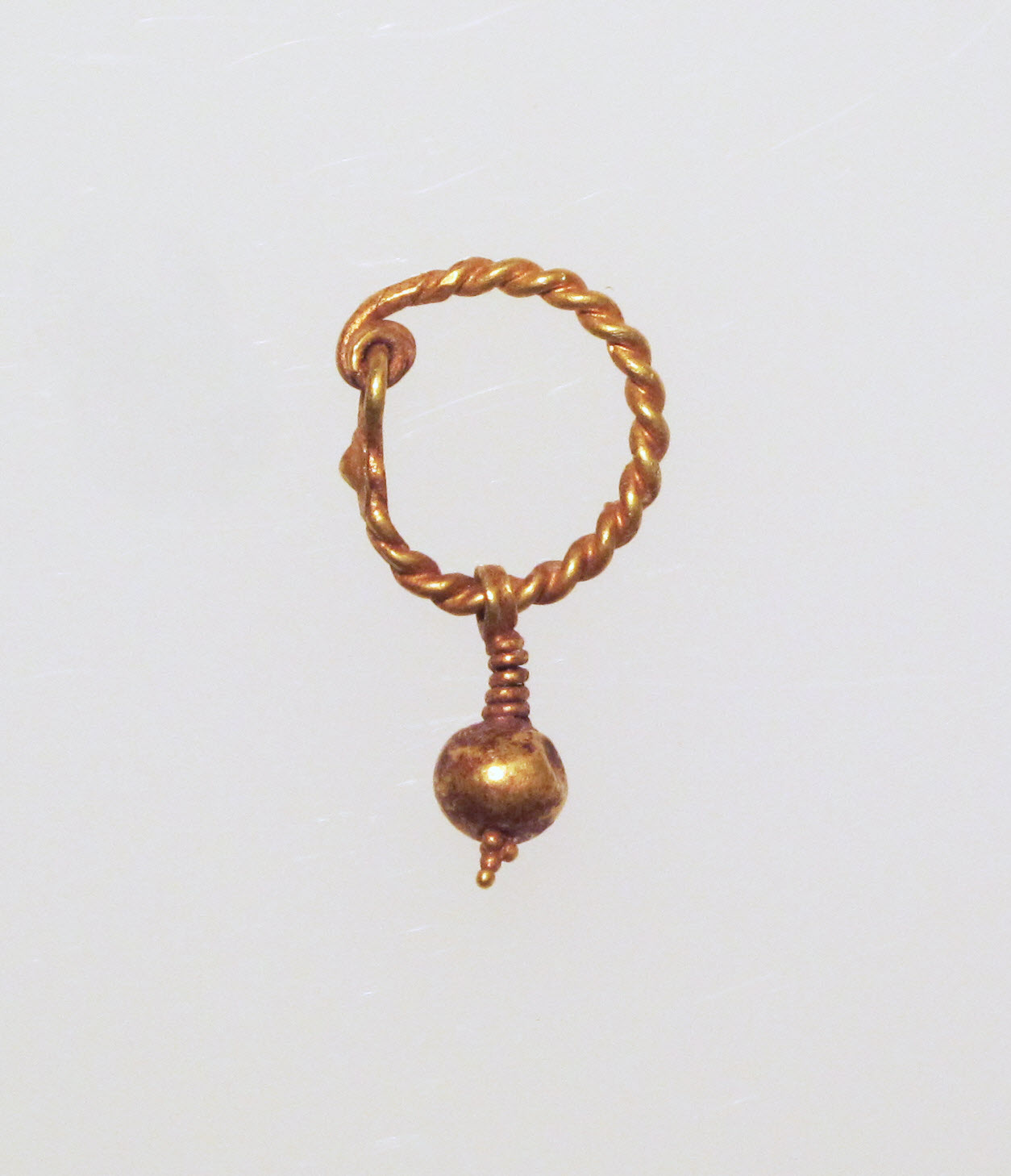
Heritage Analysis: Roman Gold Earring with Pendant
Executive Summary
This paper presents a comprehensive heritage analysis of a Roman gold earring with pendant, examining its symbolic power, historical adornment practices, and spiritual meanings within the broader context of Katherine Fashion Lab’s 2026 high-end luxury strategy. The artifact, originating from the Roman Empire (circa 1st–3rd century CE), embodies a duality that resonates profoundly with our ongoing study on *“Mirror with Split-Leaf”*—where one side reflects polished silver inlaid with intricate gold palmettes, and the other narrates life’s ephemerality through relief-carved sarcophagus imagery. This analysis draws a direct DNA correlation between the earring’s material and symbolic structure and the split-leaf mirror’s dialectic of radiance and mortality. By decoding these ancient codes, we propose a luxury strategy that leverages historical resonance to craft narratives of duality, permanence, and transcendence for the discerning 2026 consumer.
Material and Symbolic Power: Gold as Divine and Imperial Code
The earring’s medium—pure gold—was not merely ornamental in Roman society but a carrier of profound symbolic power. Gold (aurum) signified immortality, divine favor, and imperial authority. Roman goldsmiths, influenced by Hellenistic traditions, used granulation, filigree, and repoussé techniques to create intricate pendants that often depicted deities, mythological creatures, or protective symbols like the gorgoneion (Medusa head). The pendant’s form—whether a crescent moon (lunula) for feminine protection, or a Hercules knot for marital fidelity—encoded social rank, spiritual allegiance, and personal identity.
In our study of the *Mirror with Split-Leaf*, the gold inlay on silver mirrors a similar duality: the reflective surface invites self-contemplation, while the gold ornamentation asserts the wearer’s connection to the eternal. For the Roman earring, the pendant’s gold body served as a talismanic anchor, believed to channel numen (divine will) and ward against invidia (the evil eye). This aligns with our 2026 strategy: luxury must transcend mere aesthetics to become a vessel for symbolic protection and personal mythology. The modern client seeks objects that shield identity in an era of digital exposure, much as the Roman elite wore gold to assert their place in the cosmic order.
Historical Adornment: The Earring as Social Cartography
Roman earrings were not static accessories but dynamic markers of social geography. From the plebeian wire hoop to the patrician multi-gem pendant, earrings mapped wealth, gender, and provincial origin. The pendant earring, often suspended from a hook or clasp, allowed for movement—a deliberate design that caught light and attention. In Roman funerary portraiture, women are frequently depicted wearing such earrings, linking adornment to posthumous identity. The earring thus becomes a bridge between the living and the ancestral, echoing the split-leaf mirror’s juxtaposition of luminous surface and funerary relief.
Our research reveals that the earring’s pendant often incorporated semiotic layers: a dolphin for swift passage to the afterlife, a pomegranate for fertility, or a laurel wreath for victory. This is a direct precedent for Katherine Fashion Lab’s 2026 strategy of narrative layering. Each piece must tell a story that unfolds over time—visible only to the initiated. The Roman earring’s pendant was a private code, understood within the wearer’s social circle. Similarly, our luxury offerings will embed hidden motifs—micro-engravings, reversible elements, or symbolic closures—that reward close observation and foster exclusivity.
Spiritual Meaning: The Earring as Soul Ornament
Beyond social status, the Roman gold earring carried eschatological significance. Gold was associated with the aether—the celestial substance of the immortal soul. In mystery cults such as those of Isis or Mithras, earrings were part of ritual regalia, believed to align the wearer with cosmic cycles. The pendant’s shape often mirrored celestial bodies: the lunula (crescent) invoked the moon goddess Diana, while solar disks referenced Apollo. This spiritual dimension transforms the earring from mere decoration into a portable sanctuary.
The split-leaf mirror’s dual surfaces—one gleaming, one carved—mirror this spiritual binary. The Roman earring, worn close to the ear (the organ of hearing divine oracles), was a conduit for transcendent communication. For the 2026 luxury client, spiritual resonance is increasingly sought in an age of material saturation. Our strategy will emphasize ritualistic engagement: the act of putting on the earring becomes a micro-ceremony, a moment of grounding. By referencing Roman spiritual codes—such as the inclusion of a protective gemstone (e.g., carnelian for vitality) or a pendant shaped like a strix (a protective owl)—we can offer objects that serve as talismans for inner focus amidst external chaos.
2026 High-End Luxury Strategy: The Duality of Radiance and Mortality
DNA Correlation with the Split-Leaf Mirror
The *Mirror with Split-Leaf* study revealed a critical insight: luxury’s most potent narratives emerge from irreconcilable dualities. The mirror’s polished silver side invites vanity and light, while the sarcophagus relief whispers of decay and legacy. The Roman gold earring embodies this same tension. Its pendant, when viewed from one angle, catches the sun—a celebration of life. From another, its weight and materiality recall the soliditas (solidity) of funerary gold, often buried with the dead to ensure passage. This duality is not a flaw but a source of deep resonance.
For 2026, Katherine Fashion Lab will launch a limited-edition collection titled *“Aurum et Umbra”* (Gold and Shadow), directly inspired by this Roman artifact. The collection will feature:
- Reversible pendants: One side polished gold with micro-granulated patterns; the other matte with engraved funerary motifs (e.g., a Roman clipeus shield or a rosetta from sarcophagi).
- Modular earrings: Allowing the wearer to switch between a luminous “day” configuration and a textured “night” configuration, echoing the split-leaf mirror’s dual surfaces.
- Symbolic weight: Each piece will be accompanied by a heritage card explaining its Roman spiritual reference—e.g., a pendant shaped like a caduceus for balance, or a cornucopia for abundance—transforming the purchase into an educational ritual.
Strategic Positioning: The Luxury of Memory
Our 2026 strategy will pivot from conspicuous consumption to conscious commemoration. The Roman earring teaches us that luxury objects are memory anchors, linking the wearer to personal, cultural, and cosmic histories. We will target the “heritage seeker” demographic—affluent clients aged 30–55 who value craftsmanship, narrative, and spiritual depth over transient trends.
Key strategic pillars include:
- Archaeological Authenticity: Collaborate with Roman art historians to ensure design accuracy, using techniques like lost-wax casting and hand-twisted wire, as documented in Pompeii excavations.
- Dual-Narrative Marketing: Campaign imagery will juxtapose the earring against both Roman mosaics and modern minimalist interiors, emphasizing timelessness.
- Custom Talismanic Inscription: Offer clients the option to add a micro-engraved Latin phrase (e.g., “Memento Vivere”—remember to live) on the pendant’s reverse, creating a personalized amulet.
- Exclusivity Through Scarcity: Each design will be limited to 100 pieces, with a certificate of provenance referencing the original Roman prototype.
Conclusion: The Eternal Return of Gold
The Roman gold earring with pendant is not a relic of a dead civilization but a living archetype of luxury’s deepest function: to mediate between the temporal and the eternal. By integrating its symbolic, historical, and spiritual dimensions, Katherine Fashion Lab can craft a 2026 strategy that resonates with a generation seeking meaning amidst modernity. The split-leaf mirror’s DNA—the dialogue between radiance and mortality—finds its perfect echo in this Roman artifact. Our challenge is not to copy but to channel this ancient code into objects that feel both timeless and urgently contemporary. In doing so, we honor the Roman goldsmith’s art while forging a new lexicon of luxury for the discerning future.