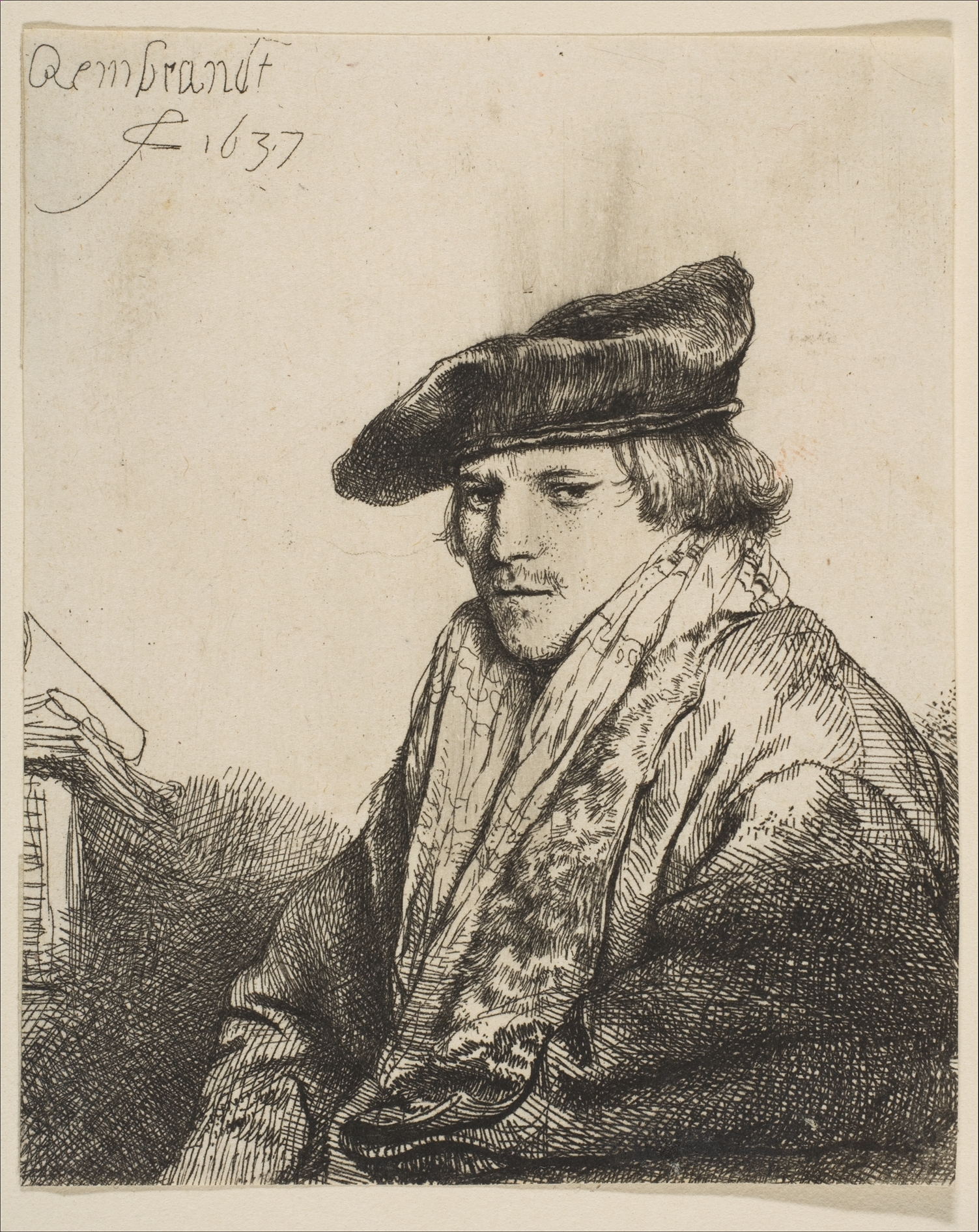
From Etching to Elegance: Deconstructing the Velvet Cap as a Couture Motif
At Katherine Fashion Lab, our mission is to distill the essence of global heritage into wearable art, transforming historical artifacts into contemporary narratives. In this analysis, we turn our attention to Ferdinand Bol’s “Young Man in a Velvet Cap,” a 17th-century etching that transcends its medium to offer profound insights into luxury, identity, and the architecture of form. While the original work is a monochromatic study—a masterclass in line and shadow—its subject, a young man adorned in a sumptuous velvet cap, presents a compelling case study for the modern couturier. This is not merely a portrait; it is a declaration of status, a meditation on texture, and a blueprint for how a single accessory can define an entire silhouette.
Bol, a pupil of Rembrandt, was renowned for his ability to imbue etchings with a tactile richness that rivals oil painting. In this piece, the velvet cap is not an afterthought but the focal point, rendered with meticulous cross-hatching that suggests both the softness of the fabric and the weight of its materiality. For the fashion house, this etching serves as a primal source—a reminder that couture begins with a singular, powerful idea. The cap, with its drooping brim and bulbous crown, evokes a sense of rebellious aristocracy, a young man who is both of his time and timeless. Our analysis will deconstruct this motif across three pillars: materiality, silhouette, and cultural resonance, demonstrating how Bol’s etching informs a new collection that bridges Dutch Golden Age portraiture and modern luxury.
Materiality and the Illusion of Opulence
The etching medium inherently challenges the designer to evoke luxury through absence. There is no color, no fabric swatch—only black ink on paper. Yet Bol achieves a tactile illusion that is the bedrock of high couture. The velvet cap is rendered with dense, parallel lines that create a deep, absorbent blackness, contrasting sharply with the lighter, more delicate strokes defining the young man’s skin and collar. This chiaroscuro effect is a direct parallel to the play of light on actual velvet—a fabric that drinks in light at certain angles and reflects it at others. In our lab, we translate this into a fabric development brief: a custom-woven silk velvet with a variable pile height, dyed in a near-black indigo that shifts to a midnight blue under gallery lighting. The etching’s monochrome palette becomes a constraint that liberates—forcing us to prioritize texture over hue.
Furthermore, the cap’s construction in the etching suggests a soft, unstructured form, perhaps lined with wool or felted beaver fur, a common luxury in 17th-century Netherlands. For our couture interpretation, we propose a deconstructed cap that is less a headpiece and more a sculptural collar or shoulder detail. By isolating the cap’s silhouette—its rounded dome and asymmetrical brim—and reimagining it in liquid metal organza or crushed velvet, we create a piece that echoes the original’s opulence without literal reproduction. The etching’s lines become a pattern for embroidery: a lattice of black silk thread on a matte base, mimicking the cross-hatching technique. This is not costume; it is a conceptual translation where the medium itself—the etching—becomes the textile.
Silhouette and the Architecture of Youth
The young man’s posture in Bol’s etching is one of quiet confidence. His gaze is direct, his shoulders relaxed, but the cap tilts slightly, introducing an element of asymmetry. This asymmetry is a design principle that Katherine Fashion Lab explores in our forthcoming collection. The cap’s brim, which dips lower on one side, creates a dynamic line that breaks the symmetry of the human form. In couture, this translates to a bias-cut gown or a tailored jacket with one shoulder deliberately dropped, echoing the cap’s languid tilt. The etching teaches us that luxury is not in rigidity but in controlled fluidity—a lesson from the Dutch Baroque, where fabric was often depicted in motion, caught in a moment of drape.
The cap also defines the negative space around the face. Bol leaves the young man’s forehead partially obscured, drawing the viewer’s eye to the cheekbones and the shadowed eyes. For our design team, this inspires a series of headpieces and necklines that frame the face without overwhelming it. Consider a velvet hood that merges into a capelet, leaving the collarbone exposed—a nod to the etching’s interplay of concealment and revelation. The silhouette is elongated, vertical, with the cap’s height balancing the width of the shoulders. In our pattern-making, we adopt a similar proportion: a high, rounded shoulder pad that mimics the cap’s dome, paired with a narrow waist. The result is a modern armor—soft, yet imposing—that speaks to the young man’s implied power.
Cultural Resonance and the Global Heritage Narrative
Ferdinand Bol’s etching is a product of the Dutch Golden Age, a period of immense economic and cultural expansion. The velvet cap, often associated with artists, intellectuals, and the merchant class, signifies a democratization of luxury—a time when fashion became a marker of individualism rather than birthright. For Katherine Fashion Lab, this resonates deeply with our commitment to global heritage. The etching is not a relic; it is a conversation starter about identity, appropriation, and reinvention. The young man’s cap, while distinctly European in origin, shares visual DNA with the beret of French bohemians, the taqiyah of the Middle East, and the chaperon of medieval Burgundy. Our collection seeks to honor this universality by weaving these threads together.
In practice, this means collaborating with artisans from regions where velvet-making is a tradition—from the silk weavers of Como, Italy, to the velvet embroiderers of Uttar Pradesh, India. The etching’s black-and-white palette becomes a neutral canvas for these global techniques. We might incorporate hand-block printing inspired by Mughal patterns into the velvet’s surface, or add a fringe of black glass beads that references both Dutch trade beads and West African adornment. The young man’s cap is thus a portal to multiple histories, not a fixed object. Our design process involves deconstructing the etching’s cultural context—its place in the Dutch art market, its relationship to portraiture as a status symbol—and recontextualizing it for a global audience that values heritage as a living, breathing entity.
Moreover, the etching’s status as a standalone study is crucial. It is not part of a larger narrative, but a singular moment of observation. This gives us creative freedom. We are not bound to a historical costume; we are inspired by a gesture, a texture, a line. The young man’s direct gaze challenges the viewer, and by extension, the wearer, to own their identity. In our collection, this translates to a series of looks that are intentionally unfinished—raw edges, exposed seams, and detachable elements that allow the wearer to become the curator. The velvet cap, in its etching form, is a study in potential. Our couture is the realization of that potential.
Conclusion: The Etching as a Living Brief
Ferdinand Bol’s “Young Man in a Velvet Cap” is more than an art historical artifact; it is a design manifesto for the modern couturier. Through its masterful use of line, shadow, and proportion, it teaches us that luxury is not about excess but about intention. The velvet cap, rendered in ink, becomes a symbol of how a single element can anchor an entire composition. At Katherine Fashion Lab, we take this lesson to heart, using the etching as a living brief that informs every aspect of production—from fabric development to silhouette construction to cultural storytelling. The young man’s cap, once a symbol of 17th-century Dutch sophistication, now whispers to a global audience: fashion is eternal, and heritage is always in motion. Our collection is not a reproduction; it is a reinterpretation, an homage to the power of a single, well-drawn line.