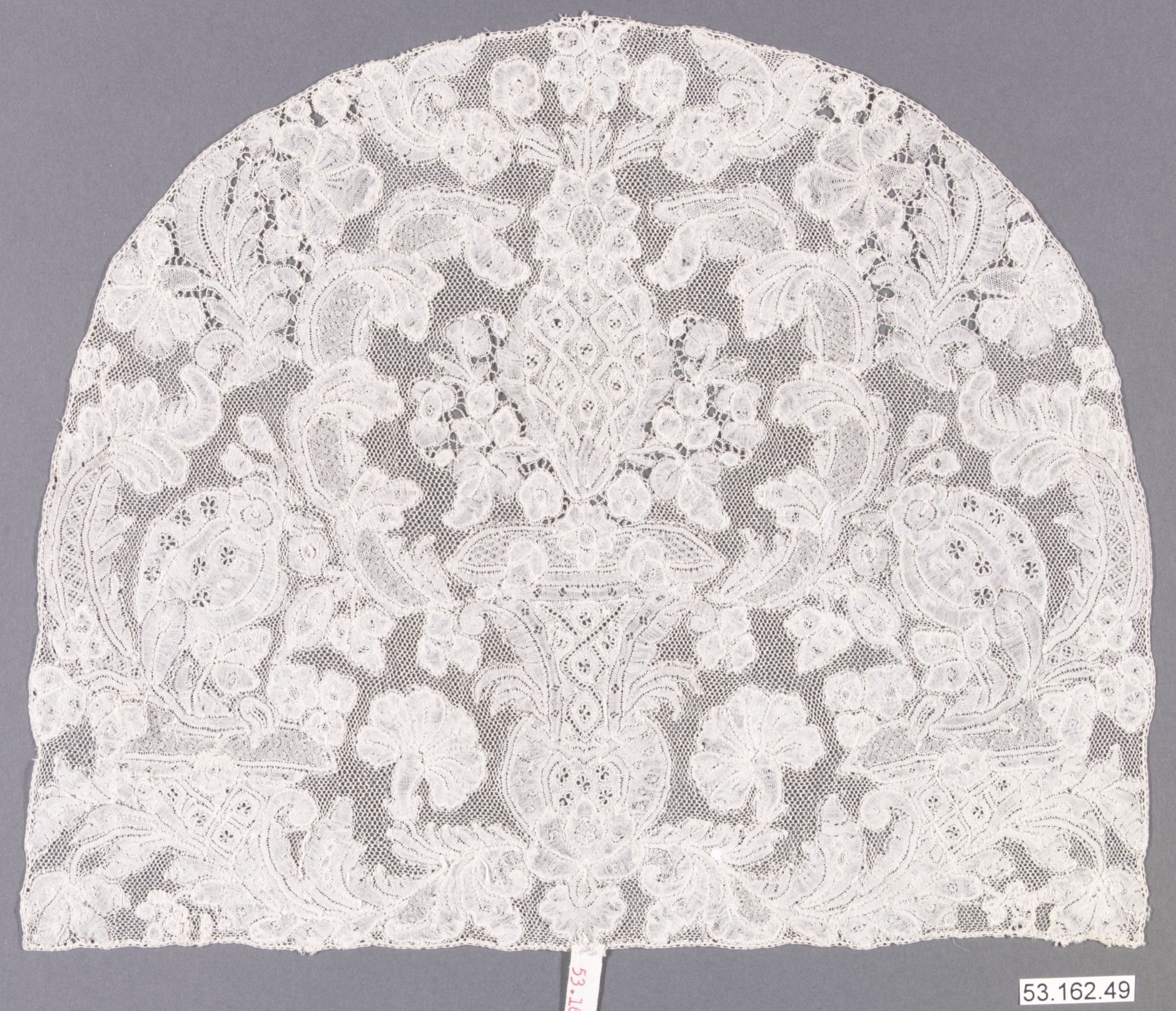
The Cap Crown: An Architectural Study in Bobbin Lace and Point d'Angleterre
In the rarefied world of haute couture, the cap crown—a structural element traditionally associated with millinery and regal headwear—has been reimagined by Katherine Fashion Lab as a standalone artifact of textile engineering. This analysis dissects the cap crown’s evolution from a functional foundation to a sculptural statement, leveraging the intricate techniques of bobbin lace and the ethereal refinement of point d’Angleterre. Drawing from a global heritage that spans European convents, Asian court traditions, and Indigenous weaving practices, the piece exemplifies how historical craftsmanship can transcend geography and time to inform contemporary luxury.
Deconstructing the Cap Crown: Form and Function
The cap crown, at its core, is a domed structure designed to fit the cranial contour, historically serving as the base for hats, tiaras, or veils. In this standalone study, however, Katherine Fashion Lab elevates it from a mere support system to a protagonist. The crown is no longer hidden beneath embellishments; it is the embellishment. Its silhouette—a gentle arc reminiscent of a bird’s egg or a Byzantine dome—is achieved through a meticulous interplay of tension and negative space. The bobbin lace technique, with its twisted and braided threads, creates a lattice that is both rigid and airy, allowing the crown to maintain its shape while appearing almost weightless. This duality is the hallmark of the collection: structural integrity married to ephemeral beauty.
The decision to use bobbin lace as the primary material is a deliberate homage to the labor-intensive traditions of 16th-century Europe, particularly Flanders and Italy, where lace was a marker of status and artistic prowess. Yet, the cap crown’s design also nods to the point d’Angleterre technique, a specific form of bobbin lace that originated in Brussels but was perfected in England. This style is characterized by its fine mesh background and raised, floral motifs, which in Katherine Fashion Lab’s hands become abstract geometric patterns—circles, chevrons, and interlocking loops—that mimic the structural ribs of a crown. The result is a textile that breathes, casting shadows and catching light in a way that static materials cannot.
Global Heritage: A Tapestry of Influences
The cap crown’s global heritage is not merely decorative; it is conceptual. Katherine Fashion Lab’s research draws from the Ming Dynasty’s phoenix crowns, which used gold filigree and kingfisher feathers to signify imperial power, and the Victorian mourning caps of Europe, which employed black silk lace to convey grief and social standing. In this piece, the bobbin lace replaces the metallic threads of the East and the somber silks of the West, creating a universal language of status that is both accessible and exclusive. The point d’Angleterre technique, with its intricate ground netting, echoes the Maori taniko weaving of New Zealand, where geometric patterns in flax fibers tell stories of lineage and land. By integrating these disparate traditions, the cap crown becomes a map of human connectivity, a reminder that couture is never insular but a dialogue across civilizations.
This global perspective is further emphasized by the color palette: a monochromatic spectrum of ecru, ivory, and pearl, which allows the texture of the lace to take center stage. In many cultures, white lace symbolizes purity and transcendence—from the whitework of Indian chikan embroidery to the white-on-white of European bridal veils. The cap crown, therefore, is not just a fashion object; it is a vessel for cultural memory, a silent testament to the hands that have spun, twisted, and knotted threads for centuries.
Materiality and Technique: The Art of Bobbin Lace and Point d’Angleterre
To fully appreciate the cap crown, one must understand the technical demands of its materials. Bobbin lace is crafted by winding threads around weighted bobbins and crossing them over pins stuck in a pillow, following a pattern pricked into parchment. This process is painstakingly slow—a single square inch can take hours—and requires a level of precision that borders on the obsessive. Katherine Fashion Lab sources its lace from master artisans in the Belgian region of Bruges, where the tradition has been preserved since the 15th century. The point d’Angleterre variant, however, introduces a further layer of complexity: it uses a finer thread and a more open ground, creating a “reseau” or network that is almost invisible to the naked eye. This technique allows the cap crown to achieve a transparency that belies its strength, much like a spider’s web.
In the cap crown, the bobbin lace is not merely applied but engineered. The crown’s dome is constructed from multiple segments of lace, each shaped over a wooden mold and then joined with tiny, invisible stitches. The point d’Angleterre motifs—often floral or scroll-like—are strategically placed at the crown’s apex and brim, reinforcing areas of high stress while adding ornamental rhythm. The result is a piece that can be worn as a headpiece, displayed as a sculpture, or even deconstructed into its component parts for study. This versatility is a testament to Katherine Fashion Lab’s philosophy: that couture should be both art and artifact, a living document of human skill.
Contextualizing the Standalone Study
This cap crown is not part of a larger collection; it is a standalone study, a departure from the seasonal cycles of fashion. In this context, the piece functions as a thesis on the value of slowness in an era of fast fashion. By isolating the cap crown from the body and from the runway, Katherine Fashion Lab invites the viewer to consider it as a pure object of design, devoid of commercial pressure. The crown becomes a meditation on form, material, and technique, much like a Renaissance painting studied in a gallery.
Furthermore, the choice to use point d’Angleterre—a technique that nearly disappeared in the 19th century due to industrialization—is a political act. It challenges the notion that innovation must be technological, arguing instead for a revival of handcraft as a form of resistance. The cap crown, with its intricate loops and delicate mesh, stands as a bulwark against the homogenization of global fashion, a reminder that true luxury lies in the time and touch of the human hand.
Conclusion: The Cap Crown as Cultural Archive
In the hands of Katherine Fashion Lab, the cap crown transcends its utilitarian origins to become a cultural archive woven in thread. Through the dual techniques of bobbin lace and point d’Angleterre, it captures the essence of global heritage—from the courts of Europe to the weaving traditions of the Pacific—while asserting a contemporary vision of couture as intellectual pursuit. This standalone study is not merely a hat; it is a manifesto for the preservation of craft, a celebration of the intricate and the ephemeral, and a bold statement that fashion, at its highest level, is an art of profound depth. For the discerning collector, the cap crown is not an accessory but an heirloom, a piece of history that will continue to speak long after the last thread is spun.