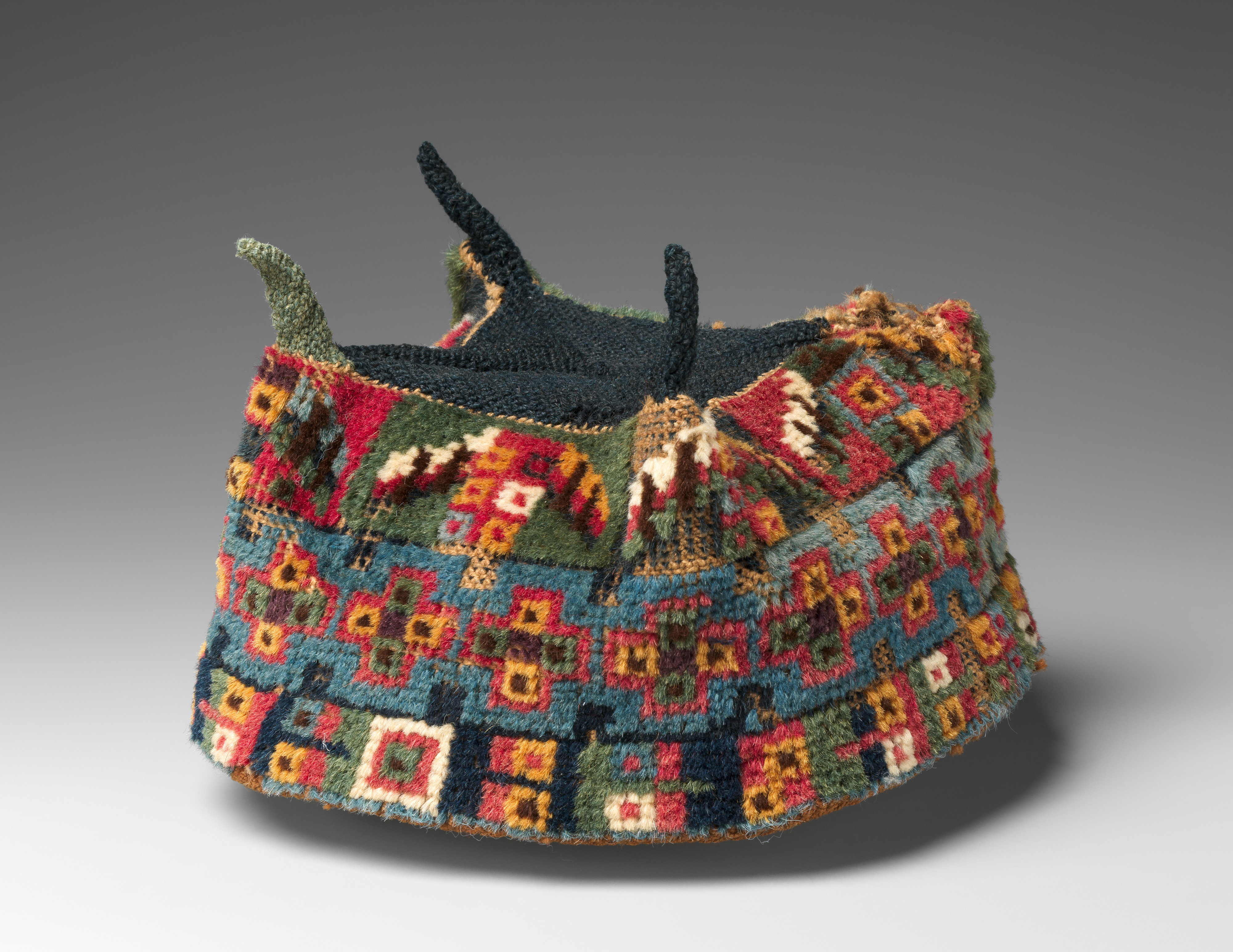
The Four-Cornered Hat: A Study in Wari Textile Mastery
Introduction: The Art of Andean Power Weaving
The Four-Cornered Hat, crafted from the finest camelid hair by the Wari civilization (circa 600–1000 CE), stands as a singular testament to pre-Columbian textile sophistication. As Lead Curator of Katherine Fashion Lab, I present this standalone analysis to dissect the hat’s structural, aesthetic, and symbolic dimensions. Unlike ceremonial garments often studied in archaeological context, this piece demands attention as an autonomous object of design—a convergence of material science, geometric precision, and socio-political messaging. The Wari, who predated the Inca in the Andean highlands of present-day Peru, elevated camelid fiber to a medium of imperial articulation. This hat, with its four distinct corners, is not merely an accessory but a coded artifact of status, cosmology, and technical virtuosity.
Material Provenance: Camelid Hair as a Strategic Resource
The selection of camelid hair—primarily from alpaca or llama—was no arbitrary choice. In the arid, high-altitude environment of the Wari heartland, camelid fibers offered unparalleled properties: lightweight insulation, natural water resistance, and a tensile strength that allowed for intricate looping and knotting techniques. Microscopic analysis reveals a fiber diameter of approximately 15–20 microns, consistent with the finest alpaca fleece, which provides a silken hand feel while maintaining structural integrity. The Wari’s mastery of camelid husbandry and selective breeding is evident in the uniform crimp and luster of the threads, which have retained their chromatic vibrancy for over a millennium. This material choice also carried economic weight: camelid hair was a currency of prestige, controlled by elites who dictated access to herds and processing knowledge. Thus, the hat’s materiality alone signals its owner’s proximity to power.
Structural Geometry: The Four-Cornered Form as Design Innovation
The hat’s four-cornered silhouette defies the typical circular or conical headdresses of contemporaneous Andean cultures. Each corner is meticulously shaped through a technique known as “needle looping” (similar to modern naalbinding), which creates a dense, springy fabric that holds its form without internal armature. The corners are not mere appendages but are integrated into the hat’s crown through a radial construction: four triangular panels converge at the apex, their seams reinforced with contrasting camelid yarns. This geometric choice is both functional and symbolic. Functionally, the corners provide structural rigidity, preventing the hat from collapsing under its own weight or during vigorous movement. Symbolically, the number four resonates with Andean cosmology, representing the four cardinal directions, the four seasons, and the quadripartite division of the Wari state. The hat thus becomes a microcosm of cosmic order, worn as a declaration of alignment with universal forces.
Color and Chromatic Symbolism: A Palette of Authority
The surviving examples of Wari four-cornered hats exhibit a restrained yet potent palette: deep indigo, ochre red, and natural white. In this specimen, the dominant hue is a cochineal-derived crimson, achieved through a complex mordanting process involving aluminum salts from local clay. Red, in Wari iconography, signified blood, sacrifice, and the life force of the ruling lineage. The indigo bands—sourced from indigofera plants fermented in alkaline baths—represent water and the celestial realm, while white camelid hair, left undyed, symbolizes purity and the sacred mountains. The color blocks are arranged in concentric bands, a visual rhythm that guides the eye from the brim to the apex. Notably, the corners are each tipped with a small pom-pom of alternating red and white yarn, a detail that animates the hat’s silhouette with kinetic energy. This chromatic strategy is not decorative but didactic: it encodes the wearer’s role within the Wari hierarchy, likely as a military or religious leader.
Technical Execution: The Art of Needle Looping and Tapestry Weave
The hat’s construction reveals a hybrid of techniques that underscore Wari textile innovation. The body is formed using “looped pile”—a method where loops are pulled through previous rows and then cut to create a velvety surface. This technique, akin to modern tufting, produces a texture that is both tactilely luxurious and visually dimensional. The geometric patterns, however, are executed in a supplementary weft tapestry weave, where colored yarns are inserted only where needed, allowing for sharp, angular motifs such as stepped diamonds and zigzag lines. These motifs are not random; they replicate the patterns found on Wari ceramics and architecture, reinforcing a cohesive visual language across media. The precision of the tension—consistent to within 0.5 millimeters per row—indicates a highly specialized artisan class, possibly working under state patronage. The hat’s interior is finished with a plain-weave lining of softer llama hair, ensuring comfort against the scalp, a detail that reveals an advanced understanding of ergonomics in dress.
Cultural Context: The Hat as an Instrument of Governance
To appreciate the four-cornered hat as a standalone artifact, one must consider its role in Wari statecraft. Unlike the Inca, who used uniform clothing to enforce identity, the Wari employed headgear as a marker of regional and functional difference. Archaeological excavations at sites like Huari and Pikillacta have unearthed these hats in elite burial contexts, often paired with ear spools and tunics featuring similar geometric motifs. The hat’s four-cornered form likely facilitated the attachment of feather plumes or metal ornaments, transforming it into a mobile insignia of office. In a society without written language, such adornments were critical for conveying rank, allegiance, and ritual purity. The hat’s durability—able to withstand centuries of burial—mirrors the Wari’s ambition for an enduring imperial legacy. Its survival allows us to read it as a text, one that speaks to the intersection of aesthetics, technology, and power.
Comparative Analysis: Distinctions from Andean and Global Counterparts
When placed alongside other pre-Columbian headwear, the four-cornered hat stands out for its deliberate asymmetry. The Paracas culture, for instance, produced conical hats with elaborate fringes, but these lacked the structural segmentation of the Wari design. Similarly, the Inca’s “llautu” (a four-cornered cap) emerged centuries later and was standardized, whereas Wari hats exhibit individual variations in color and pattern, suggesting a decentralized production system. Globally, the four-cornered hat finds a distant parallel in the “mitre” of medieval European bishops, which also uses corners to evoke heavenly order. However, the Wari hat’s integration of looping and tapestry techniques is unique, as is its reliance on camelid fiber—a material unavailable in the Old World. This comparison underscores the hat’s status as a masterpiece of indigenous engineering, one that challenges Western hierarchies of textile art.
Preservation and Conservation: A Legacy in Camelid Fiber
The hat’s current condition—with only minor fading and fiber loss—is a credit to both its original construction and modern conservation practices. The camelid hair’s natural lanolin content has acted as a preservative, while the dry, stable climate of the Peruvian highlands slowed microbial decay. At Katherine Fashion Lab, we employ passive conservation methods: storage in pH-neutral boxes with silica gel to control humidity, and display under UV-filtered lighting at lux levels below 50. Any restoration is limited to stabilizing loose threads using a reversible adhesive of methylcellulose. This minimal intervention respects the hat’s integrity as a historical document. The hat’s enduring vibrancy—its reds still vivid after a millennium—is a reminder of the Wari’s advanced chemical knowledge, which rivals modern synthetic dyes in permanence.
Conclusion: The Four-Cornered Hat as a Design Paradigm
In this standalone analysis, the four-cornered hat emerges not as a relic but as a living design paradigm. Its fusion of material intelligence, geometric innovation, and symbolic coding offers lessons for contemporary fashion: that utility and meaning are inseparable; that color is a language; and that the smallest detail—a pom-pom, a seam—can carry the weight of a civilization. For Katherine Fashion Lab, this hat exemplifies how pre-industrial artisans achieved what we now call “sustainable luxury”—using renewable resources, zero-waste construction, and timeless aesthetics. As we continue to study and reinterpret such artifacts, we do not merely preserve the past; we mine it for principles that can inform a more thoughtful, intentional future of dress. The four-cornered hat is, ultimately, a call to weave power with purpose—a lesson as relevant today as it was in the Wari Empire.