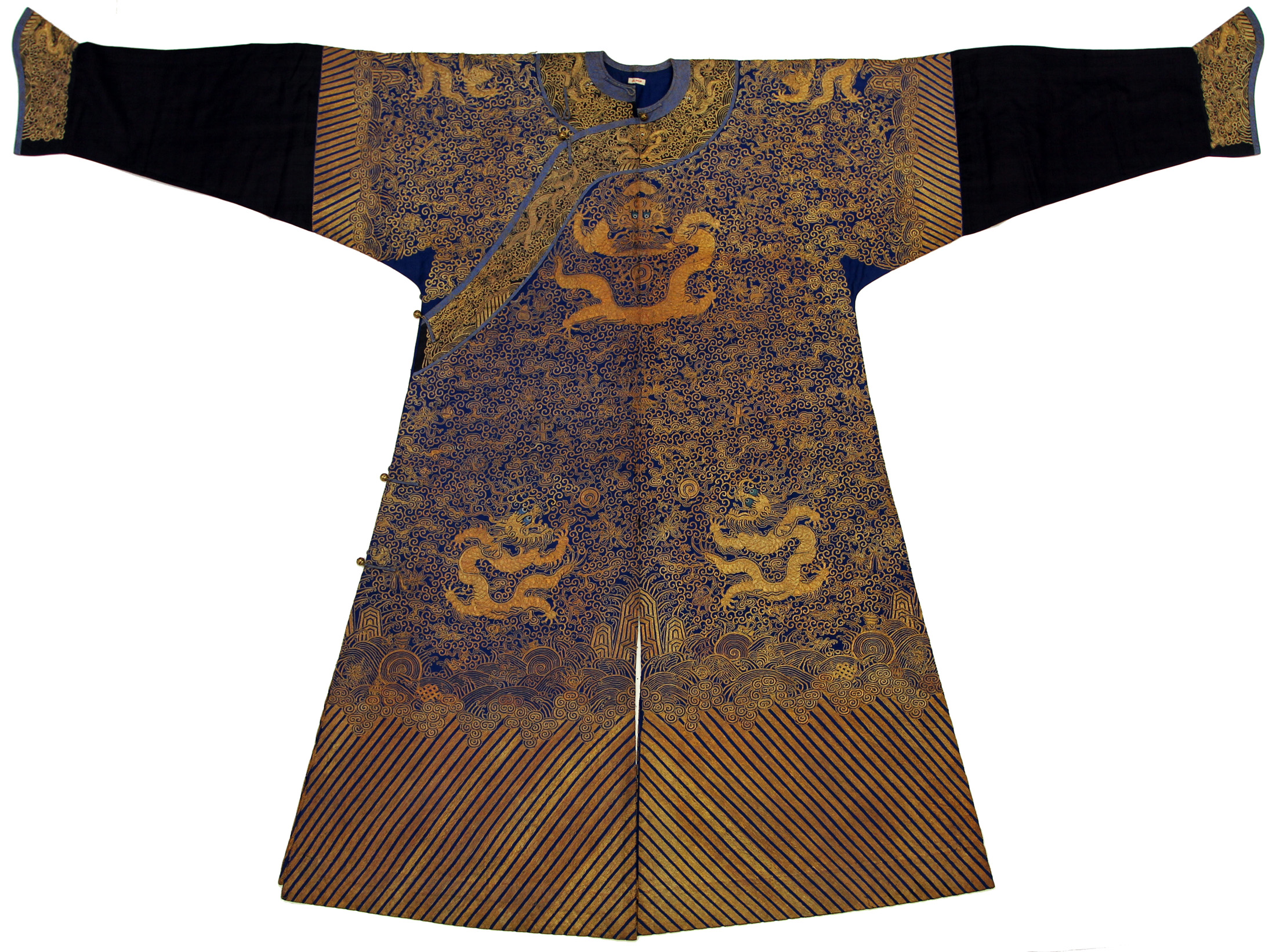
The Sovereign Silhouette: Deconstructing the Imperial Court Robe
In the annals of global couture, few garments command the gravitas of the Chinese Imperial Court Robe. At Katherine Fashion Lab, we approach this artifact not merely as a relic of dynastic power, but as a masterclass in the fusion of material science, symbolic communication, and structural engineering. This standalone analysis dissects the robe’s construction from silk and metallic thread, revealing how its form and ornamentation encode centuries of imperial ideology. For the modern fashion executive, understanding this garment offers profound lessons in brand storytelling, craftsmanship as capital, and the enduring power of sartorial authority.
Material Alchemy: Silk and Metallic Thread
The foundational choice of silk is far from arbitrary. Silk’s natural luster, tensile strength, and thermoregulatory properties made it the optimal canvas for a garment worn during elaborate court ceremonies that could span hours. From a supply-chain perspective, silk represented a state-controlled monopoly, with production secrets guarded under penalty of death. This exclusivity transformed the fabric into a geopolitical asset, akin to a modern luxury conglomerate’s proprietary textile. The robe’s silk base, often a deep imperial yellow or azure, was woven with a satin weave to maximize light reflection, ensuring the emperor appeared luminous, almost ethereal, against the subdued tones of the court.
The integration of metallic thread—typically gilt paper or flattened gold wire wrapped around a silk core—elevated the robe from clothing to treasure. This thread was not merely decorative; it was a declaration of infinite resources. The weight of a fully embroidered robe could exceed fifteen pounds, demanding immense physical endurance from the wearer. This deliberate discomfort reinforced the emperor’s role as a vessel of cosmic duty, enduring hardship for the realm. For the modern designer, this tension between beauty and burden is a critical lesson: true luxury often demands sacrifice, transforming the wearer into a living monument.
Structural Syntax: The Silhouette of Sovereignty
The robe’s construction follows a rigid geometric logic. The cross-collar (jiaoling) and right-side closure (youren) are not stylistic choices but codified rules. The left lapel overlapping the right symbolized the dominance of the living over the dead, a cosmological principle embedded in every stitch. The wide, flowing sleeves—often extending beyond the fingertips—served a dual purpose: they obscured the emperor’s hands, emphasizing that his power was impersonal and absolute, while also providing a sweeping visual field that commanded presence in vast throne halls.
Katherine Fashion Lab’s analysis highlights the robe’s proportional hierarchy. The shoulder-to-waist ratio was deliberately elongated, creating a triangular torso that projected stability and strength. The hem, often trimmed with fur or additional silk bands, anchored the garment to the ground, visually connecting the emperor to the earth. This grounding effect was crucial: the robe was designed to be seen from a distance, often from a lower vantage point, ensuring that the emperor appeared larger than life. In contemporary terms, this is the power of silhouette as branding—a shape that becomes instantly recognizable as authority.
Embroidered Lexicon: The Twelve Symbols of Imperial Authority
The most sophisticated element of the robe is its embroidery program. The Twelve Symbols (shier zhang) are not random motifs but a codified narrative of cosmic and temporal power. Each symbol holds specific meaning, and their placement follows strict rules. For instance, the sun and moon are positioned on the shoulders, representing the emperor’s role as the bridge between heaven and earth. The dragon (long), often the most prominent, is not a beast of destruction but a benevolent rain-bringer, symbolizing imperial benevolence and control over nature.
Other symbols include the phoenix (feng) for virtue, the mountain (shan) for stability, the ax (fu) for decisive judgment, and the fire (huo) for enlightenment. Together, they form a visual constitution, a garment that literally embodies the emperor’s job description. Katherine Fashion Lab’s research reveals that the embroidery technique—often using split-stitch and satin-stitch methods—required months of labor by master artisans. The density of the stitching, sometimes over 30 stitches per square centimeter, created a raised, tactile surface that invited close inspection, rewarding the few allowed near the emperor with a sensory experience of power.
Color as Power: The Chromatic Code of the Court
Color in the Imperial Court Robe is a strategic tool of differentiation. Imperial yellow was reserved exclusively for the emperor and his immediate family. This hue, derived from the gardenia fruit, was chemically unstable and difficult to reproduce, ensuring its scarcity. The color itself symbolized the center of the universe, with the emperor as the pivot point. For lesser ranks, colors shifted: blue for princes, crimson for high officials, and black for lower ranks. This chromatic hierarchy created a visual map of the court’s power structure, readable at a glance.
From a marketing perspective, this is a masterclass in color as intellectual property. The brand “Imperial Yellow” was, in effect, a trademark, enforced by law. Modern luxury brands, from Tiffany’s blue to Hermès’s orange, owe a debt to this ancient strategy of color exclusivity. The robe’s palette also included gold and silver threads, which shifted in hue depending on the light, creating a dynamic visual experience that reinforced the emperor’s otherworldly nature.
Manufacturing as Ritual: The Artisan’s Role
The creation of a single Imperial Court Robe was a bureaucratic and ritualized process. The Imperial Workshops (zaobanchu) in Beijing employed thousands of artisans, each specializing in a single skill: embroidery, dyeing, weaving, or tailoring. The production timeline could span two to three years, with every stage overseen by eunuch supervisors to ensure compliance with sumptuary laws. This system bears striking resemblance to the atelier model of modern haute couture, where a single garment may require hundreds of hours of handwork.
Katherine Fashion Lab’s analysis underscores the economic multiplier of such production. The robe’s creation sustained entire villages of silkworm farmers, gold beaters, and dyers. It was a state-sponsored ecosystem of luxury, where the final garment was the apex of a vast supply chain. For contemporary fashion leaders, this offers a cautionary tale: true craftsmanship cannot be scaled without diluting its essence. The robe’s value derived from its rarity and the invisible labor embedded in every thread.
Legacy and Implications for Modern Couture
The Imperial Court Robe is more than a historical artifact; it is a template for how fashion can encode power, identity, and narrative. At Katherine Fashion Lab, we see its DNA in modern collections that prioritize storytelling through material, color, and silhouette. The robe teaches us that exclusivity is not about price but about access—the emperor’s robe was priceless because it could never be owned by another. For the contemporary brand, this translates into creating garments that are not just worn but experienced, where every stitch tells a story of authority and artistry.
As we deconstruct this sovereign silhouette, we recognize that the robe’s ultimate power lies in its ability to transcend time. It remains a benchmark for how fashion can serve as a medium of governance, memory, and transcendence. In a world of fast fashion and ephemeral trends, the Imperial Court Robe stands as a monument to the enduring value of patience, precision, and purpose.