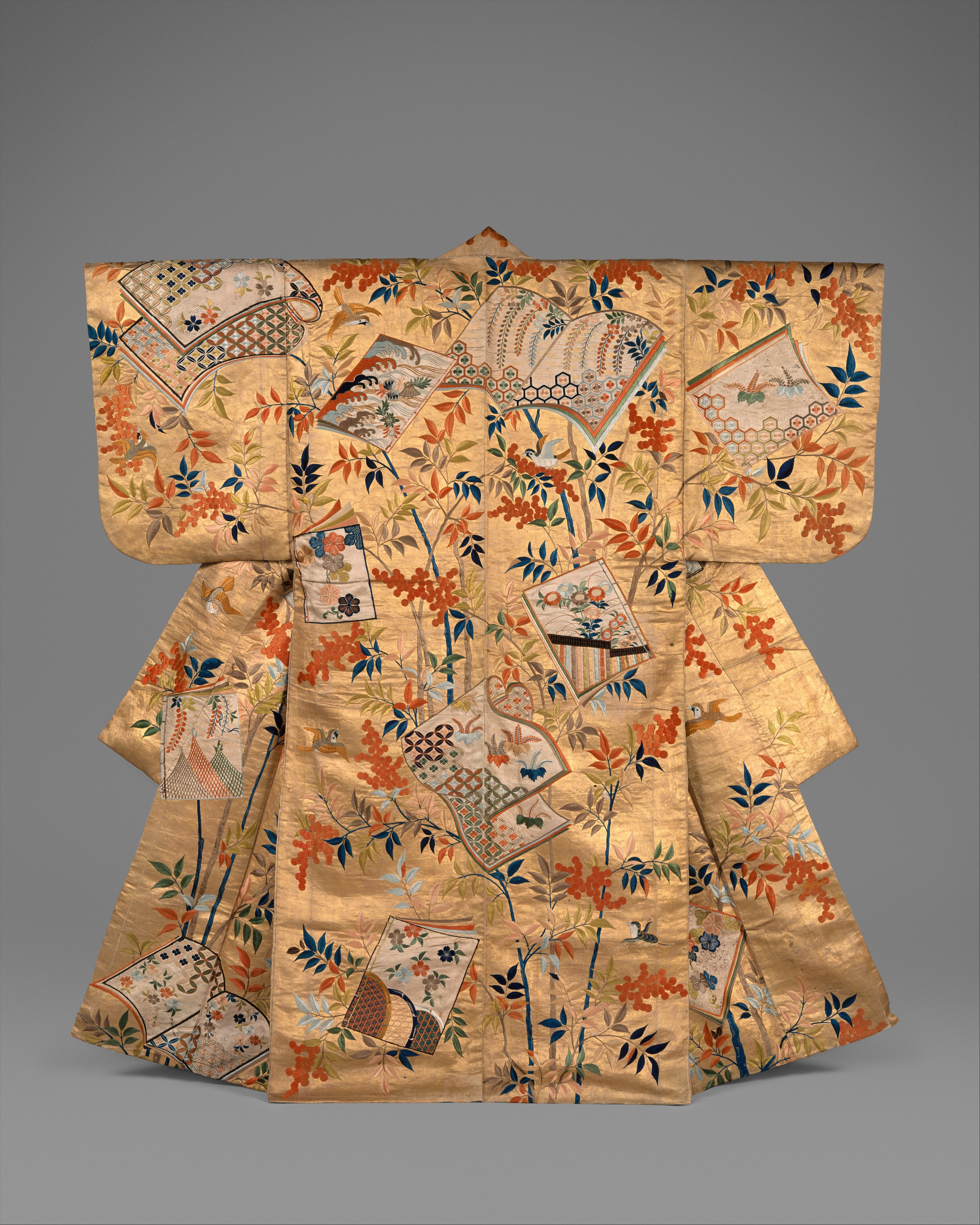
Deconstructing the Nuihaku: A Study in Textile Semiotics and Material Alchemy
Within the rarefied realm of couture analysis, the Noh costume, or nuihaku, presents a profound case study in the confluence of material intelligence, symbolic narrative, and disciplined artistry. This particular specimen, a Nuihaku adorned with Books and Nandina Branches, transcends its theatrical origins to become a standalone treatise on the language of luxury. As a curatorial object, it demands an examination not merely of its aesthetic surface but of its deep structural poetics—the way its material choices, embroidery techniques, and symbolic motifs engage in a complex dialogue about knowledge, nature, and temporality.
Materiality as Foundation: Silk Satin and the Canvas of Light
The foundation of this analysis begins with the ground: silk satin. This is not a passive substrate but an active participant in the garment’s narrative. The satin weave, with its long, floating warp threads, creates a high-gloss, light-reflective surface that behaves as a liquid canvas. It captures and modulates light, causing the overlaid elements to appear as if emerging from or submerging into a luminous pool. This technical choice is strategic. In the subdued, often candlelit environment of the classical Noh stage, this inherent luminosity allowed the performer to become a focal point of ethereal radiance. In a contemporary couture context, studied in isolation, this property translates to an inherent dynamism; the garment’s appearance is never static, shifting with the viewer’s perspective and ambient light, embodying a living, breathing quality that defies the inertness of a mere object.
The Alchemy of Adornment: Embroidery and Metallic Leaf
Upon this luminous ground operates a dual system of adornment: silk embroidery and applied metallic leaf. These are not decorative afterthoughts but distinct textual layers with their own semantic weight. The silk embroidery, likely executed in the nuihaku tradition of flat, delicate stitching, creates a tactile, matte texture. It represents the earthly, the meticulous, the human hand’s patient labor. The depicted motifs—scholarly books and nandina branches—are rendered with botanical and geometric precision, rooting the garment in the recognizable world.
In stark contrast, the metallic leaf—often gold or silver—introduces a element of the sublime and the divine. The application of kirihaku or surihaku (cut or impressed foil) is a technology of light manipulation. Unlike embroidery, which absorbs and softens light, metallic leaf acts as a mirror, creating sharp, brilliant points of reflection. This juxtaposition is a masterclass in textural and luminous contrast. It creates a visual hierarchy on the surface: the embroidered elements provide narrative content and depth, while the metallic elements provide structure, highlight, and a celestial sparkle. This alchemy transforms the silk satin from a fabric into a landscape where the earthly (embroidery) and the heavenly (gold) coexist.
Semiotics of the Motif: The Dialectic of Knowledge and Nature
The chosen motifs elevate this garment from a technical exercise to an intellectual proposition. The combination of books and nandina branches is a deeply resonant symbolic pairing. Books, in the context of Japanese aristocratic and spiritual culture, symbolize scholarship, law, sacred texts (sutras), and the accumulated wisdom of civilization. They represent order, structure, and the human intellect’s attempt to codify the world.
Nandina, or heavenly bamboo, is rich in cultural connotations. It is an evergreen, symbolizing endurance and immortality. Its berries are a vibrant red, a color that wards off evil in Japanese tradition, and its triply compound leaves offer a complex, natural geometry. It represents resilience, protection, and the untamed, cyclical force of nature.
Their juxtaposition on the nuihaku is not accidental. It stages a dialectic between culture and nature, between the constructed order of human knowledge and the organic, persistent vitality of the natural world. The embroidery does not show them in conflict but in elegant coexistence, perhaps even in conversation. This reflects a core tenet in Japanese aesthetics—the seamless integration of cultivated artistry and natural beauty, of fūryū (refined taste) observing and harmonizing with the essence of the season and the environment.
Couture Context: From Theatrical Archetype to Standalone Sculpture
Analyzing this piece as a standalone study, divorced from the performer’s body and the narrative of a specific Noh play, liberates it to be read as pure wearable sculpture. The nuihaku’s construction—typically a loose, T-shaped robe (kosode)—prioritizes the planar display of its textile art over the articulation of the human form. This shifts the focus from silhouette to surface, from fit to field. In contemporary couture terms, this aligns with the conceptual work of designers who treat the garment as a canvas for artistic expression, where the textile itself is the primary protagonist.
The craftsmanship embodies the couture principles of singularity, time-intensive labor, and material excellence. Each stitch in the embroidery, each meticulously applied fragment of metallic leaf, represents an investment of hours that defies industrial replication. The knowledge required to handle the fragile leaf, to blend the stitching techniques, and to balance the composition speaks to a guild-like mastery. This piece, therefore, serves as a historical anchor and a benchmark, reminding us that true luxury lies in the intersection of profound symbolic intent and uncompromising material execution.
Conclusion: A Laboratory for Timeless Principles
For Katherine Fashion Lab, this Noh nuihaku is far more than an archival artifact. It is a functional laboratory demonstrating timeless principles of high creation. It teaches the strategic use of material contrast to create narrative depth. It exemplifies how motif selection can embed a garment with intellectual and cultural resonance. Most importantly, it showcases a holistic design philosophy where every element—from the weave of the ground fabric to the choice of metallic application—is part of a cohesive, intentional system aimed at producing an object of awe, reflection, and enduring beauty. In its silent eloquence, it challenges modern couture to aspire not just to novelty, but to this level of integrated, meaningful, and masterful expression.