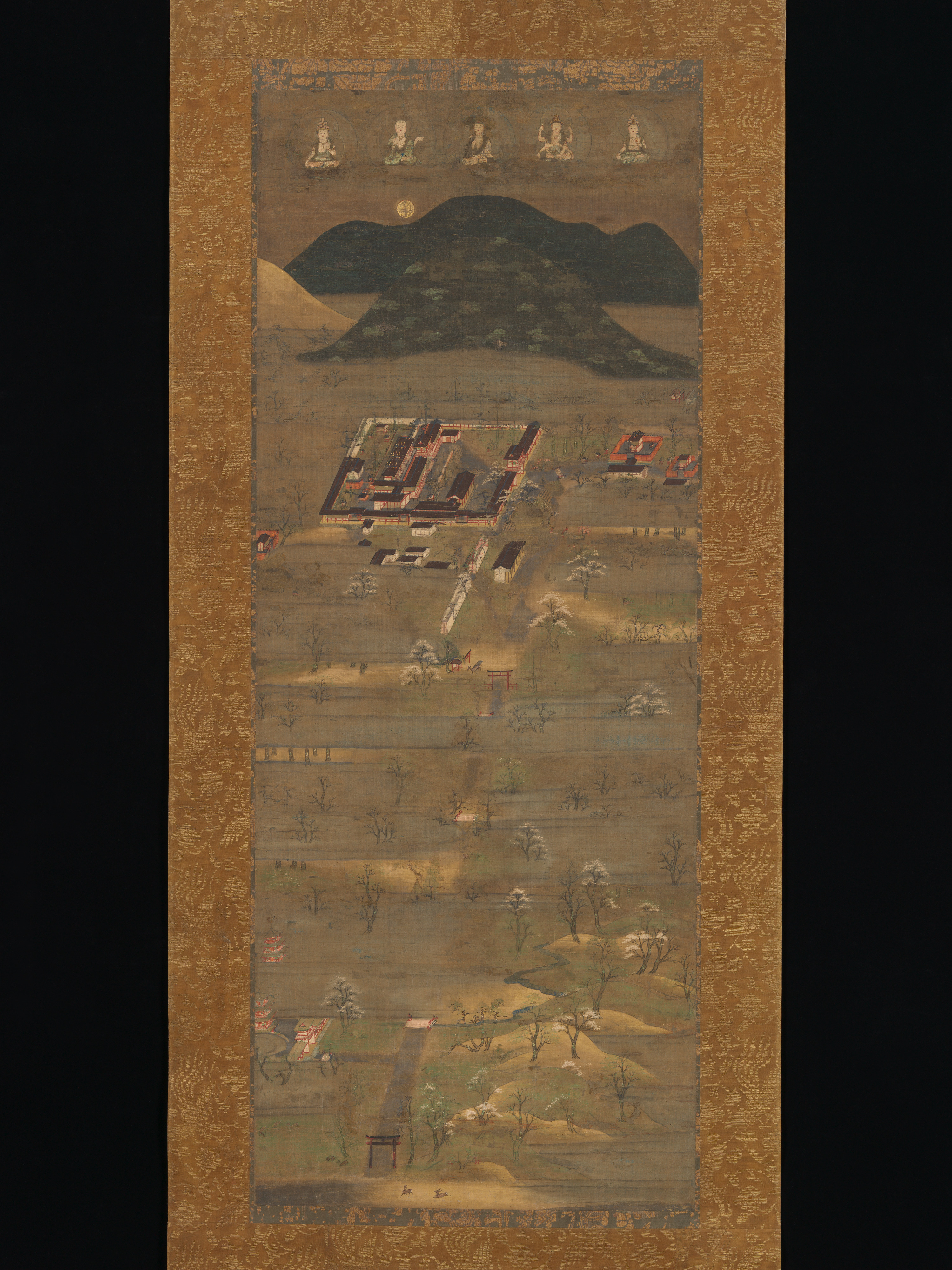
Heritage Analysis: Kasuga Shrine Mandala (Kasuga miya mandara)
The Kasuga Shrine Mandala (Kasuga miya mandara), a hanging scroll executed in ink, color, and gold on silk, represents one of the most sophisticated intersections of spiritual cosmology and aristocratic patronage in medieval Japan. Originating from the Kasuga Taisha shrine complex in Nara, this mandala form flourished from the Heian period (794–1185) into the Kamakura era (1185–1333), serving as both a devotional object and a symbol of the Fujiwara clan’s political and cultural hegemony. For Katherine Fashion Lab’s 2026 high-end luxury strategy, this artifact offers profound insights into how symbolic power, historical adornment, and spiritual meaning can be translated into contemporary luxury narratives that resonate with discerning, culturally literate consumers.
Symbolic Power: The Mandala as Political and Spiritual Authority
The Kasuga Shrine Mandala is not merely a religious icon; it is a carefully constructed visual manifesto of authority. At its center, the Kasuga shrine complex is depicted in a bird’s-eye, quasi-abstract layout, surrounded by sacred Mount Mikasa and framed by the sun, moon, and auspicious clouds. The mandala’s structure aligns with Esoteric Buddhist principles, where the physical site is transformed into a purified realm—a Buddha-land—that simultaneously legitimizes the Fujiwara clan’s divine right to rule. The Fujiwara, who served as regents and dominated the imperial court, claimed Kasuga Taisha as their ancestral shrine, thus embedding their political power within a sacred geography.
For Katherine Fashion Lab, this dual function—spiritual and political—offers a template for brand authority. In 2026, luxury brands must transcend mere aesthetic appeal; they must embody a worldview. The mandala teaches that visual symbolism can encode power hierarchies and ancestral legitimacy. A strategic application would involve crafting a “brand mandala”—a cohesive visual system that layers heritage motifs (e.g., the shrine’s iconic vermilion pillars, sacred deer, or wisteria crests) to convey lineage, exclusivity, and timeless authority. This approach positions the brand not as a commodity but as a custodian of cultural memory.
Historical Adornment: Silk, Gold, and the Art of Precious Materials
The materiality of the Kasuga Shrine Mandala is central to its allure. Painted on silk with mineral pigments and gold leaf, the scroll exemplifies the Japanese aesthetic of “kintsukuroi”—the valorization of precious materials as carriers of spiritual and social value. The gold outlines and cloud patterns not only illuminate the divine realm but also signify the wealth and patronage of the Fujiwara court. Silk, imported from China, was a luxury commodity accessible only to the elite, making the mandala a statement of both devotion and status.
In the context of 2026 high-end luxury, this historical adornment strategy directly informs material selection and craftsmanship. Katherine Fashion Lab can draw inspiration by prioritizing artisanal techniques that echo the mandala’s meticulous layering: hand-painted silk scarves with gold-leaf accents, embroidered panels using precious metal threads, or limited-edition garments that mimic the scroll’s celestial composition. The key is to treat materials as narrative carriers—each thread, pigment, and metal element should tell a story of provenance, rarity, and sacred intention. This aligns with the growing luxury consumer demand for “slow luxury” and tangible heritage.
Spiritual Meaning: The Mandala as a Meditative and Transformative Object
Beyond its political and material dimensions, the Kasuga Shrine Mandala functions as a spiritual technology. In Esoteric Buddhist practice, mandalas are visual aids for meditation, allowing the practitioner to mentally “enter” the sacred space and achieve union with the divine. The Kasuga mandala specifically blends Shinto and Buddhist iconography, reflecting Japan’s syncretic religious culture. Deer, considered sacred messengers of the Kasuga deity, appear alongside Buddhist bodhisattvas, creating a layered spiritual cosmology that invites contemplation and transcendence.
For Katherine Fashion Lab, this spiritual dimension offers a powerful differentiation in the luxury market. The 2026 consumer seeks not just products but experiences of meaning. A luxury line inspired by the Kasuga mandala could incorporate ritualistic design elements: garments with hidden motifs that reveal themselves only upon close inspection, accessories that function as personal talismans, or packaging that unfolds like a mandala, encouraging a mindful unboxing ritual. The brand can position itself as a guide to inner transformation, using design to facilitate moments of stillness and reflection in a chaotic world. This taps into the growing trend of “wellness luxury” and spiritual materialism.
2026 High-End Luxury Strategy: Translating the Kasuga Mandala into Brand Equity
To operationalize these insights, Katherine Fashion Lab should adopt a three-tiered strategic framework for 2026: Heritage Anchoring, Material Poetry, and Ritual Engagement.
Heritage Anchoring
Establish the Kasuga Shrine Mandala as a foundational reference for a capsule collection or flagship narrative. This involves commissioning scholarly essays, collaborating with Japanese art historians, and producing a short film that decodes the mandala’s symbolism. The goal is to position the brand as a cultural curator, not a mere appropriator. Authenticity is paramount; any use of motifs must be respectful and contextualized, ideally with a portion of proceeds supporting Kasuga Taisha’s preservation.
Material Poetry
Develop a “sacred materials” palette inspired by the mandala: silk, gold leaf, cinnabar red, indigo blue, and deer-leather accents (ethically sourced). Garments and accessories should feature hidden symbolic details—embroidered deer, cloud patterns, or shrine silhouettes—that reward connoisseurship. Limited-edition pieces could be numbered and accompanied by a certificate of authenticity referencing the mandala’s historical provenance.
Ritual Engagement
Create a “Mandala Experience” for VIP clients: private viewings of the scroll at a museum or cultural institution, followed by a meditation session led by a Zen practitioner, and culminating in a bespoke fitting. This transforms the purchase into a rite of passage, reinforcing the brand’s role in the client’s personal journey. Digital extensions could include an augmented reality app that overlays the mandala’s iconography onto the client’s space, blending heritage with technology.
Conclusion: The Mandala as a Blueprint for Timeless Luxury
The Kasuga Shrine Mandala is far more than a historical artifact; it is a masterclass in how visual culture can encode power, beauty, and transcendence. For Katherine Fashion Lab, this 13th-century scroll offers a strategic blueprint for 2026 luxury: one that marries symbolic depth with material excellence, and spiritual resonance with commercial viability. By honoring the mandala’s layered meanings—political, aesthetic, and sacred—the brand can create offerings that are not only desirable but enduring. In an era of ephemeral trends, the Kasuga Mandala reminds us that true luxury is eternal, rooted in the sacred geometry of culture and the human longing for meaning.