Deconstructing the Embroidered Coverlet: A Couture Analysis of Textile Narrative
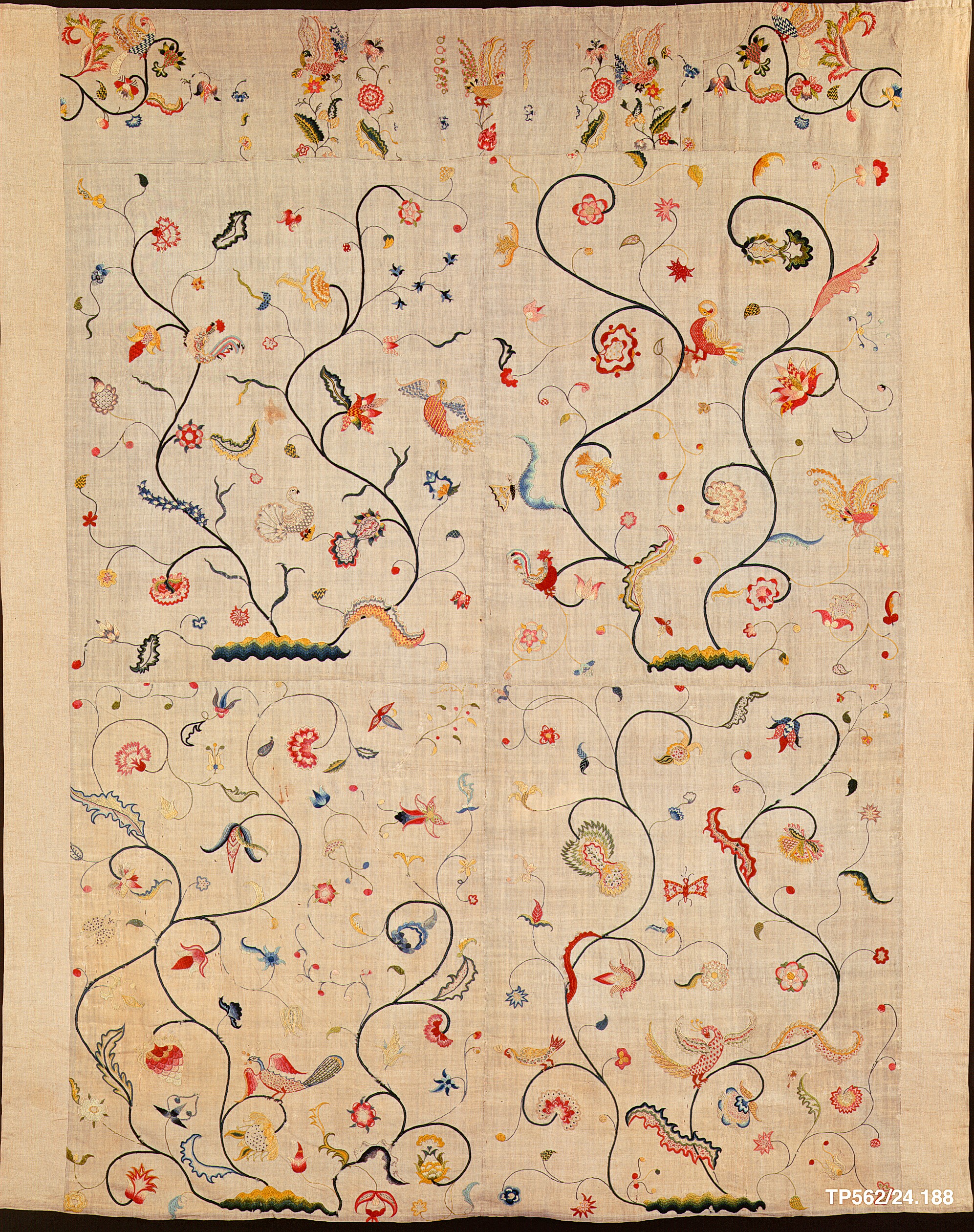
The embroidered coverlet, a seemingly humble household textile, emerges as a profound artifact of couture-level craftsmanship when examined through the lens of Katherine Fashion Lab’s curatorial rigor. This analysis focuses on a specific specimen: a linen ground, meticulously embroidered with wool, of American or British origin, intended for standalone study rather than as part of a larger ensemble. Such a piece transcends its utilitarian origins, serving as a canvas for narrative, technical mastery, and socio-economic expression. In the context of fashion history, it is not merely a bed covering but a wearable—or displayable—textile that embodies the intersection of art, labor, and identity.
Materiality and Craft: Linen and Wool as Mediums of Expression
The choice of linen as the base fabric is itself a statement of durability and prestige. Linen, derived from flax fibers, was historically labor-intensive to produce, requiring retting, scutching, and heckling—processes that yielded a fabric renowned for its strength, breathability, and subtle luster. In both American and British contexts, linen was a marker of domestic industry and, often, of wealth, as it could be produced on estate farms or imported from continental Europe. The warp and weft of this coverlet’s linen ground reveal a tight, even weave, suggesting a high-quality hand-loomed or early industrial production. The fabric’s off-white patina, developed over decades or centuries, adds a layer of historical authenticity that no synthetic replica could replicate.
The wool embroidery thread introduces a contrasting tactile and visual dimension. Wool, with its natural crimp and ability to absorb dyes deeply, allows for rich, saturated colors—frequently indigo blues, madder reds, and weld yellows in period pieces. The interaction between the smooth, cool linen and the soft, warm wool creates a dynamic surface that invites touch. This haptic quality is essential to the coverlet’s function as a standalone study object; it demands physical engagement, not just visual appreciation. The embroidery stitches—likely crewel work, characterized by two-ply wool and a variety of techniques including stem stitch, satin stitch, and French knots—demonstrate a sophisticated understanding of tension and texture. Each stitch is a deliberate act, a micro-decision that contributes to the overall composition.
Design Vocabulary: Narrative Through Motif and Composition
The embroidered motifs on this coverlet are not arbitrary decorations but a lexicon of cultural symbols. In American examples, common themes include floral bouquets, vines, and fruit, often inspired by English crewel work patterns or imported design books. British coverlets, conversely, might feature more heraldic or pastoral scenes, such as stylized trees, birds, and geometric borders. The specimen under analysis presents a central medallion of a flowering tree, flanked by symmetrical scrolling vines and stylized blossoms—a composition that echoes the Jacobean tradition of the “Tree of Life.” This motif carries deep symbolic weight: it represents fertility, growth, and the interconnectedness of nature and domestic life. For a standalone study, the absence of a functional bed frame allows the viewer to focus entirely on this narrative, unencumbered by context.
Color usage further enriches the narrative. The wool threads here employ a restrained palette of indigo, rust, and cream, with occasional accents of sage green. This chromatic choice suggests a period of production between the late 18th and mid-19th centuries, when natural dyes dominated. The indigo, sourced from woad or imported indigofera, was a costly and prestigious pigment, often reserved for special commissions. The rust, derived from madder root, provides warmth, while the cream of the unbleached wool offers contrast. The balance of these hues indicates a designer who understood color theory intuitively, using value and saturation to create depth without overwhelming the linen ground.
Technical Execution: The Couture of Stitch and Structure
From a couture perspective, the coverlet’s construction is as significant as its design. The embroidery is executed on a single piece of linen, with no piecing or seams—a testament to the weaver’s ability to produce a broad width of fabric, or to the embroiderer’s skill in working on a large, uninterrupted surface. The stitches are uniformly small and even, indicating the use of a frame or tambour to maintain tension. This precision is akin to the haute couture techniques of petit point or broderie anglaise, where every millimeter is controlled. The reverse side of the coverlet, often overlooked, reveals a chaotic yet organized tangle of wool threads—a “wrong side” that tells its own story of labor and efficiency. In couture, the inside of a garment is as important as the outside; here, the reverse side is a diary of the embroiderer’s hand movements, showing where threads were carried across open spaces or knotted to prevent unraveling.
The structural integrity of the coverlet is maintained through the density of the embroidery. In areas of heavy stitch coverage, the linen is reinforced, preventing distortion over time. This functional aspect elevates the piece from mere decoration to engineering. The edges are finished with a simple hem, hand-stitched with linen thread, further emphasizing the object’s intended longevity. For a standalone study, this durability allows the coverlet to be handled, examined, and displayed without the risk of damage—a critical feature for archival or educational purposes.
Historical and Socio-Economic Context: The Coverlet as Social Text
To fully appreciate this coverlet, one must situate it within the socio-economic fabric of its time. In both America and Britain, such textiles were produced by women—either as part of domestic education, as commissioned work by professional embroiderers, or as expressions of personal creativity. The coverlet’s size (typically 90 by 100 inches) and complexity suggest it was not a daily-use item but a “best” piece, displayed on special occasions or passed down as an heirloom. It functioned as a marker of status, taste, and skill. For a standalone study, the object becomes a primary source for understanding gender roles, economic conditions, and aesthetic preferences of its era.
In the American context, the coverlet might have been created in a colonial or early federal household, where women’s needlework was a celebrated accomplishment. The British counterpart, particularly from the 17th and 18th centuries, often emerged from professional workshops or aristocratic estates. The choice of wool embroidery on linen, rather than silk on satin, indicates a middle-to-upper-class provenance—neither the poorest nor the richest, but a stratum that valued both utility and beauty. This economic nuance is crucial for a couture analysis, as it highlights how luxury is not solely defined by material cost but by the investment of time and skill.
Implications for Contemporary Fashion and Textile Study
As a standalone object of study, this embroidered coverlet offers rich insights for modern fashion designers and textile scholars. Its techniques—crewel work, natural dyeing, hand-finishing—are increasingly relevant in an era of slow fashion and artisanal revival. The coverlet’s narrative power, achieved through motif and color, challenges contemporary designers to imbue their work with meaning beyond the visual. Moreover, the object’s materiality—the feel of linen against wool, the sight of stitches forming a story—reminds us that fashion is fundamentally tactile and temporal.
In conclusion, this American or British embroidered coverlet, rendered in linen and wool, is a masterpiece of couture-level textile art. Its analysis reveals a convergence of material science, design intelligence, and cultural significance. For Katherine Fashion Lab, it stands as a testament to the enduring power of handcraft, a silent but eloquent document of human creativity. As a standalone study, it invites us to look, touch, and reflect—a textile that, though no longer covering a bed, continues to cover a world of meaning.