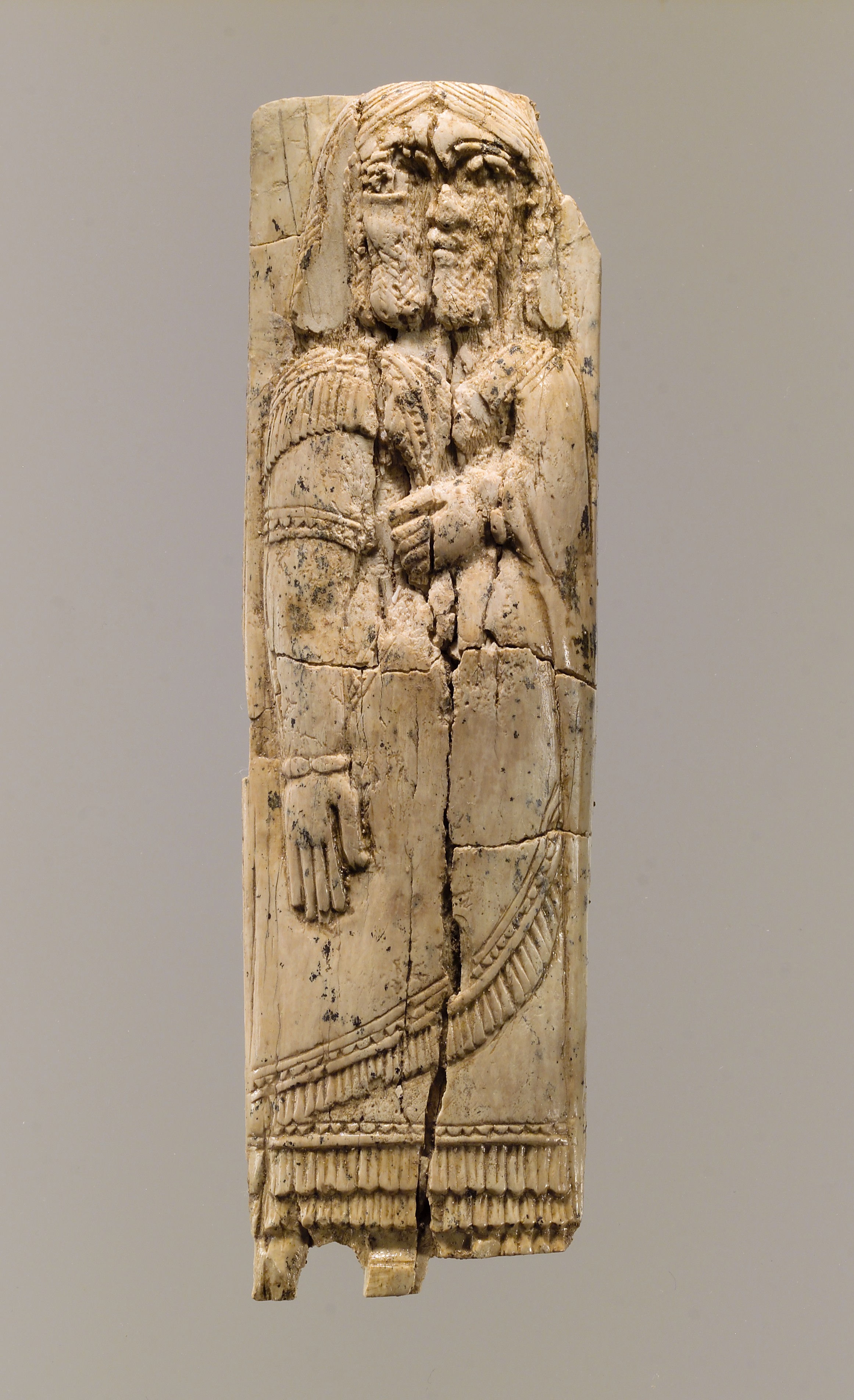
The Ivory Throne: Deconstructing the Assyrian Furniture Plaque as a Masterclass in Couture Narrative
In the hallowed archives of ancient craftsmanship, few artifacts speak with the silent eloquence of the Assyrian furniture plaque. Carved from elephant ivory during the height of the Neo-Assyrian Empire (c. 9th–7th century BCE), this small yet commanding relief—depicting a figure in regal posture—transcends its functional origin as a decorative inlay for thrones, beds, or ceremonial furniture. For the modern couturier, this plaque is not merely an archaeological curiosity; it is a primer in narrative construction, a lesson in material hierarchy, and a blueprint for the fusion of power and adornment. At Katherine Fashion Lab, we analyze this artifact not as a relic, but as a foundational text in the language of luxury.
The Material as Message: Ivory and the Economics of Scarcity
Ivory, in the Assyrian context, was far more than a medium—it was a declaration of imperial reach. Sourced from African elephants and Syrian elephants (now extinct), its acquisition required vast networks of trade, tribute, and conquest. The plaque’s materiality speaks to a couture principle we hold sacred: scarcity creates value, but provenance creates narrative. The warm, honeyed patina of aged ivory, with its subtle grain and capacity for fine detail, allowed the carver to render the figure’s musculature, drapery, and facial features with a precision that rivals contemporary haute couture embroidery.
For the modern designer, the lesson is clear: the fabric is the first story. Just as a silk from Como or a cashmere from Inner Mongolia carries geographic and artisanal weight, the Assyrian plaque’s ivory announces a global supply chain that predates globalization by millennia. The plaque’s survival—its chips, cracks, and discoloration—adds a layer of patina-as-authenticity, a concept we at Katherine Fashion Lab integrate into our distressed leathers and hand-finished textiles. The imperfection is not a flaw; it is a chronicle of endurance.
Compositional Grammar: The Figure as a Couture Silhouette
The plaque’s relief carving presents a figure—likely a royal attendant, a deity, or a tribute bearer—in a static yet imposing stance. The posture is frontal, shoulders broad, hips narrow, with one arm raised in a gesture of offering or blessing. This hieratic frontality is not a limitation but a deliberate choice: it commands attention, much like a couture gown’s architectural structure. In our analysis, the figure’s silhouette echoes the power-shoulder aesthetic of the 1980s, but with a gravity that transcends fashion cycles.
Key details demand scrutiny:
- The headdress: A conical or rounded cap, possibly of felt or metal, frames the face with geometric precision. Its verticality elongates the figure, creating a visual line that draws the eye upward—a trick we employ in our evening wear through elongated necklines and high collars.
- The garment: A fringed shawl or robe, carved with incised lines that simulate woven texture. The fringe is not mere decoration; it is a status marker, as elaborate fringe in Assyrian art indicated rank and wealth. In couture, fringe serves the same purpose: it announces motion, luxury, and labor intensity.
- The hands: Carved with exaggerated fingers, one holding a lotus or a cone—symbols of fertility and purification. This gestural language is the equivalent of a couture accessory: the fan, the glove, the sculptural clutch. Every element must carry meaning.
The plaque’s shallow relief—barely a centimeter deep—creates a play of light and shadow that we replicate through strategic draping and underlayers. The carver understood that the eye reads depth through contrast; the couturier applies the same principle with pleats, tucks, and appliqué.
Proportion and Hierarchy: The Couture Proportion System
One of the most sophisticated aspects of the Assyrian plaque is its deliberate distortion of proportion. The head is oversized relative to the body, the eyes are large and almond-shaped, and the shoulders are broader than anatomically possible. This is not primitive error; it is a visual code for power and divine favor. In couture, we call this the idealized silhouette—the exaggeration of certain features to convey status, beauty, or ideology.
For instance, the plaque’s enlarged eyes—a hallmark of Assyrian art—suggest divine vision and vigilance. In our collections, we achieve a similar effect through exaggerated shoulder pads, cinched waists, and lengthened limbs via high-waisted trousers or floor-sweeping hems. The plaque teaches us that proportion is a tool of persuasion, not a mirror of reality.
The figure’s placement within the plaque’s rectangular frame is equally deliberate. Centered, with ample negative space above and below, the figure becomes a monument. This isolation is a couture strategy: a single, powerful garment on a minimalist runway, or a solitary gown in a gallery-like showroom. The frame is not a constraint; it is a stage.
Narrative and Symbolism: The Garment as a Story
The plaque is not merely decorative; it is narrative architecture. The figure’s gesture—offering a pine cone or lotus—references the Assyrian sacred tree motif, symbolizing fertility, rebirth, and the king’s role as mediator between gods and men. Every couture collection tells a story, but the Assyrians understood that the story must be embedded in the structure, not just the theme.
At Katherine Fashion Lab, we deconstruct this narrative layer by layer:
- The base layer (the plaque itself): The material and its origins. For us, this is the fabric—its weave, its weight, its history.
- The middle layer (the carving): The technique. For us, this is the cut, the seam, the embroidery—the artisanal hand that transforms cloth into form.
- The surface layer (the gesture and symbols): The meaning. For us, this is the color palette, the embellishment, the accessory—the semiotics that communicate status, identity, or rebellion.
The plaque’s function—as part of a throne or bed—also speaks to contextual luxury. A couture garment is not worn in a vacuum; it is worn in a room, at an event, for a purpose. The Assyrian plaque’s original setting—a palace interior, likely gilded and painted—amplified its impact. Similarly, a Katherine Fashion Lab gown is designed for a specific moment: a gala, a wedding, a biennale. The environment is part of the design.
The Modern Couture Translation: From Ivory to Innovation
How does this ancient plaque inform a 21st-century collection? At Katherine Fashion Lab, we extract three core principles:
- Material as manifesto: Just as ivory signaled imperial power, our use of sustainable, rare, or innovative materials—from lab-grown diamonds to recycled ocean plastics—signals a new kind of status: ethical luxury. The plaque’s ivory, now a prohibited material, reminds us that scarcity must be redefined through creativity, not exploitation.
- Silhouette as identity: The plaque’s exaggerated proportions are a statement of intent. In our collections, we use architectural draping, asymmetric cuts, and voluminous sleeves to create silhouettes that are instantly recognizable. The figure’s frontality becomes a brand signature—a visual shorthand for power.
- Detail as devotion: Every incised line on the plaque required hours of labor. In couture, hand-embroidery, beadwork, and pleating are the modern equivalents. The plaque’s fringe, carved with painstaking precision, finds its echo in our hand-knotted tassels and micro-pleated panels. The lesson: luxury is measured in hours, not inches.
Conclusion: The Plaque as a Couture Artifact
The Assyrian furniture plaque with figure in relief is not a static historical object; it is a living textbook for the couturier who seeks to understand the eternal principles of adornment, power, and narrative. At Katherine Fashion Lab, we view this ivory fragment as a precursor to the runway—a testament to the fact that clothing, like carving, is a form of storytelling in three dimensions. The plaque’s figure, frozen in a gesture of offering, offers us a timeless lesson: couture is not about covering the body; it is about elevating the spirit. And in that elevation, we find our own voice, carved from the same desire to create something that endures beyond the moment.