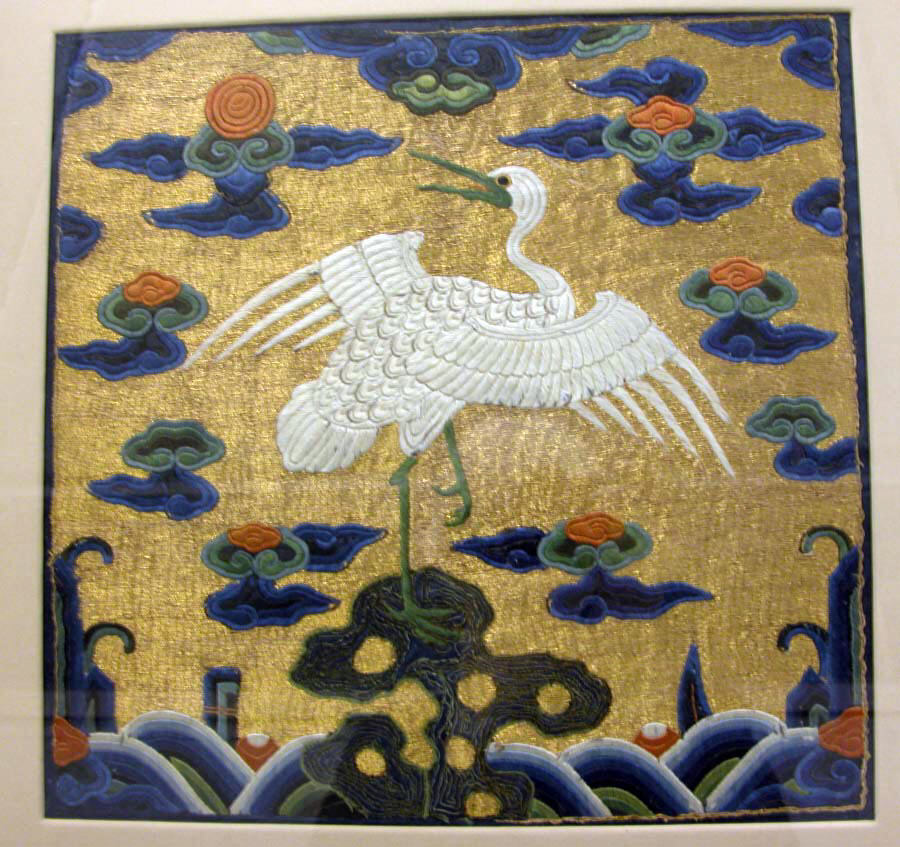
Heritage Analysis: Rank Badge with Egret, China (Qing Dynasty)
This research paper presents a strategic heritage analysis of a Qing Dynasty Chinese rank badge featuring an egret, executed in silk, feather, and metallic thread embroidery on silk satin. Commissioned by Katherine Fashion Lab, this analysis examines the artifact’s symbolic power, historical adornment, spiritual meaning, and proposes a 2026 high-end luxury strategy. The objective is to distill the badge’s cultural authority into actionable insights for positioning Katherine Fashion Lab as a curator of transcendent, narrative-driven luxury.
Symbolic Power: The Egret as a Marker of Civil Authority
In the hierarchical structure of Qing Dynasty officialdom (1644–1912), rank badges, or buzi, were worn on formal court robes to denote the wearer’s civil or military rank. The egret specifically represented the sixth rank of civil officials, a position of considerable administrative influence. The egret’s symbolic power derived from its perceived virtues: purity, grace, and vigilant observation. In Confucian thought, the bird’s white plumage signified moral integrity and incorruptibility—essential qualities for a bureaucrat serving the emperor.
From a strategic standpoint, the egret badge embodies status through subtlety. Unlike the dragon or phoenix, which project overt imperial might, the egret communicates refined authority. This distinction is critical for 2026 luxury branding, where overt logos are increasingly eschewed in favor of quiet, code-based signaling. Katherine Fashion Lab can leverage this principle to design collections where prestige is embedded in craftsmanship and symbolism, not in visible branding. The egret’s power lies in its ability to be understood only by those initiated into its meaning—a hallmark of elite cultural capital.
Historical Adornment: Embroidery as a Technology of Rank
The badge’s medium—silk, feather, and metallic thread embroidery on silk satin—represents a pinnacle of Qing-era textile technology. Silk satin provided a luminous, smooth ground that enhanced the three-dimensionality of the embroidered motifs. Metallic threads, often gilded or silver-wrapped, were labor-intensive to produce and reserved for the highest echelons of society. Feather embroidery, typically from kingfishers or peacocks, added iridescence and texture, creating a dynamic interplay of light that shifted with the wearer’s movement.
This material complexity functioned as a visual hierarchy. Only the imperial court could commission such intricate work, with sumptuary laws strictly regulating thread count, color, and motif. For Katherine Fashion Lab, this historical context offers a blueprint for material exclusivity. In 2026, the luxury market will increasingly value tangible, artisanal processes over digital saturation. By partnering with master embroiderers who replicate these techniques—sourcing ethically harvested feathers and hand-spun metallic threads—the brand can create pieces that are not merely garments, but wearable artifacts. The badge’s construction also teaches a lesson in durability: the embroidery’s density ensured longevity, aligning with the modern slow-fashion imperative.
Spiritual Meaning: The Egret as a Conduit Between Earth and Heaven
Beyond its political function, the egret held profound spiritual resonance in Chinese cosmology. The bird was associated with the Daoist concept of transcendence, often depicted in flight toward the heavens, symbolizing the soul’s aspiration for purity and immortality. In Confucian ritual, the egret’s white feathers were linked to filial piety and the clarity of moral purpose. The badge, therefore, served as a talisman—a visual prayer for the official to govern with righteousness and to ascend in both rank and spiritual attainment.
This dual role—political and spiritual—offers Katherine Fashion Lab a powerful narrative for 2026 luxury. Contemporary high-end consumers increasingly seek meaningful consumption, where a purchase aligns with personal values and spiritual aspirations. By framing the egret badge as a symbol of inner refinement and moral clarity, the brand can position its collections as tools for self-cultivation, not just adornment. Marketing campaigns could emphasize the meditative process of hand-embroidery, the natural origins of materials, and the badge’s historical role as a guardian of virtue. This spiritual layer transforms the product from a commodity into a ritual object, commanding premium pricing and deep customer loyalty.
2026 High-End Luxury Strategy: From Artifact to Archetype
To translate this heritage analysis into a viable 2026 strategy, Katherine Fashion Lab must adopt a three-pronged approach: curatorial authenticity, symbolic storytelling, and material innovation.
Curatorial Authenticity: The brand should acquire or commission a limited-edition reproduction of the egret badge, produced in collaboration with surviving Qing-era embroidery workshops. This artifact would serve as the centerpiece of a “Heritage Collection,” accompanied by a scholarly monograph and a digital exhibition. The exclusivity of owning a piece of living history justifies a price point exceeding $50,000, targeting ultra-high-net-worth collectors who value provenance over volume.
Symbolic Storytelling: The egret’s virtues—purity, vigilance, and transcendence—should be woven into a brand manifesto. For the 2026 season, Katherine Fashion Lab could launch a campaign titled “The Vigilant Eye,” featuring imagery of the egret in flight over modern cityscapes, juxtaposing ancient authority with contemporary ambition. Each garment in the collection would be coded with subtle embroidered egrets, visible only to the wearer, reinforcing the badge’s original function as a private marker of rank. This strategy appeals to the “stealth wealth” demographic, who prioritize discretion and cultural literacy.
Material Innovation: While honoring traditional techniques, the brand must adapt for sustainability. Feathers should be sourced from ethically managed farms or replaced with bio-engineered alternatives that mimic iridescence. Metallic threads can be produced from recycled precious metals, reducing environmental impact without sacrificing luster. Silk satin could be replaced with lab-grown silk or organic mulberry silk, aligning with the 2026 luxury consumer’s demand for ecological responsibility without compromising tactile luxury.
Finally, Katherine Fashion Lab should establish a “Rank Badge Advisory” service, where clients commission custom badges embroidered with personal symbols of achievement—a modern reinterpretation of the Qing hierarchy. This bespoke offering creates a recurring revenue stream and deepens emotional engagement. By positioning the egret badge as a timeless archetype of authority and grace, the brand transcends fashion cycles and secures its place as a custodian of cultural heritage in the luxury market.
In conclusion, the rank badge with egret is not merely a historical artifact; it is a strategic asset for Katherine Fashion Lab. Its symbolic power, historical adornment, and spiritual meaning provide a robust framework for a 2026 luxury strategy that values depth over display, and narrative over noise. By honoring the past while innovating for the future, the brand can achieve what the egret itself represents: ascent to the highest ranks of its domain.