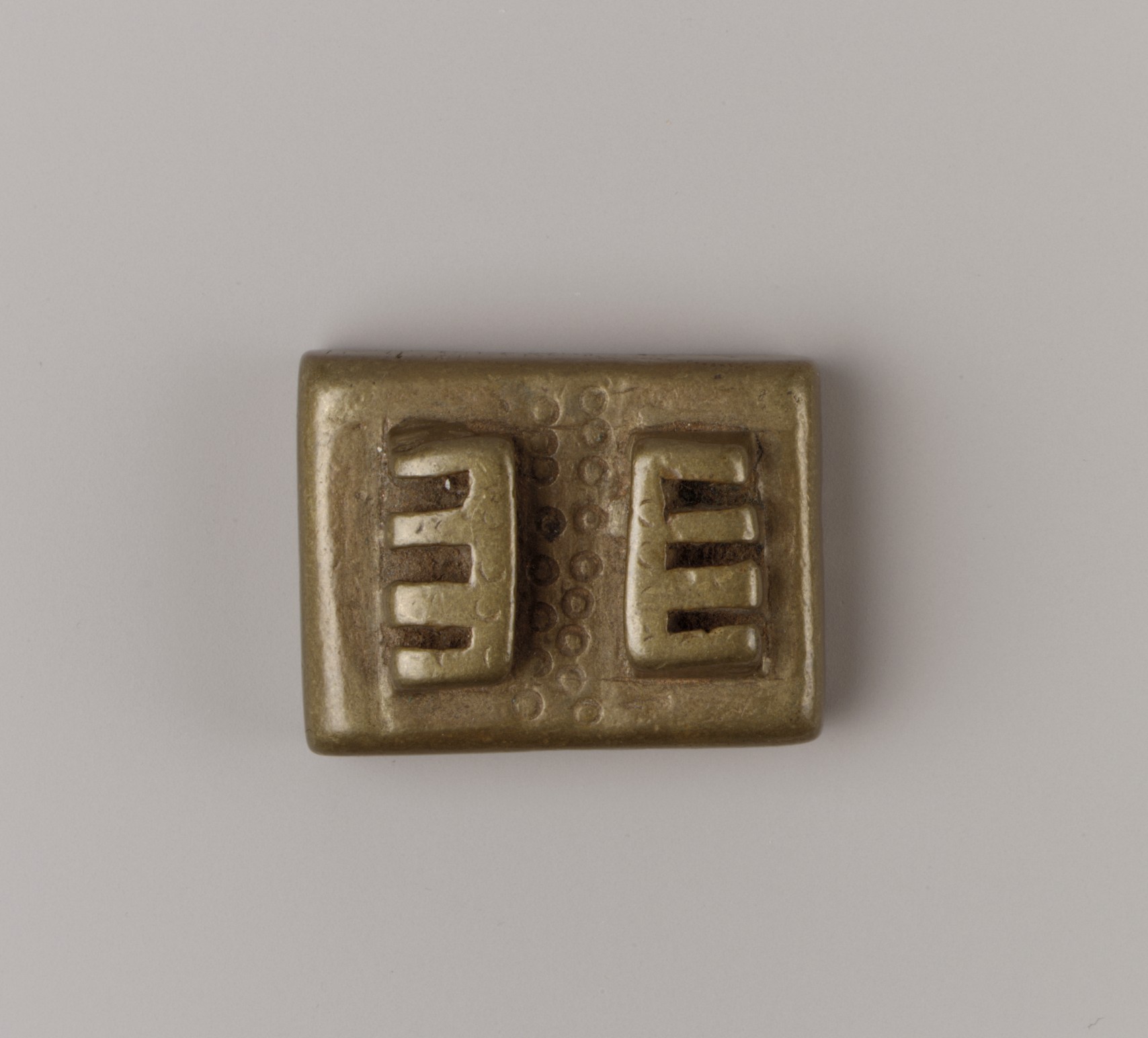
The Geometry of Sovereignty: Deconstructing an Akan Brass Gold Weight
Introduction: The Object as Argument
Within the vast lexicon of African material culture, few artifacts articulate the intersection of aesthetics, economics, and power as precisely as the Akan brass gold weight. The subject of this analysis—a geometric gold weight from the Akan peoples of present-day Ghana and Côte d’Ivoire, cast in brass—is not merely a utilitarian counterbalance. It is a condensed treatise on value, a portable monument to mathematical sophistication, and a silent negotiator in the gold trade that once fueled trans-Saharan and Atlantic commerce. As a standalone study, this object demands a reading that transcends its physical dimensions, positioning it within a framework of design intelligence, economic anthropology, and symbolic communication.
Materiality and Craft: Brass as a Medium of Prestige
The choice of brass as the primary material is itself a statement of technical mastery and cultural significance. Unlike iron, which was associated with warfare and utilitarian labor, brass—an alloy of copper and zinc—held a privileged place in Akan regalia and ritual objects. The lost-wax casting technique employed to create this weight required not only metallurgical expertise but also a deep understanding of thermal dynamics and material flow. Each piece was individually modeled in wax, encased in clay, and fired, allowing the molten brass to fill the void left by the melted wax. This process ensured that no two weights were identical, imbuing each with a unique fingerprint of craftsmanship.
From a luxury management perspective, the materiality of brass communicates durability and exclusivity. The warm, golden hue of the alloy—often patinated over centuries of handling—mimics the very gold it was designed to measure. This visual and tactile resonance between the weight and the commodity it balanced created a sensory loop of value confirmation. The weight’s surface, when polished, reflects light in a manner that echoes the gleam of gold dust, reinforcing the object’s role as a mediator of wealth. In contemporary couture analysis, such material storytelling is paramount; the weight becomes a precursor to modern luxury branding, where the container (the weight) and the contained (the gold) are aesthetically and symbolically intertwined.
Geometric Abstraction: Mathematics as Design Language
The geometric configuration of this weight—whether a pyramid, cube, or polyhedron—is not arbitrary. Akan gold weights are renowned for their adherence to a strict mathematical system based on the awisi or seed-based measurement. The geometric forms often represent abstracted proverbs, historical events, or natural phenomena, but their primary function was to ensure transactional accuracy. The precision of the angles and edges suggests a sophisticated understanding of Euclidean principles, developed independently within Akan society.
From a design analysis standpoint, the weight’s geometry achieves several objectives. First, it provides a stable, stackable form that allowed merchants to calculate multiple units efficiently. Second, the sharp, clean lines create a visual contrast with the organic, often figurative forms found in other Akan art, such as fertility dolls or ceremonial stools. This abstraction signals a shift from narrative to logic—a visual code that prioritizes function without sacrificing aesthetic rigor. The minimalist geometry, with its exacting proportions, anticipates the modernist design movements of the 20th century, challenging Western narratives that often locate the origins of geometric abstraction in early 20th-century Europe. Instead, this weight stands as evidence of a parallel, indigenous tradition of mathematical aesthetics.
Economic Anthropology: The Weight as a System of Trust
To understand the weight’s full significance, one must consider its role within the Akan gold trade. Gold dust, the primary currency for large transactions, was measured using a set of these weights, typically kept in a leather pouch alongside a set of scales and a brass spoon. The weight’s geometric consistency—its mass, volume, and shape—was the foundation of a trust-based economy. Merchants and buyers would negotiate not only the quantity of gold but also the accuracy of the weights themselves. A weight that deviated from the standard could be grounds for dispute, and the most respected traders were those whose weights were known to be true.
This system of verification is a precursor to modern quality assurance and brand integrity. The weight’s design, with its precise geometry, served as a visual guarantee of its own reliability. In a transaction, the act of placing a geometric weight on the scale was a performative ritual of honesty. The weight’s material—brass—resisted corrosion and deformation, ensuring longevity and consistency across generations. For the luxury analyst, this object exemplifies how design can embed trust into a commercial artifact. The weight is not just a tool; it is a contract, a promise of fair exchange that is physically inscribed in its form.
Symbolic Resonance: Geometry as Proverb
Beyond its economic function, the geometric gold weight operates as a repository of cultural wisdom. Many Akan weights are known to reference proverbs, and even abstract geometric forms can carry symbolic weight. For instance, a square or cube might symbolize stability, the earth, or the four cardinal directions, while a pyramid or triangle could represent hierarchy, spiritual ascent, or the three pillars of Akan cosmology: the Creator, the ancestors, and the living. The absence of figurative representation in this particular weight does not diminish its narrative capacity; rather, it invites a more open-ended interpretation, allowing the weight to speak to universal principles of order and balance.
In the context of standalone study, this symbolic ambiguity is a strength. The weight becomes a blank canvas onto which the observer projects their own understanding of value, geometry, and culture. It is a testament to the Akan ability to encode meaning within the most austere of forms. For the couture analyst, this mirrors the luxury brand’s capacity to imbue a simple silhouette or logo with layers of narrative—a geometric shape that, through repetition and cultural embedding, becomes synonymous with heritage and exclusivity.
Conclusion: The Weight as a Prototype of Luxury Intelligence
The geometric Akan brass gold weight, when examined as a standalone object, reveals itself as a masterclass in the convergence of art, science, and commerce. Its materiality communicates prestige, its geometry embodies precision, and its economic function establishes a system of trust that underpins transactional integrity. This object is not merely a historical curiosity; it is a prototype of what we now call luxury intelligence—the ability to design an object that is simultaneously beautiful, functional, and symbolically resonant.
For Katherine Fashion Lab, this analysis offers a profound lesson in the power of geometric abstraction to convey value without excess. The weight’s spare, mathematical purity is a counterpoint to the ornate, often excessive, tendencies in contemporary fashion. It suggests that true luxury lies not in decoration but in the rigorous pursuit of form, material, and meaning. As a piece of standalone study, this brass weight stands as a timeless testament to the Akan genius—a small, golden-hued object that carries the weight of an entire civilization’s economic and aesthetic philosophy.