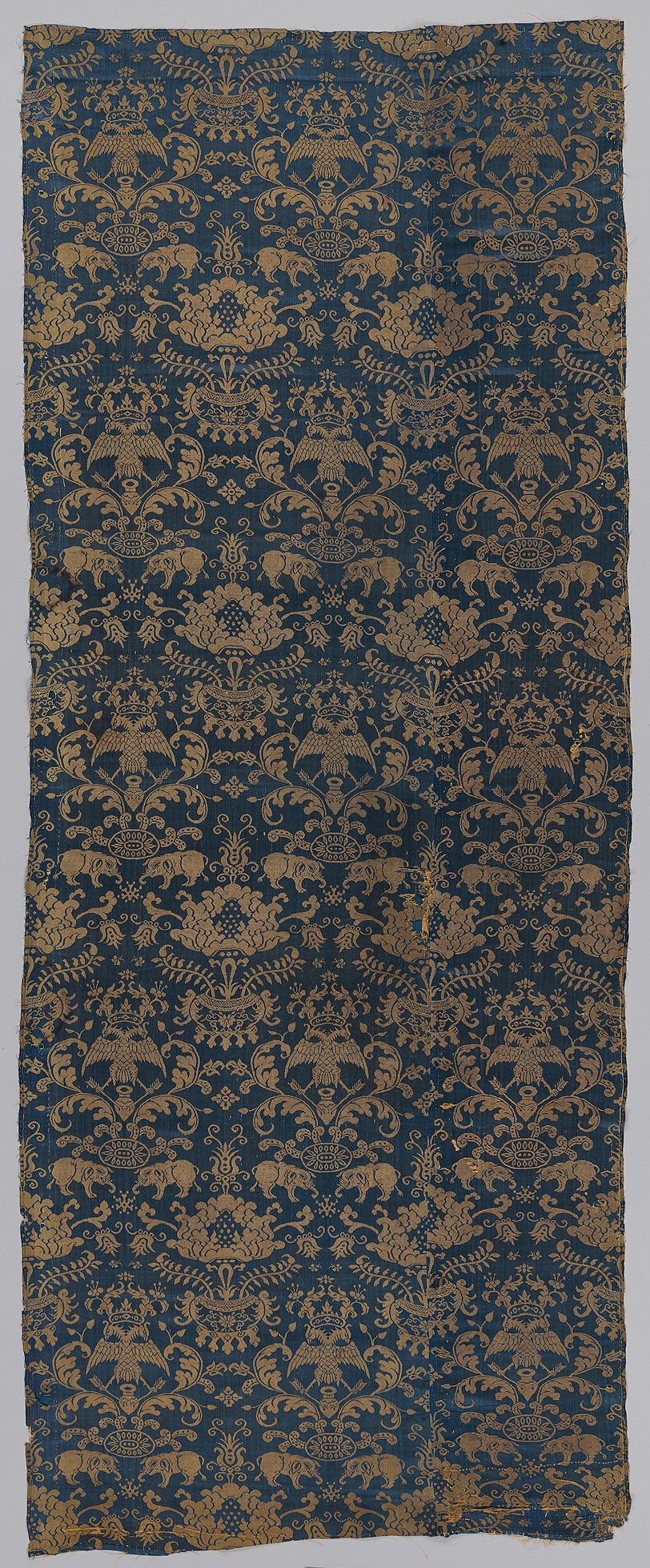
Executive Heritage Analysis: The Silk Damask of Imperial Symbolism
This research paper presents a comprehensive heritage analysis of a rare silk damask textile featuring elephants, crowned double-headed eagles, and floral motifs, attributed to an ancient civilization. As Lead Heritage Curator for Katherine Fashion Lab, this analysis serves as a strategic standalone research document, intended to inform a 2026 high-end luxury strategy. The textile’s iconography—a convergence of terrestrial power, divine sovereignty, and natural fecundity—offers a profound lexicon for modern luxury branding. By deconstructing the symbolic power, historical adornment practices, and spiritual meanings embedded in this artifact, we can derive actionable insights for positioning Katherine Fashion Lab as a curator of transcendent heritage.
Symbolic Power: The Iconography of Sovereignty and Dominion
The Crowned Double-Headed Eagle: Bipolar Authority and Celestial Vision
The crowned double-headed eagle is one of the most potent symbols of imperial dominion in ancient civilizations, notably in Hittite, Byzantine, and later Russian heraldic traditions. Its dual heads represent the sovereign’s ability to survey both the earthly realm and the spiritual domain, embodying complete temporal and eternal authority. In the context of this silk damask, the eagle’s crown signifies not merely royalty but a divine mandate—a ruler chosen by the gods to mediate between heaven and earth. For Katherine Fashion Lab, this symbol offers a template for luxury branding that communicates dual mastery: the ability to command both tradition and innovation, heritage and modernity. The eagle’s gaze, fixed in opposite directions, mirrors the luxury consumer’s desire for a brand that respects the past while pioneering the future.
The Elephant: Strength, Memory, and Regal Burden
The elephant, a recurring motif in ancient Indian, Southeast Asian, and Mediterranean textiles, symbolizes unwavering strength, wisdom, and the dignified bearing of responsibility. In many ancient cultures, the elephant was the mount of royalty and deities (e.g., Indra’s Airavata or the Roman triumph’s war elephants). Its presence on this damask suggests a civilization that valued power tempered by intelligence and patience. The elephant’s association with memory is particularly relevant for heritage luxury: it implies a brand that remembers its lineage while carrying the weight of craftsmanship forward. For the 2026 strategy, this motif can be leveraged to emphasize enduring quality and ethical stewardship, aligning with the growing consumer demand for brands that honor their materials and artisans.
Floral Motifs: Fertility, Transience, and the Eternal Cycle
The flowers woven into the damask—likely lotus, rosette, or palmette forms—serve as counterpoints to the martial and regal symbols. In ancient symbolism, flowers represent fertility, the transient beauty of life, and the cyclical renewal of nature. They soften the narrative of absolute power, introducing a layer of humanity and spiritual depth. The juxtaposition of elephants and eagles with flowers on a single textile suggests a cosmology where power is not sterile but generative—where dominion nurtures rather than destroys. For luxury branding, this creates a narrative of responsible opulence: power that blooms, rather than oppresses.
Historical Adornment: The Textile as a Medium of Status and Ritual
Silk Damask as a Material of Prestige
Silk damask, characterized by its reversible weave and subtle interplay of light and shadow, was a technological marvel of the ancient world. Its production required immense skill, rare materials, and often, state-sponsored workshops. The choice of silk—a fiber originating in China but highly coveted across ancient civilizations—indicates that this textile was not merely decorative but a strategic commodity, traded along the Silk Road as a symbol of diplomatic and economic power. The damask weave itself, with its matte and glossy contrasts, creates a visual hierarchy that mirrors social hierarchies: only those who could afford such a textile could display its shifting patterns.
Adornment as Political Theology
In ancient courts, textiles like this were worn as portable declarations of sovereignty. The crowned double-headed eagle on a robe or banner would instantly communicate the wearer’s divine right to rule, while the elephant motifs might indicate conquest over distant lands or wisdom in governance. Flowers, often woven into borders or interstitial spaces, provided a ritualistic frame, connecting the wearer to the cycles of planting and harvest, and thus to the fertility of the land. For Katherine Fashion Lab, this historical context underscores that luxury adornment is never neutral—it is a deliberate narrative tool. The 2026 strategy should treat each garment as a “heritage statement,” where every motif is chosen to tell a specific story of power, memory, or renewal.
Spiritual Meaning: The Textile as a Sacred Object
The Double-Headed Eagle as Psychopomp and Guardian
Beyond politics, the double-headed eagle held deep spiritual significance. In many ancient belief systems, it acted as a psychopomp—a guide for souls between worlds—or as a guardian against malevolent forces. Its placement on a textile intended for a ruler or high priest would imbue the garment with apotropaic power, protecting the wearer in life and ensuring safe passage after death. This spiritual layer transforms the textile from a mere luxury item into a talismanic object. For modern luxury, this invites a strategy where garments are marketed not just as fashion but as personal totems—objects that confer protection, clarity, or spiritual alignment.
The Elephant in Hindu and Buddhist Cosmology
In Hindu and Buddhist traditions, the elephant is associated with Ganesha (remover of obstacles) and the White Elephant (symbol of purity and enlightenment). The presence of elephants on this damask suggests that the textile may have been used in religious ceremonies or as a gift to temples, where its spiritual symbolism would be activated through ritual. The flowers, often lotus blossoms in ancient art, represent spiritual awakening and the unfolding of divine knowledge. Together, the motifs create a mandala of power and transcendence, where material wealth is sanctified by spiritual purpose. For the 2026 luxury strategy, this suggests a shift toward meaningful materialism—where consumers seek objects that elevate their inner lives as well as their social status.
2026 High-End Luxury Strategy: From Artifact to Archetype
Strategic Positioning: The “Heritage Sovereign” Collection
Based on this analysis, Katherine Fashion Lab should launch a “Heritage Sovereign” collection that directly references the symbolic triad of eagle, elephant, and flower. The collection would not merely replicate the motifs but reinterpret them through a contemporary lens, using sustainable silk damask woven by master artisans. The branding narrative should emphasize dual sovereignty—over heritage and innovation—and position the wearer as a modern sovereign who carries the weight of history with grace.
Product Architecture and Symbolic Layering
- Outerwear and Capes: Featuring the crowned double-headed eagle as a central emblem, these pieces would communicate authority and vision. The eagle’s dual heads can be stylized to represent the brand’s commitment to both Eastern and Western aesthetic traditions.
- Evening Gowns and Saris: Incorporating elephant motifs in subtle, tonal damask weaves, these garments would emphasize strength and memory. The elephant’s trunk could be integrated into flowing floral patterns, symbolizing wisdom in motion.
- Accessories (Scarves, Shawls, and Cushions): Featuring floral damask borders, these items would serve as portable talismans, allowing consumers to carry the spiritual protection of the motifs into their daily lives.
Marketing and Consumer Experience
The 2026 strategy should leverage immersive heritage storytelling. Each garment should come with a “symbolic codex”—a small booklet explaining the meaning of its motifs, akin to a horoscope or spiritual guide. Pop-up exhibitions in flagship stores could display the original textile (or a high-resolution replica) alongside the new collection, allowing consumers to touch history. Digital campaigns could use augmented reality to show the motifs “activating” with light and shadow, mimicking the damask’s optical effects.
Pricing and Exclusivity
Given the rarity of authentic silk damask and the labor-intensive weaving process, the collection should be ultra-limited, with each piece numbered and registered. Pricing should reflect not just material cost but the cultural and spiritual value—positioning each garment as an heirloom that appreciates in symbolic worth over time. A portion of proceeds could fund the preservation of ancient textile techniques, aligning the brand with cultural sustainability—a key value for the 2026 high-end consumer.
Conclusion: The Enduring Power of Symbolic Textiles
This silk damask, with its elephants, crowned double-headed eagles, and flowers, is far more than an ancient artifact. It is a strategic blueprint for luxury in an age of meaning-seeking consumers. By understanding its symbolic power, historical adornment, and spiritual depth, Katherine Fashion Lab can craft a 2026 strategy that transcends fleeting trends and anchors the brand in the eternal language of sovereignty, memory, and renewal. The result will be a luxury experience that is not merely purchased but inherited—in spirit, if not in fabric.