The Sartorial Legacy of Patronage: Francesco Sassetti and Teodoro as a Study in Renaissance Couture
Introduction: The Fabric of Power in the Quattrocento
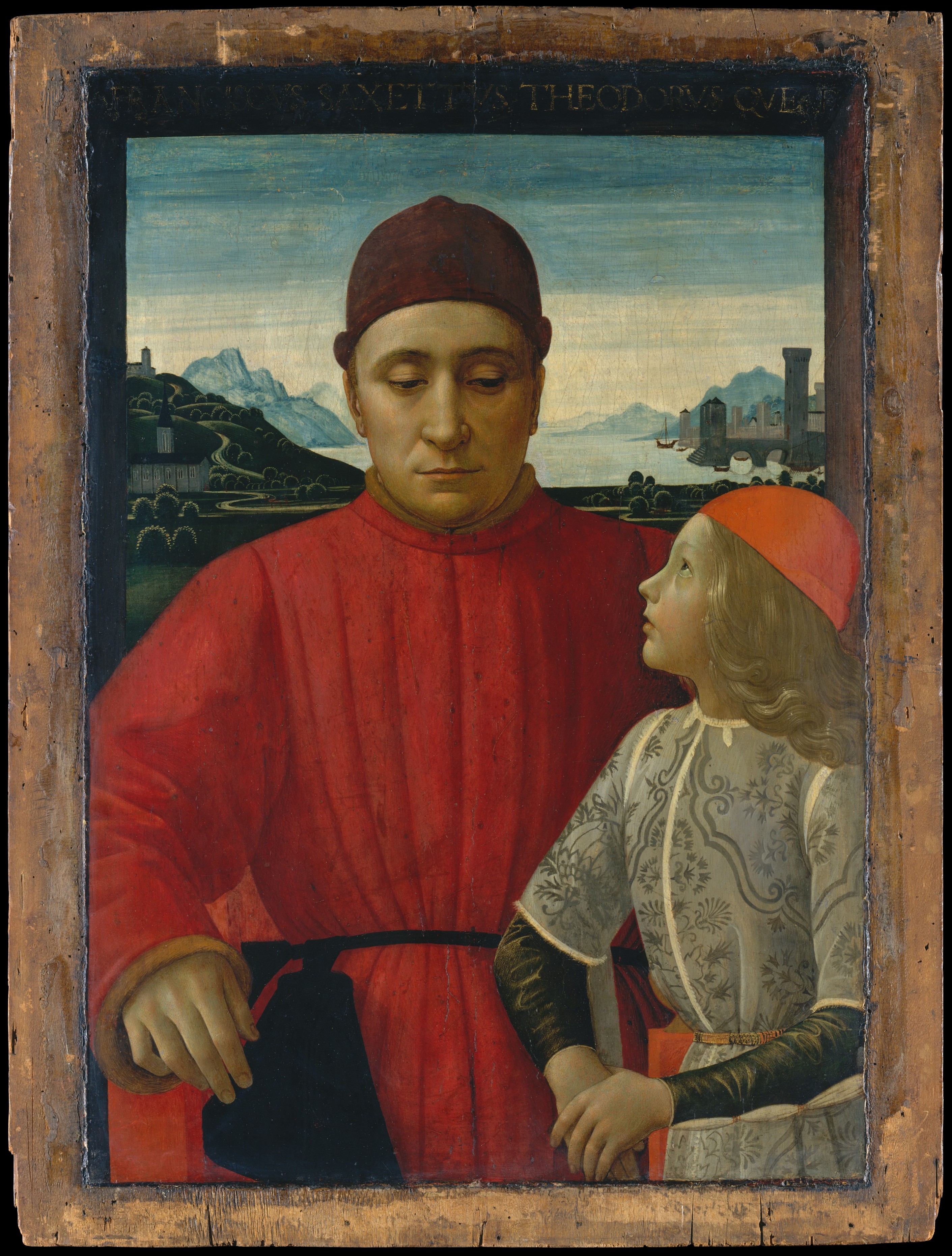
In the annals of Renaissance art, few works encapsulate the intersection of wealth, lineage, and personal identity as vividly as the portrait of Francesco Sassetti (1421–1490) and His Son Teodoro. Painted in tempera on wood, this standalone study offers more than a familial tableau—it is a masterclass in the semiotics of dress, where every fold of fabric, every hue, and every accessory serves as a deliberate statement of status, piety, and cultural ambition. For Katherine Fashion Lab, this work is not merely a historical artifact but a living lexicon of couture principles that transcend time. Through the lens of global heritage, we deconstruct how Sassetti’s attire and his son’s garments encode a narrative of power, mercantile success, and the dawn of modern individualism—a narrative that continues to inform luxury fashion today.
The Patriarch’s Palette: Color as Currency
Francesco Sassetti, a Florentine banker and patron of the arts, is depicted in a deep crimson robe, a color derived from costly kermes or cochineal dyes. In the Quattrocento, red was not merely aesthetic; it was a marker of affluence and political clout. The dye’s provenance—imported from the Levant or the New World—underscored global trade networks, much like today’s luxury houses source rare materials from exclusive ateliers. The robe’s rich saturation and voluminous drape are achieved through meticulous layering of tempera, a technique that mimics the weight of fine wool or velvet. This choice of fabric, likely a panno di lana or silk blend, speaks to Sassetti’s role as a banker to the Medici, where cloth was both a commodity and a symbol of economic hegemony. The crimson’s intensity is tempered by a dark fur lining—likely sable or marten—visible at the collar and cuffs, a nod to sumptuary laws that reserved such materials for the elite. For the modern couturier, this palette teaches that color is never innocent; it is a calculated investment in perception.
The Son’s Silhouette: Innocence and Inheritance
Teodoro Sassetti, depicted as a young boy, wears a tunic of muted blue-grey, a hue associated with humility and youth. Yet, the fabric’s subtle brocade pattern—perhaps a damask or lampas weave—belies its simplicity. The tunic’s high collar and fitted bodice echo the adult fashion of the era, suggesting that Teodoro is being groomed for his future role as a merchant or cleric. His golden chain and small pendant are not mere adornments; they are talismans of family legacy, likely bearing the Sassetti coat of arms or a religious motif. The contrast between father and son is deliberate: Francesco’s robust, expansive form versus Teodoro’s slender, restrained silhouette. This juxtaposition mirrors the Renaissance ideal of the paterfamilias as a figure of authority, while the son embodies promise and continuity. In couture terms, this is a lesson in generational storytelling—how garments can articulate lineage without overt declaration.
Global Heritage: Textile Trade and Cultural Hybridity
The tempera medium itself, with its egg-based binder, was a staple of Italian Renaissance painting, but the textiles depicted in this work are global in origin. Sassetti’s robe likely incorporates silk from China, traded along the Silk Road, while the gold thread in Teodoro’s brocade may have been sourced from West African mines, refined in Venice, and woven in Florence. This cross-continental supply chain is a precursor to today’s luxury fashion ecosystem, where a single garment might combine Italian wool, Indian embroidery, and French lace. The portrait’s dark background, devoid of landscape, forces the viewer to focus solely on the figures’ attire—a deliberate compositional choice that elevates dress to the primary subject. For Katherine Fashion Lab, this underscores the importance of material provenance as a pillar of couture identity. In an era of fast fashion, the Sassetti portrait reminds us that true luxury is rooted in the narrative of its making, from raw material to finished form.
Tailoring as Identity: The Cut of Power
The construction techniques implied in this portrait reveal a sophisticated understanding of tailoring. Francesco’s robe features deep pleats and wide sleeves, cut to allow movement while maintaining a stately silhouette. The shoulder seams are slightly padded, a precursor to the structured jackets of later centuries. Teodoro’s tunic, by contrast, is more fitted, with narrow sleeves and a cinched waist, reflecting the era’s emerging focus on the child as a distinct individual rather than a miniature adult. The button closures on both garments—likely made of bone or metal—are functional yet decorative, a detail that modern designers might reinterpret as a signature closure. This attention to fit and form is a testament to the artisanal skill of Florentine tailors, who were among the first to treat garment construction as a discipline akin to architecture. In contemporary couture, this translates to the importance of bespoke tailoring—a practice that Katherine Fashion Lab champions as the antithesis of mass production.
The Accessories: Symbols of Status and Spirituality
Beyond the garments, the portrait’s accessories are laden with meaning. Francesco’s ring, likely a signet, signifies his role as a patriarch and banker. His beret, a cap of crimson velvet, is a marker of civic office or learned status. Teodoro’s small book—perhaps a prayer book or a primer—hints at education and piety. These items are not afterthoughts; they are integral to the ensemble, much like a modern couture collection’s accessory line. The absence of ostentatious jewelry is notable; Sassetti’s wealth is expressed through fabric and fit rather than gaudy ornament. This restraint is a key lesson for luxury brands: true sophistication lies in subtlety, not excess. The father’s hand resting on his son’s shoulder is the ultimate accessory—a gesture of protection and legacy that no fabric can replicate.
Conclusion: Couture as Historical Dialogue
The portrait of Francesco Sassetti and Teodoro is more than a family snapshot; it is a textile document of Renaissance values, global trade, and personal ambition. For Katherine Fashion Lab, this work serves as a case study in how clothing can articulate power, lineage, and cultural hybridity. The tempera medium, with its luminous permanence, mirrors the enduring nature of couture—a craft that resists ephemerality. As we analyze this piece, we are reminded that every stitch, every dye, and every silhouette carries the weight of history. In the hands of a modern designer, the lessons of Sassetti’s robe—its color, cut, and context—can be reimagined for a global audience. The portrait stands as a testament that fashion is never merely decorative; it is a language of identity, spoken across centuries. At Katherine Fashion Lab, we honor this dialogue by translating the past into the future, one garment at a time.