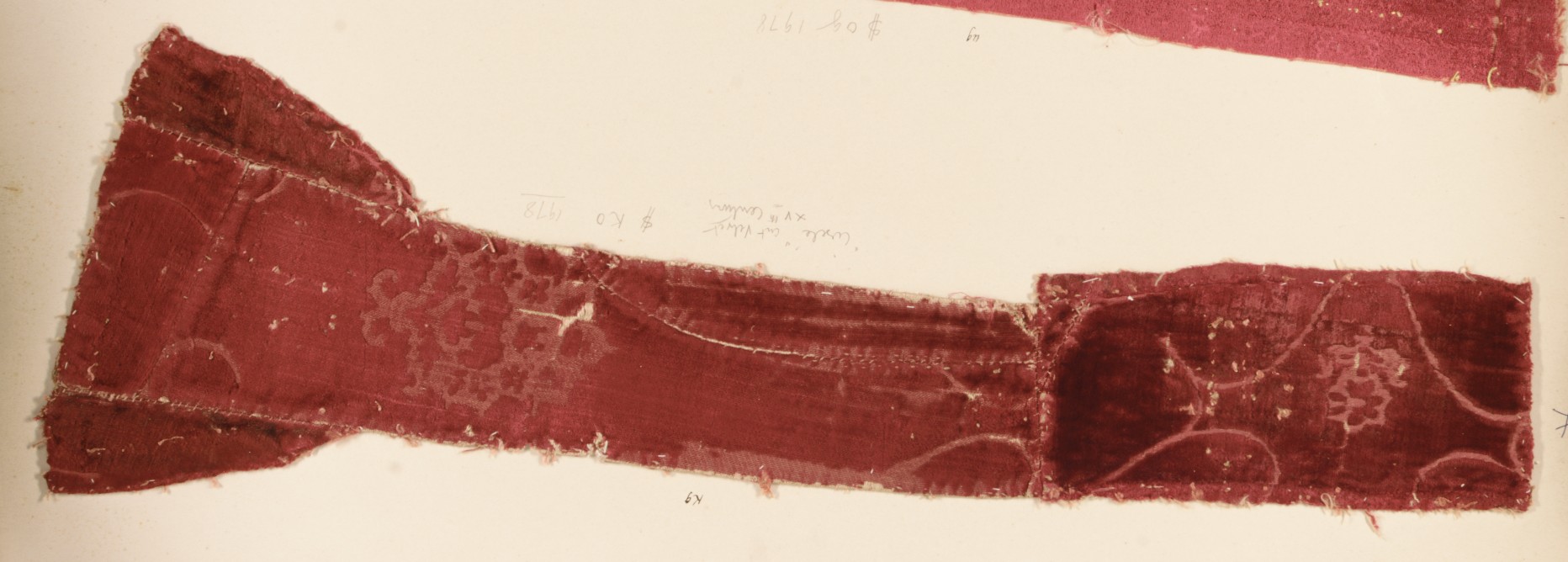
Deconstructing Heritage: The Fragment as a Couture Statement
In the rarefied world of haute couture, where precision and perfection are often the guiding principles, the concept of the "fragment" emerges as a radical, intellectual counterpoint. Katherine Fashion Lab’s latest standalone study, titled “Fragment,” challenges the conventional narrative of the finished garment. Instead of presenting a seamless whole, the collection celebrates the incomplete, the broken, and the recovered. This analysis dissects how the lab uses silk—a material historically synonymous with opulence and continuity—to articulate a global heritage of fragmentation, memory, and reconstruction. The result is not merely a dress, but a philosophical inquiry into the nature of beauty, time, and cultural preservation.
The Philosophical Framework: Fragment as Narrative Device
The fragment is not a flaw; it is a story. In art history, from Hellenistic sculptures to Japanese kintsugi, the broken piece carries more weight than the pristine whole. Katherine Fashion Lab seizes this principle, transforming the garment into a canvas for historical palimpsest. The “Fragment” study does not attempt to hide its seams or its cuts. Instead, it exposes them as deliberate markers of a journey—a journey through global heritage that has been disrupted, preserved, and reimagined.
This approach demands a rethinking of couture’s traditional vocabulary. A hemline is not a boundary but a threshold; a tear is not an accident but a portal. The lab’s designers have employed silk as the ideal medium for this dialogue because of its inherent duality: it is both delicate and resilient, luminous and matte. When fragmented, silk does not simply fray; it reveals a new texture, a new light refraction, a new vulnerability. This vulnerability is the core of the collection’s emotional resonance.
Materiality of Silk: A Global Heritage in Fibers
Silk’s origin story is a global one. From the ancient trade routes of the Silk Road to the royal courts of Europe and Asia, this fiber has always been a carrier of culture. Katherine Fashion Lab’s “Fragment” study honors this heritage by sourcing silk from multiple regions—Chinese habotai, Indian tussar, Italian crepe de chine, and Japanese chirimen. Each silk type brings a distinct weight, drape, and history. The lab then treats these silks not as uniform panels, but as fragments of a larger cultural tapestry.
The construction process is akin to archaeological restoration. Artisans cut the silk into irregular, jagged shapes—some reminiscent of ancient pottery shards, others mimicking torn manuscript pages. These pieces are then reassembled using visible seams, raw edges, and deliberate gaps. The technique is not about hiding the joins but about highlighting them, creating a visual rhythm of loss and recovery. The silk’s natural luster becomes a metaphor for the light that shines through historical ruptures, illuminating what was once obscured.
One standout piece is a floor-length gown constructed from dozens of trapezoidal silk fragments, each dyed in a gradient of indigo and ochre. The seams are stitched with a contrasting gold thread, echoing the kintsugi philosophy of repairing broken ceramics with precious metals. This is not a repair that conceals; it is a repair that celebrates the break. The gown’s silhouette is asymmetrical, with one shoulder bare and the other covered by a cascade of silk shards that flutter like fallen petals. The effect is both ancient and futuristic, a garment that belongs to no single time or place.
Global Heritage: A Dialogue Across Continents
The “Fragment” study draws explicitly from global heritage motifs, but it does so without cultural appropriation. Instead, it treats each motif as a fragment of a larger, interconnected human story. For instance, a jacket features silk patches embroidered with patterns inspired by the geometric designs of Uzbek ikat, the floral motifs of French toile, and the abstract symbols of pre-Columbian textiles. These patches are not blended into a seamless whole; they remain distinct, separated by raw seams and contrasting textures.
This approach challenges the homogenizing tendencies of globalization. In a world where cultural boundaries are increasingly blurred, the fragment becomes a tool for preserving distinctiveness while acknowledging interconnection. The wearer of a Katherine Fashion Lab fragment piece is not a passive consumer of heritage; they are an active participant in a conversation across centuries and civilizations. The silk becomes a medium for this dialogue, its fibers carrying the whispers of artisans from the East and West.
The lab also incorporates traditional handcraft techniques from these regions. Indian kantha stitching, Japanese sashiko, and French hand-embroidery are all used to bind the silk fragments together. Each stitch is a signature of a specific heritage, yet they coexist on the same garment, creating a polyphonic visual language. This is not fusion in the sense of blending; it is juxtaposition in the sense of dialogue.
Context of the Standalone Study: Beyond the Runway
A standalone study like “Fragment” operates outside the constraints of a seasonal collection. It is an academic and artistic inquiry, free from the pressure of commercial viability. This freedom allows Katherine Fashion Lab to push the boundaries of what couture can be. The study is presented not as a fashion show, but as an exhibition—a series of garments displayed on mannequins or suspended from the ceiling, each piece accompanied by a narrative label explaining the provenance of its silk fragments and the heritage motifs they carry.
The context of a standalone study also emphasizes the ephemeral nature of couture. Unlike ready-to-wear garments designed for multiple seasons, these pieces are singular, irreproducible artifacts. The fragmentation is not only aesthetic but conceptual: each garment is a fragment of the lab’s ongoing research into material culture and historical memory. The viewer is invited to consider the garment as a document, a primary source of cultural history.
Furthermore, the study challenges the consumerist model of fashion. There is no "collection" to buy; there is only an experience to engage with. The fragments are not for sale; they are for contemplation. This elevates the work from commodity to art, aligning it with the traditions of conceptual art and museum curation. The silk, once a symbol of trade and wealth, becomes a symbol of intellectual and emotional wealth.
Conclusion: The Fragment as a New Whole
Katherine Fashion Lab’s “Fragment” study is a masterclass in redefining luxury. By using silk—a material of global heritage—as a medium for fragmentation, the lab creates garments that are not just beautiful but deeply meaningful. The fragment becomes a metaphor for the human condition: we are all made of pieces, some broken, some restored, but all carrying the light of history. In this standalone study, the fragment is not the absence of the whole; it is a new kind of whole, one that is honest about its fractures and proud of its scars.
For the discerning connoisseur, this collection offers a profound lesson: that true couture is not about perfection, but about authenticity. And authenticity, as the “Fragment” study proves, is often found in the broken, the incomplete, and the beautifully reassembled.