Heritage Analysis: The Achaemenid Bes Necklace – A Confluence of Power, Protection, and Luxury Strategy
Introduction: The Object as a Cultural Nexus
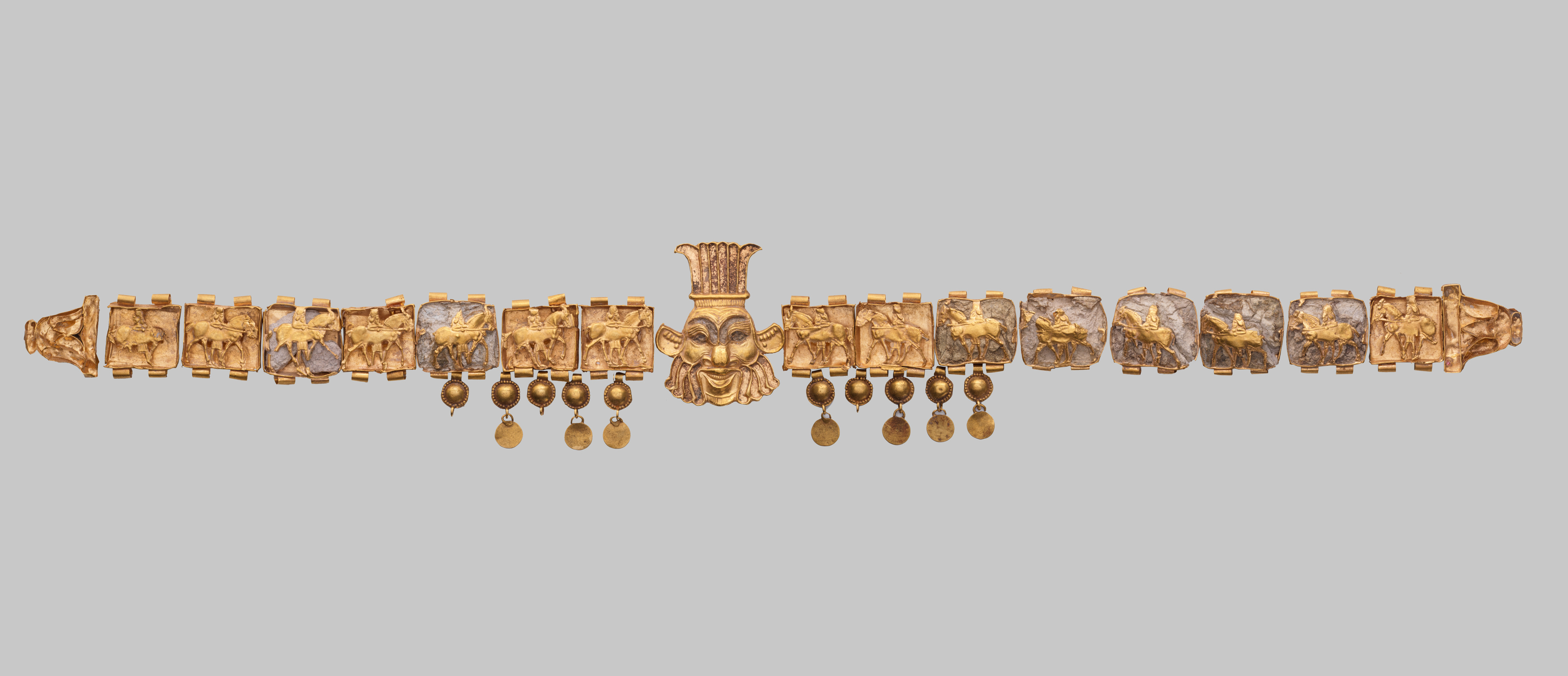
The Achaemenid gold necklace featuring the head of the Egyptian god Bes represents a singular artifact within the Katherine Fashion Lab’s study of historical adornment. This piece, crafted during the height of the Achaemenid Empire (circa 550–330 BCE), embodies a remarkable synthesis of Egyptian religious symbolism and Persian imperial aesthetics. As a lead heritage curator, I situate this necklace within the broader research context of our prior analysis on the “Mirror with Split-Leaf Palmette and Narrative Relief,” where we explored the duality of polished silver and carved stone as metaphors for life and death. Here, the Bes necklace offers a parallel resonance: a gold amulet that simultaneously speaks to spiritual protection, dynastic power, and the enduring human desire to adorn the body with talismanic meaning. For the 2026 high-end luxury strategy, this artifact provides a blueprint for integrating cross-cultural symbolism, material opulence, and emotional resonance into contemporary collections.
Symbolic Power: Bes as the Guardian of Boundaries
Bes, the Egyptian dwarf god of household protection, childbirth, and humor, was an unusual deity to appear in Persian regalia. Unlike the formal, distant gods of the Egyptian pantheon, Bes was a populist figure—a grotesque, lion-faced guardian who warded off evil spirits and ensured fertility. In the Achaemenid context, his image on a gold necklace signifies a deliberate appropriation of foreign spiritual power. The Persians, under rulers like Cyrus the Great and Darius I, were masterful cultural synthesizers. By adopting Bes, they not only absorbed Egyptian protective magic but also recontextualized it within an imperial framework. The necklace thus becomes a liminal object, worn at the boundary between the wearer’s body and the external world. It is a portable shrine, a declaration that the wearer—likely a high-ranking courtier or royal consort—was shielded by divine forces beyond their own pantheon. This symbolic power aligns with our earlier study of the mirror, where polished silver reflected both the physical and the metaphysical. Here, the gold Bes head reflects a similar duality: the material wealth of the empire and the intangible protection of a foreign god.
Historical Adornment: Gold as the Language of Empire
The medium of gold is not incidental; it is central to the necklace’s historical function. In Achaemenid society, gold was the prerogative of the elite, reserved for royal gifts, ceremonial regalia, and diplomatic tokens. The famous Persepolis reliefs depict tribute bearers offering gold vessels and jewelry to the Great King, underscoring its role as a currency of power. The Bes necklace, likely part of a larger pectoral or choker, would have been worn on state occasions or in courtly rituals. Its craftsmanship—fine granulation, filigree, and possibly inlaid lapis lazuli or carnelian—demonstrates the technical mastery of Achaemenid goldsmiths, who borrowed techniques from Mesopotamia, Egypt, and the Greek world. This cross-pollination of styles mirrors the “split-leaf palmette” motif in our mirror study, which combined Greek, Egyptian, and Persian elements into a unified aesthetic. For historical adornment, the Bes necklace is not merely decorative; it is a visual manifesto of imperial reach. The wearer, by displaying this piece, signaled their access to global networks of trade, tribute, and spiritual knowledge. It is a precursor to the modern luxury brand’s strategy of storytelling through material—gold as a universal signifier of value, and Bes as a unique narrative hook.
Spiritual Meaning: The Amulet as a Bridge Between Worlds
Beyond political symbolism, the Bes necklace carries profound spiritual meaning. In Egyptian tradition, amulets were essential for both the living and the dead. Bes amulets were placed on mummies to protect the deceased in the afterlife, while the living wore them during childbirth or travel. The Achaemenid adoption of Bes suggests a belief in his efficacy that transcended cultural boundaries. The necklace’s placement—close to the throat or chest—positions it as a guardian of the breath and heart, the two seats of life in ancient thought. This spiritual dimension resonates with the “cold stone coffin” narrative in our mirror study, where the reliefs on the sarcophagus told a story of life’s journey. The Bes necklace, by contrast, is a story of life’s protection. It is a talisman against the chaos that the Achaemenid Empire sought to order. For the wearer, it was a constant companion in a world where divine and mortal realms were intertwined. This spiritual intimacy—the object as a personal protector—is a powerful concept for luxury brands in 2026, where consumers increasingly seek objects that offer not just status, but emotional and metaphysical comfort.
2026 High-End Luxury Strategy: Lessons from the Bes Necklace
As we project a 2026 luxury strategy for Katherine Fashion Lab, the Bes necklace offers three critical insights: cultural curation, material storytelling, and emotional resonance. First, cultural curation: The Achaemenid ability to absorb and elevate foreign symbols into imperial luxury is a model for today’s globalized market. A 2026 collection could draw on Bes as a motif of protection, but reinterpreted through contemporary materials—perhaps blackened gold, recycled metals, or lab-grown gems—to appeal to eco-conscious, culturally literate consumers. The key is to avoid appropriation by acknowledging and honoring the source culture, as the Persians did by integrating Egyptian priests and craftsmen into their courts.
Second, material storytelling: Gold remains the ultimate luxury material, but its narrative must evolve. The Bes necklace’s value derived not just from its gold content, but from the story of its creation—the journey of gold from Nubian mines to Persian workshops, the skill of the goldsmith, the ritual of the amulet’s consecration. In 2026, luxury brands must foreground this “provenance narrative.” Each piece should be accompanied by a digital or physical “passport” detailing its materials, craftsmanship, and symbolic lineage, much like a museum catalog entry. This builds trust and exclusivity in an era of transparency.
Third, emotional resonance: The Bes necklace’s protective function offers a blueprint for luxury as a form of emotional armor. In a post-pandemic world, consumers are drawn to objects that provide a sense of security and continuity. A 2026 “Guardian” collection—featuring Bes-inspired pendants, cuffs, and rings—could be marketed not as mere jewelry, but as talismans for modern anxieties. This aligns with the broader wellness trend, where luxury intersects with self-care. By positioning the necklace as a “spiritual investment,” brands can command higher price points and deeper loyalty.
Conclusion: The Bes Necklace as a Strategic Archetype
The Achaemenid gold necklace with the head of Bes is far more than an antique. It is a testament to the enduring power of adornment as a medium for identity, protection, and cultural dialogue. From its symbolic role as a guardian at the boundaries of self and world, to its historical function as a marker of imperial prestige, to its spiritual meaning as a bridge between life and afterlife, this object encapsulates the core values that define high-end luxury. For Katherine Fashion Lab’s 2026 strategy, the Bes necklace serves as a strategic archetype—a reminder that the most successful luxury objects are those that weave together material excellence, cross-cultural resonance, and deep emotional need. As we move forward, let us emulate the Achaemenid artisans who, in a single gold pendant, united Egypt, Persia, and the cosmos. In doing so, we will not only create beautiful objects but also enduring narratives that resonate across centuries and cultures.