Sacred Lineage and Secular Power: A Couture Analysis of a Dynastic Devotion
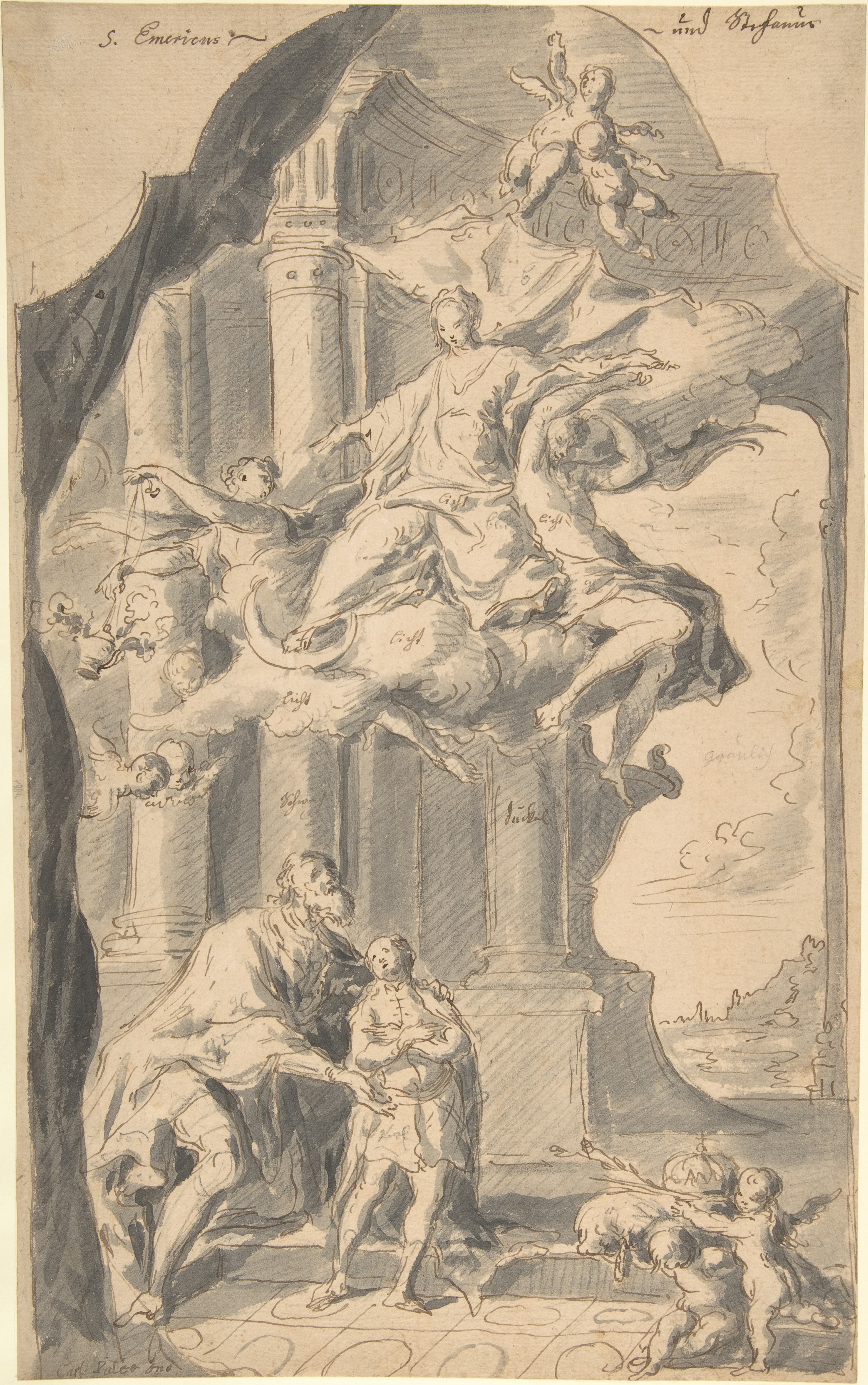
The presented study, Saint Stephen of Hungary Presenting his Son, Saint Emeric, to the Virgin, is far more than a preparatory devotional sketch. It is a profound visual treatise on the intersection of sacred authority, dynastic legacy, and the very fabric of sovereignty. Executed in pen and brown ink with gray wash and black chalk, this standalone work from the Global Heritage collection offers a masterclass in using layered media to articulate hierarchical weight and spiritual narrative. For Katherine Fashion Lab, this piece serves as a pivotal case study in the "architecture of authority"—how silhouette, drapery, and compositional focus are engineered to communicate unassailable power and divine sanction.
Deconstructing the Silhouette: Hierarchical Volume and Sacred Geometry
The composition’s core power dynamic is established through a masterful manipulation of silhouette and spatial arrangement. The Virgin Mary, enthroned, forms the apex of a stable, pyramidal structure. This is not merely an artistic convention; it is a deliberate construction of visual stability and eternal order. Her form, amplified by the architectural framing of the throne and the cascading volumes of her gown, creates an immovable anchor. In contrast, the figures of King Stephen and the young Prince Emeric are integrated into the ascending diagonals that lead the viewer’s eye toward this sacred apex.
From a couture perspective, the treatment of the Virgin’s garments is particularly instructive. The gray wash is employed with strategic genius to model the gown’s drapery. Deep folds are rendered in dark, weighty tones, suggesting a luxurious, heavy fabric—perhaps a velvet or a densely woven silk—that absorbs light, while highlights left in reserve by the chalk imply a rich, matte texture. This creates a silhouette of formidable, yet graceful, volume. The folds do not flutter; they cascade with a liturgical gravity, echoing the permanence of her celestial role. The mantle enveloping her head and shoulders functions as a sacred canopy, a sartorial halo that extends her presence and sanctifies the space she occupies.
The Semiotics of Royal Drapery: Stephen's Mantle of Office
Saint Stephen’s attire demands a focused analysis, as it embodies the dual nature of his sainthood and kingship. He is depicted not in ethereal, saintly robes, but in the regalia of a medieval monarch. The precise, pen-drawn lines delineate a long, fur-lined mantle—a koronázási palást (coronation mantle) in essence. This garment is the ultimate symbol of secular power received from and ordained by God. The black chalk and brown ink work in concert to define the mantle’s luxurious weight and the intricate pattern likely embroidered along its border, a testament to earthly wealth and craft.
Critically, the drapery of Stephen’s mantle is active and directional. It swirls around his kneeling form, with lines that guide the viewer’s gaze toward his son and, ultimately, to the Virgin. This kinetic energy in his fabric contrasts with the Virgin’s static volume, visually narrating his role as the supplicant and the conduit. He is the mover in the earthly realm, presenting his lineage for divine blessing. The fabric here tells a story of action and purpose, whereas the Virgin’s fabric speaks of reception and eternal judgment. The texture implied by the sketch—the softness of fur against the dense weave of wool or silk—adds a tactile dimension to the power dynamic, reminding us that authority is experienced through both sight and substance.
Emeric: The Linear Promise and the Unfinished Hem
The figure of Saint Emeric, the presented heir, is rendered with a distinct linear quality, often using the pen’s sharpest point. His clothing is simpler, less modeled by the gray wash, focusing on clean outlines. This stylistic choice is profoundly intentional. It represents potential, the unwritten future, and the purity of the dynastic line. His silhouette is slimmer, more vertical, a direct arrow pointing upward. He is the living link, the human element in this sacred transaction.
Notably, the hemlines and edges of Emeric’s attire may appear less finished, more suggested than defined. This is not an oversight in a study of this caliber. It is a narrative device. It symbolizes the unfulfilled destiny of the prince, whose life was cut short, and whose sanctification came through martyrdom and promise rather than long reign. The "unfinished" quality of his dress, as rendered in this media, speaks to a life—and a sartorial story—interrupted, its full volume and embellishment left to the realm of what might have been.
Materiality as Narrative: The Genius of Mixed Media
The chosen materials—pen and ink, gray wash, black chalk—are not merely tools; they are active participants in the storytelling. The pen defines immutable structure: the architectural lines of the throne, the strict contours of crowns, the determined features of Stephen. It is the law, the rule, the hard edge of authority.
The gray wash, however, is the medium of spirit, weight, and texture. It creates the volumetric illusion of fabric, the soft shadow of divine grace, the atmospheric space that separates yet connects the earthly and the heavenly. It models the tactile reality of power, from the dense pile of velvet to the delicate veil. The black chalk, used for underdrawing and soft shading, provides a middle ground—the human element, the warmth of skin, the subtle suggestion of form beneath the garment. This interplay mirrors the couture process itself: the structural underpinnings (the pen), the sculptural padding and tailoring (the wash), and the final, living form on the body (the chalk).
Conclusion: A Legacy Woven in Line and Wash
This masterful study for Katherine Fashion Lab transcends its religious subject to offer timeless principles on designing for legacy and power. It demonstrates how the cut and flow of a mantle can articulate a kingdom’s destiny, how the volume of a gown can command a celestial space, and how the simplicity of a prince’s attire can whisper of a future entrusted to higher hands. The artwork confirms that true authority in dress is not about mere ornamentation, but about the strategic deployment of form, texture, and focus. The dynastic line of Hungary is here immortalized not just through genealogy, but through the eloquent language of draped fabric and intentional shadow, a legacy sketched in ink, wash, and chalk for the ages.