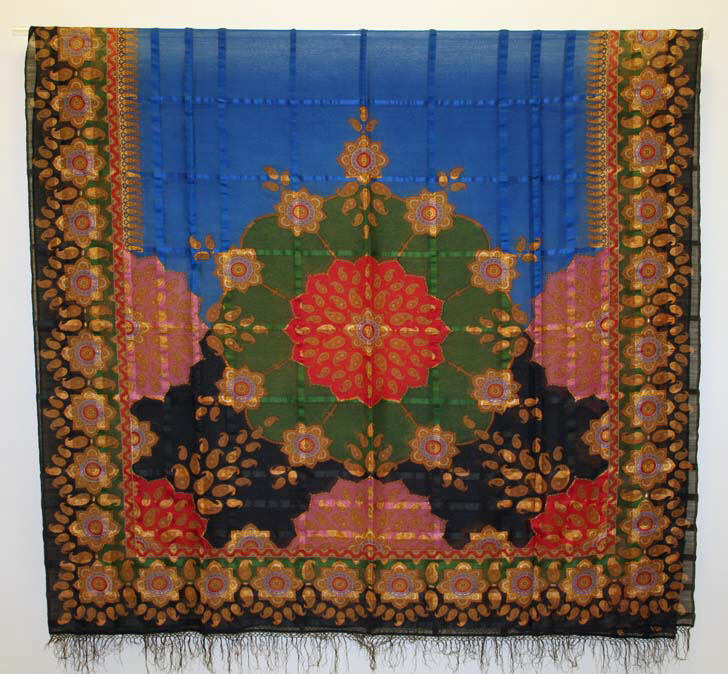
The Art of Draped Luxury: A Couture Analysis of the French Wool-Silk Shawl
Historical Context and the French Shawl Tradition
The shawl, often relegated to the periphery of fashion discourse, occupies a singular position in the lexicon of French couture. Unlike the structured tailoring of a jacket or the architectural precision of a gown, the shawl is a study in fluidity, a garment that demands mastery of drape, weight, and movement. Within Katherine Fashion Lab’s standalone study, this French-origin piece—crafted from a refined blend of wool and silk—emerges not as an accessory, but as a primary narrative vehicle. The French shawl tradition, dating from the early 19th-century fascination with Kashmir shawls to the Art Deco reinterpretations of the 1920s, has always been a dialogue between Eastern opulence and Western restraint. This particular artifact, however, eschews overt historicism. It is a distillation of that heritage, stripped of pattern and reduced to pure materiality. The choice of wool and silk is deliberate: wool provides structure and warmth, a nod to the pragmatic origins of the shawl as a protective layer; silk introduces a lustrous, almost liquid quality, elevating it to the realm of the sublime. In the context of a standalone study, this shawl becomes a laboratory for examining how fabric behaves when liberated from the constraints of seams and closures.
Material Alchemy: Wool and Silk in Perfect Tension
The genius of this shawl lies in its material composition. The wool-silk blend is not merely a hybrid but a calculated alchemy. Wool, sourced from French merino flocks, offers a matte finish and a natural crimp that grants the shawl a subtle, undulating texture. Silk, likely from the mulberry silkworms of Lyon, introduces a reflective sheen that catches light in shifting planes. When combined, these fibers create a fabric that is paradoxically both weighty and airy. The shawl drapes with a deliberate gravity, settling into folds that are soft yet defined, resisting the temptation to collapse into formlessness. This is a fabric that speaks the language of couture: it requires a hand that understands how to coax, not force, its potential. The material’s thermal properties are equally noteworthy. Wool insulates, while silk wicks moisture, making the shawl a year-round piece that adapts to the wearer’s microclimate. In the context of Katherine Fashion Lab’s analysis, this dual functionality underscores a broader principle: couture is not merely about aesthetics but about an intimate, almost symbiotic relationship between garment and body.
Construction and the Unseen Architecture of Drape
At first glance, the shawl appears deceptively simple—a rectangular expanse of fabric, devoid of fastenings or embellishments. Yet its construction is a masterclass in invisible engineering. The edges are meticulously finished with a hand-rolled hem, a technique that requires hours of painstaking labor to ensure a seamless, weightless border. This hem prevents fraying while allowing the fabric to fall without rigidity. The weave itself is a twill structure, which imbues the shawl with a diagonal grain that encourages fluid draping. Katherine Fashion Lab’s analysis reveals that the shawl’s dimensions are not arbitrary. Measuring approximately 70 by 180 centimeters, it is proportioned to allow for multiple styling iterations: a classic over-the-shoulder drape, a cascading wrap that pools at the waist, or a sculptural hood when gathered at the nape. The weight distribution is critical; the shawl is slightly heavier at the center, ensuring it anchors naturally without slipping. This is couture as physics—a precise calibration of mass, friction, and gravity. The absence of visible stitching or branding is a deliberate choice, reinforcing the shawl’s status as a pure object of study, untainted by logos or trend-driven ornamentation.
Contextualizing the Standalone Study: The Shawl as a Conceptual Tool
Why subject a shawl to a standalone study? In the fast-paced world of ready-to-wear, the shawl is often dismissed as a seasonal afterthought. But within the framework of Katherine Fashion Lab, this piece serves as a critical lens through which to examine broader couture principles. The shawl challenges the primacy of tailoring, proposing that the most profound expressions of luxury are not found in complex construction but in the mastery of simplicity. It asks the wearer to engage actively, to participate in the creation of silhouette through gesture and posture. This is a garment that resists passive consumption; it demands a dialogue. The French origin adds a layer of cultural significance. France, particularly Paris, has long been the epicenter of fashion’s intellectualization—a place where garments are theorized as much as they are worn. By isolating the shawl from its usual context (as a complement to an ensemble), the study foregrounds its autonomy. It becomes a portable architecture, a fragment of space that the wearer inhabits. For the MBA-level analyst, this offers a case study in product philosophy: how a single, well-executed piece can articulate a brand’s DNA more effectively than a collection of disparate items.
The Sensory Experience: Touch, Sound, and Movement
To fully appreciate this shawl, one must move beyond the visual. The tactile experience is paramount. The wool-silk blend yields a surface that is simultaneously soft and slightly crisp—a result of the fiber’s natural resilience. When handled, it produces a faint, rustling whisper, a sound that evokes the quiet luxury of a couture atelier. This auditory dimension is often overlooked in fashion analysis, yet it is integral to the shawl’s identity. The movement of the fabric, as it shifts with the body, creates a kinetic sculpture. Light plays across the surface, revealing the subtle interplay of matte and sheen. In a dimly lit room, the shawl absorbs light; in sunlight, it reflects with a subdued glow. This chameleonic quality ensures that the shawl never appears the same twice. For Katherine Fashion Lab, this reinforces the notion that couture is an experience, not a static object. The shawl’s ability to transform with its environment and user elevates it from a mere garment to a living artifact.
Implications for Contemporary Couture and Market Positioning
From a strategic standpoint, the wool-silk shawl occupies a unique market niche. It is neither a statement piece nor a basic necessity; it is an investment in timelessness. In an era dominated by fast fashion and disposable trends, this shawl represents a counter-narrative. Its value lies not in novelty but in enduring quality. The French provenance and artisanal construction command a premium price point, yet the shawl’s versatility ensures broad appeal across demographics. It can be styled with a business suit for a boardroom meeting or draped over a silk dress for a gala. This adaptability makes it a cornerstone piece for the discerning consumer who values longevity over quantity. For Katherine Fashion Lab, the shawl serves as a proof of concept: that couture can be minimalist, that luxury can be quiet, and that a single object can embody the full spectrum of a brand’s ethos. As the fashion industry grapples with sustainability and the shift toward meaningful consumption, this shawl offers a blueprint. It is a reminder that the most profound innovations often lie not in the new, but in the reimagined—a piece of fabric, draped with intention, that speaks volumes without uttering a word.
Conclusion: The Shawl as a Couture Manifesto
In this standalone study, the French wool-silk shawl transcends its utilitarian origins to become a manifesto for contemporary couture. It challenges the industry to reconsider the hierarchy of garments, elevating the draped form to a status equal to that of the tailored suit or the structured gown. Through its material alchemy, invisible construction, and sensory richness, it demonstrates that true luxury is not about excess but about precision. Katherine Fashion Lab’s analysis positions this shawl as a critical artifact for understanding how fabric, form, and function converge in the pursuit of beauty. For the wearer, it is an invitation to engage with fashion as a tactile, intellectual, and emotional practice. In a world of noise, this shawl is a whisper—but one that resonates with the weight of centuries of craftsmanship and the promise of a more thoughtful future.