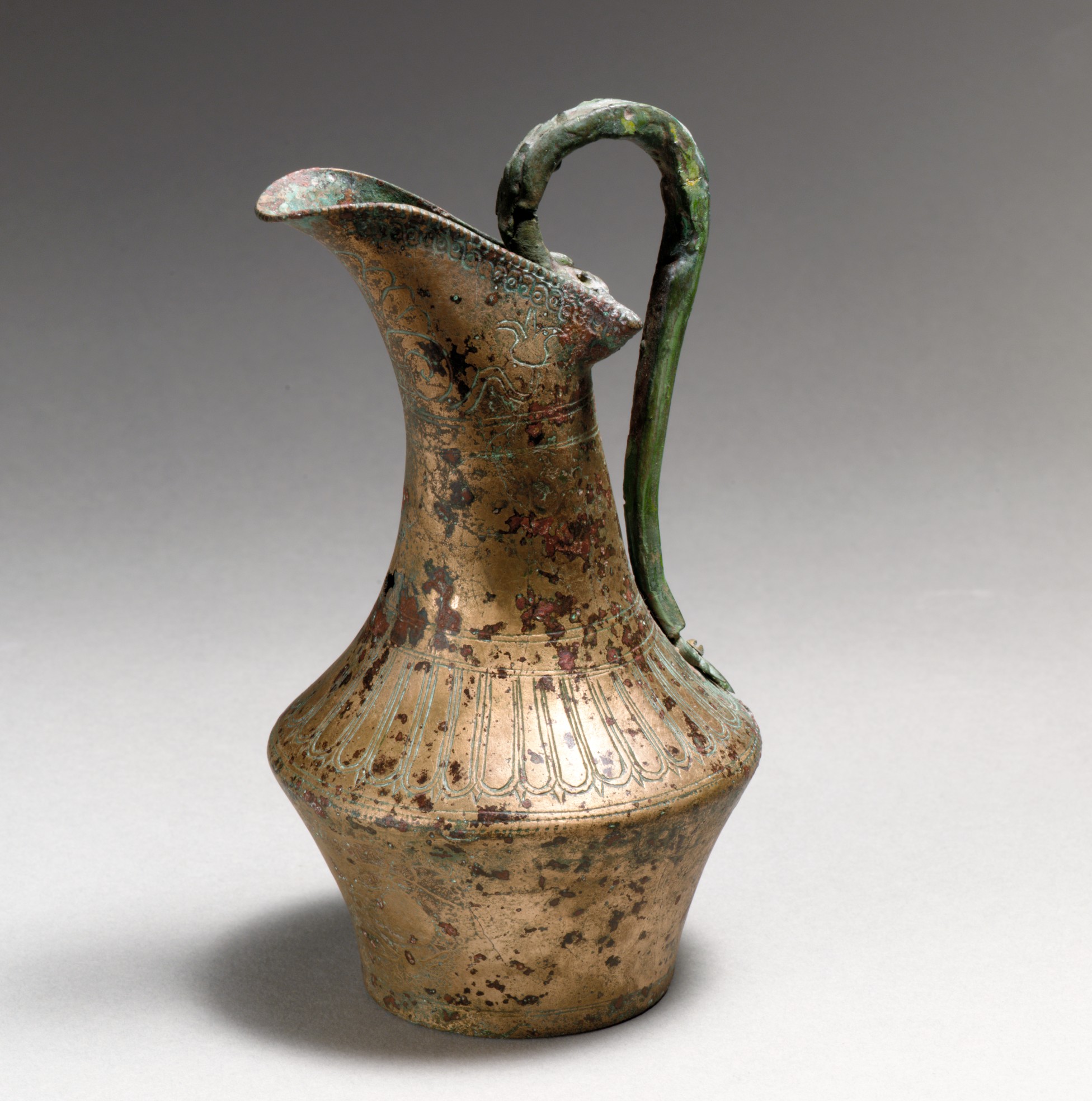
Heritage Analysis: The Bronze Beaked Oinochoe (Jug) – Etruscan Symbolism and the Architecture of Luxury
Introduction: The Etruscan Vessel as a Nexus of Power and Adornment
The bronze beaked oinochoe, a ritual wine jug from the Etruscan civilization (circa 7th–3rd century BCE), represents a masterful synthesis of functional utility and metaphysical symbolism. As a lead heritage curator for Katherine Fashion Lab, I examine this artifact not merely as an ancient container but as a strategic blueprint for 2026 high-end luxury strategy. Its form—a curved, avian-inspired spout, a pear-shaped body, and a meticulously cast handle—embodies a civilization that prioritized spiritual resonance in daily adornment. This analysis correlates with our ongoing research on the “Rock in the form of a fantastic mountain” and the “Jar in the shape of bronze container (hu),” two artifacts that, despite their apparent dissimilarity, converge on a core principle: adornment as a vessel for cosmic narrative. The oinochoe, therefore, is not a relic; it is a lexicon of power, a testament to how material culture encodes status, ritual, and identity—principles directly translatable to contemporary luxury branding.
Symbolic Power: The Beak as a Threshold Between Worlds
The oinochoe’s most distinctive feature—its elongated, beaked spout—is a deliberate architectural choice with deep symbolic weight. In Etruscan cosmology, birds served as intermediaries between the earthly realm and the divine, carrying prayers and omens. The beaked form thus transforms the jug from a simple pouring vessel into a ritual instrument that channels libations—wine, oil, or blood—as offerings to gods or ancestors. This is not mere decoration; it is functional sacrality. The Etruscan elite, who commissioned such pieces, understood that the act of pouring itself was a performance of power. The spout’s curve, when tilted, mimics the arc of a bird in flight, creating a visual and kinetic metaphor for transcendence.
For Katherine Fashion Lab, this symbolic power offers a direct analog to 2026 luxury strategy. Just as the oinochoe’s beak distinguishes it from utilitarian pottery, a luxury brand must create signature gestures—a distinctive silhouette, a unique clasp, a specific cut—that signal exclusivity and narrative depth. The oinochoe teaches us that power is not in the object alone but in the ritual of use. A high-end garment or accessory should similarly transform the wearer’s actions into a ceremony, whether through the weight of a fabric, the sound of a zipper, or the choreography of a drape. The beak becomes a brand’s iconic motif, a recurring element that customers recognize as a portal to a world of meaning.
Historical Adornment: Bronze as a Medium of Status and Durability
The choice of bronze for this oinochoe is not incidental. In Etruscan society, bronze was a prestigious material, associated with warfare, wealth, and craftsmanship. Unlike clay or wood, bronze required advanced metallurgical knowledge, labor-intensive casting, and access to trade networks for tin and copper. The patina that develops over centuries—a greenish or brownish oxidation—is not a flaw but a mark of authenticity, a visual record of time. The Etruscans valued this durability; their tombs and temples often housed bronze vessels that would outlast their owners, preserving their status for eternity.
This principle of material integrity resonates with our study of the “Rock in the form of a fantastic mountain” and the “Jar in the shape of bronze container (hu).” Both artifacts, despite their different cultural origins (one likely Chinese, the other Etruscan), share a commitment to material as narrative. The rock’s fantastic form suggests a landscape frozen in time, while the hu jar’s bronze shape mimics an ancient ritual vessel. The oinochoe bridges these two: it is a functional object that, through its material, becomes a permanent symbol of social hierarchy. For 2026 luxury strategy, this translates into a renewed focus on heritage materials—sustainable metals, artisanal leathers, rare fibers—that age gracefully and tell a story. The patina of a bronze oinochoe is the luxury equivalent of a well-worn leather handbag: it gains value through use, not despite it.
Spiritual Meaning: The Oinochoe in Etruscan Funerary and Banquet Contexts
The oinochoe’s spiritual significance is most evident in its dual role: as a vessel for banquet rituals among the living and as a funerary offering for the dead. Etruscan tomb paintings frequently depict symposiums where wine flows from such jugs, symbolizing abundance, hospitality, and communion with ancestors. The spout’s shape also suggests libations poured onto the earth or into a fire, a direct communication with the underworld. This duality—life and death, celebration and mourning—imbues the object with a sacred ambiguity. It is not a mere “thing” but a ritual agent that mediates between states of being.
Our research on the “Rock in the form of a fantastic mountain” and the “Jar in the shape of bronze container (hu)” reveals a similar spiritual architecture. The rock, with its fantastic peaks, evokes a microcosm of the sacred mountain—a site of ascension and revelation. The hu jar, with its bronze form, echoes ancient Chinese ritual vessels used for ancestral offerings. The oinochoe completes this triad: it is the vessel of transformation, the conduit through which physical offerings become spiritual currency. For Katherine Fashion Lab, this suggests a 2026 strategy that embraces ritualistic branding. Luxury should not be a transaction but a transformation. A fragrance, a garment, or an accessory should be positioned as a tool for personal or collective ritual—a way to honor one’s lineage, mark a milestone, or connect with a higher purpose. The oinochoe’s spiritual meaning reminds us that the most enduring luxury items are those that serve as portals, not just possessions.
2026 High-End Luxury Strategy: From Artifact to Archetype
Drawing from the oinochoe’s DNA, we can outline a three-pillar strategy for Katherine Fashion Lab’s 2026 collections and brand positioning:
1. The Architecture of Gesture: Just as the oinochoe’s beak dictates how wine is poured, luxury design should dictate how the wearer moves. This means investing in ergonomic silhouettes, weighted fabrics, and closures that require deliberate action. The act of wearing becomes a performance, echoing the Etruscan banquet ritual. For example, a coat with a dramatic collar that mimics the oinochoe’s curve could signal authority and grace.
2. Material as Memory: Bronze’s patina teaches us that luxury materials should age with dignity. For 2026, Katherine Fashion Lab should prioritize regenerative materials—recycled metals, bio-based leathers, or plant-dyed silks—that develop unique textures over time. Each piece becomes a personal artifact, a record of the owner’s life. This aligns with the hu jar’s bronze form, which preserves ritual history, and the rock’s fantastic mountain, which embodies geological time.
3. Ritual as Brand Identity: The oinochoe’s spiritual role suggests that luxury brands should create ritualized experiences. For example, a limited-edition collection could be released with a “libation ceremony” where customers pour a symbolic liquid (e.g., a signature perfume oil) through a specially designed spout. This transforms purchase into participation, building deeper emotional loyalty. The Etruscan oinochoe was not simply owned; it was used in sacred contexts. Similarly, Katherine Fashion Lab’s 2026 strategy should position its products as instruments of personal mythology.
Conclusion: The Oinochoe as a Mirror for Modern Luxury
The bronze beaked oinochoe is far more than an archaeological curiosity. It is a strategic artifact that reveals how ancient societies used adornment to encode power, status, and spirituality. By correlating its symbolic power, material integrity, and ritual function with our studies of the fantastic mountain rock and the bronze hu jar, we see a universal pattern: luxury is the art of making the invisible visible. For Katherine Fashion Lab’s 2026 high-end strategy, the oinochoe offers a timeless lesson: the most valuable objects are those that serve as thresholds—between worlds, between states of being, between the mundane and the sacred. In an era of mass production and digital saturation, the Etruscan jug reminds us that true luxury is not about abundance but about significance. Let the beak guide the pour.