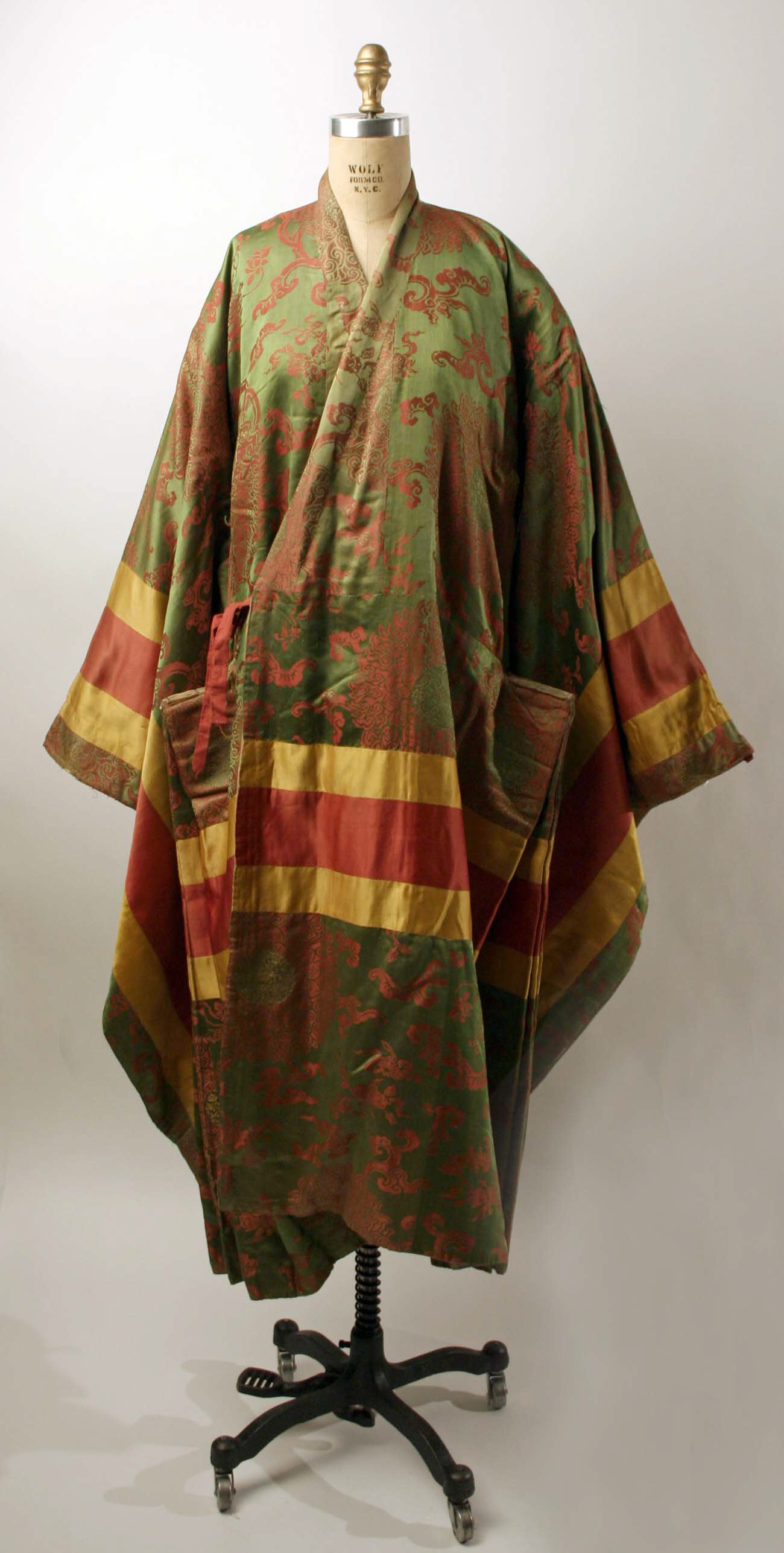
The Unfurling of the Sacred: A Couture Analysis of the Tibetan Robe
In the rarefied atmosphere of haute couture, where fabric meets philosophy, the Tibetan robe emerges not merely as a garment but as a profound architectural statement. At Katherine Fashion Lab, our curatorial lens focuses on the intersection of materiality and spirituality, and this singular piece—a robe crafted from silk, bast fiber, and metal—offers a compelling case study in transcultural design. This is not a costume nor a mere artifact; it is a wearable meditation, a standalone study in how elemental resources can be transformed into a narrative of resilience, devotion, and aesthetic transcendence. The robe’s structural logic, tactile vocabulary, and symbolic resonance demand a rigorous analysis that moves beyond ethnographic observation into the realm of high fashion critique.
Material Alchemy: The Triad of Silk, Bast Fiber, and Metal
The genius of this robe lies in its deliberate juxtaposition of three distinct materials, each carrying its own cultural and physical weight. The silk, likely sourced from the ancient trade routes that connected Tibet to the broader Himalayan and Chinese spheres, provides a luminous, fluid foundation. Its natural sheen captures light in a way that suggests the ethereal, evoking the clarity of high-altitude skies. However, this is not a delicate, decorative silk; it is robust, woven with a tightness that speaks to both protection and ceremony. The silk’s role is to ground the garment in a sense of purity and ritualistic elegance, a canvas upon which the other materials can exert their force.
Contrasting this is the bast fiber, derived from plant stems such as hemp or nettle, which introduces a textural and philosophical counterpoint. Bast fiber is rugged, unrefined, and deeply connected to the earth. In the context of Tibetan monastic and nomadic life, bast symbolizes humility and endurance. Here, it is not hidden but celebrated, often appearing as structural panels, underlayers, or binding elements. The friction between silk’s smoothness and bast’s coarse resilience creates a dynamic tension—a dialogue between the heavenly and the earthly, the transient and the permanent. This is couture that refuses to be merely decorative; it demands engagement with the physical reality of existence.
The final component, metal, is arguably the most arresting. Thin threads of silver or copper, or perhaps small, hammered discs, are interwoven or appliquéd onto the robe. Metal in Tibetan design is rarely superfluous; it carries deep spiritual significance, often representing the indestructible nature of wisdom or the armor of compassion. In this robe, the metal elements are strategically placed—along the shoulders, the hem, or the collar—to guide the eye and to create a sense of weight and grounding. When the wearer moves, the metal catches the light and emits a subtle, percussive whisper, transforming the garment into an auditory experience. This is not ornamentation for its own sake; it is a material mantra, a reminder of the sacred within the secular.
Structural Theology: The Architecture of the Robe
The silhouette of the Tibetan robe is deceptively simple—a voluminous, often asymmetrical wrap that relies on folds, sashes, and the wearer’s body to define its form. Yet, within this apparent simplicity lies a sophisticated understanding of proportion and drape. The shoulder construction is a masterclass in balance. The robe typically features wide, dropped shoulders that allow for unrestricted movement, a necessity for both meditation and physical labor. This design choice also creates a powerful visual effect: the wearer is both enveloped and liberated, the fabric cascading down in generous, unbroken planes.
The layering system is crucial. This robe is not a single piece but a composition of overlapping volumes. The bast fiber layer often serves as the inner structure, providing warmth and a tactile anchor, while the silk outer layer flows over it like a second skin. The metal elements are introduced at the points of tension—the folds that gather at the waist or the drapes that fall from the shoulder. This is structural theology in practice: the garment does not merely cover the body; it orchestrates a relationship between the physical form and the spiritual intent. The asymmetry, often with one side longer or more elaborately decorated, echoes the Tibetan Buddhist concept of impermanence and the non-duality of existence.
From a couture perspective, the robe challenges Western tailoring norms. There are no darts, no fitted seams, no rigid silhouettes. Instead, the fit is achieved through wrapping, tying, and the natural gravity of the materials. This demands a different kind of mastery from the designer—a deep understanding of how fabric behaves in motion, how weight distributes across the body, and how the wearer’s own agency completes the garment. At Katherine Fashion Lab, we recognize this as a form of participatory design, where the robe is only fully realized when it is worn, when the metal chimes with each step, and when the silk catches the ambient light.
Cultural Resonance and Contemporary Relevance
To analyze this robe solely through a material or structural lens would be to miss its deeper cultural resonance. In Tibetan tradition, the robe—often known as a chuba or monastic shawl—is a marker of identity, status, and spiritual commitment. The use of silk and metal historically signified high rank or religious authority, while bast fiber connected the wearer to the ascetic traditions of the Himalayas. This robe, therefore, is a sartorial manifesto, encoding centuries of cultural memory within its folds.
In the context of contemporary fashion, this piece stands as a powerful critique of fast-fashion’s disposability. Its materials are not synthetic; they are harvested, processed, and woven with intention. The metal is not plastic; it is forged. The robe’s construction is not designed for a single season but for a lifetime of use, perhaps even for inheritance. This is slow couture in its most authentic form, where every thread carries the weight of tradition and every fold tells a story of survival and adaptation.
Moreover, the robe’s standalone study reveals its potential for cross-cultural dialogue. For the modern design house, it offers a blueprint for integrating sustainability with luxury, for celebrating imperfection (the bast fiber’s irregularity) while achieving opulence (the silk’s luster). It challenges the Western obsession with the tight, the tailored, and the transparent, offering instead a vision of elegance that is generous, layered, and deeply rooted in place.
Conclusion: The Robe as a Living Archive
As Lead Curator for Katherine Fashion Lab, I posit that this Tibetan robe is not a relic to be preserved under glass but a living archive of material intelligence and spiritual design. It teaches us that couture is not merely about the new; it is about the eternal. The silk whispers of ancient trade, the bast fiber grounds us in the earth, and the metal rings with the clarity of a temple bell. In its folds, we find a blueprint for a fashion that honors both the hand and the heart, the individual and the collective. This is a garment that demands to be studied, worn, and revered—a testament to the fact that the most profound design often emerges from the most sacred sources.