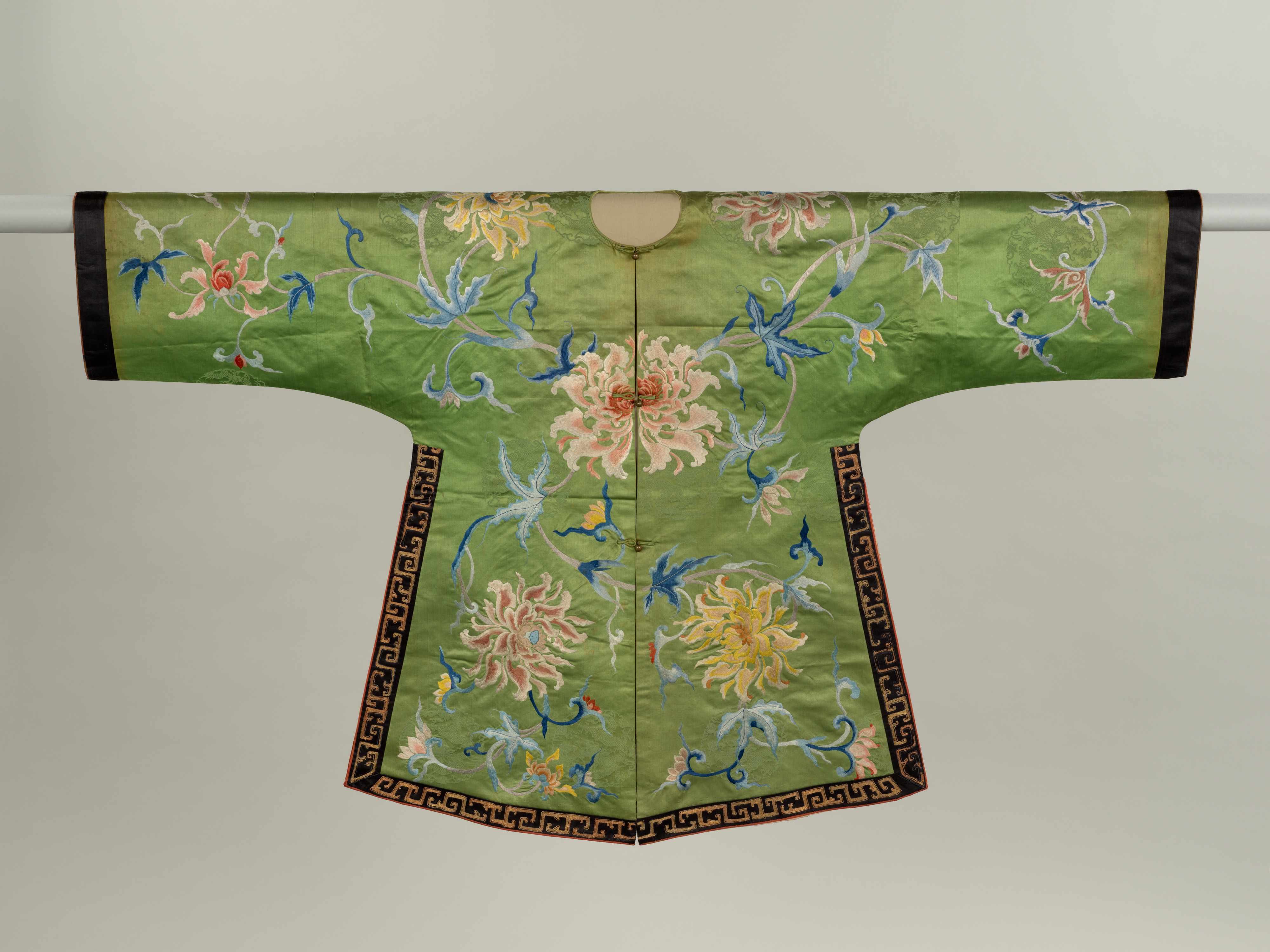
The Theatrical Jacket of a Court Lady: A Study in Silk, Status, and Symbolism
In the hallowed archives of Katherine Fashion Lab, few artifacts command the same reverence as the theatrical jacket designed for a court lady of Imperial China. This garment, a masterpiece of silk thread embroidery on silk satin, transcends mere sartorial function to become a narrative device, a political statement, and a testament to the zenith of pre-industrial textile artistry. As a standalone study, this piece offers a profound lens through which to examine the intersection of power, performance, and personal identity within the rigid hierarchies of the Chinese court. The jacket is not simply a costume; it is a carefully orchestrated visual manifesto, woven from threads of tradition, ambition, and theatricality.
Materiality as a Language of Power
The foundation of this jacket—silk satin—is itself a declaration of status. In Imperial China, sericulture was a state-guarded secret, and silk was a currency of diplomacy and a symbol of divine mandate. The choice of satin, with its lustrous, reflective surface, amplifies the garment’s visual impact under the flickering light of oil lamps or, more dramatically, on a stage. The fabric does not merely clothe; it illuminates the wearer. The silk thread embroidery is not a mere embellishment but a painstakingly applied layer of meaning. Each stitch—whether couched, satin-stitched, or knotted—represents hours of labor by artisans whose skills were passed down through generations. The density and complexity of the embroidery serve as a direct index of the wearer’s social capital. A court lady’s jacket was never a private garment; it was a public asset, designed to be read by an audience of peers, superiors, and inferiors. The materiality thus establishes a baseline of authority: the jacket announces that its owner commands resources that are both rare and exquisite.
Iconography and the Theatrical Narrative
The true genius of this jacket lies in its iconographic program. Unlike a daily court robe, which might adhere to strict sumptuary regulations, this theatrical piece operates in a liminal space—between reality and fiction, between the court and the stage. The embroidery likely features motifs drawn from classical literature, mythology, or historical allegory. For example, the presence of peonies (symbolizing wealth and honor) intertwined with phoenixes (representing the empress and feminine virtue) would not only flatter the wearer but also align her with celestial hierarchies. More daringly, the jacket might incorporate scenes from operatic performances—such as the Story of the Western Wing or The Palace of Eternal Life—allowing the court lady to literally wear her cultural literacy and emotional aspirations on her sleeve. This is where the “theatrical” designation becomes crucial. The jacket is not worn for a static portrait but for a dynamic performance, whether in an actual play, a ritual dance, or a courtly game of wit and flirtation. The embroidery becomes a script, and the wearer, an actor in a drama of her own making.
Structural Ingenuity and the Art of Movement
Beyond its surface, the jacket’s construction reveals a sophisticated understanding of biomechanics and visual spectacle. The cut—typically a wide, flowing silhouette with long, wing-like sleeves—is designed to exaggerate and stylize movement. When the court lady raises her arms, the embroidered dragons or clouds appear to take flight; when she turns, the train of the jacket unfurls like a peacock’s tail. The silk satin is lightweight yet structured, allowing for graceful draping without sacrificing the crisp lines required for dramatic gestures. The placement of embroidery is strategic: heavier motifs on the back and shoulders create a focal point for the audience, while the front remains more restrained to allow for interaction. This attention to kinetic design underscores the jacket’s function as a tool of persuasion. A court lady’s influence was often wielded not through direct speech but through subtle physical cues—a tilt of the head, a sweep of the sleeve. The jacket amplifies these cues, turning every gesture into a calculated statement.
Color Psychology and Social Signaling
The color palette of this jacket is equally deliberate. While the base satin might be a deep, resonant imperial yellow—traditionally reserved for the emperor and his immediate family—the theatrical context allows for more adventurous choices. A crimson base, for instance, would signal passion and vitality, while a midnight blue could evoke the heavens or scholarly depth. The embroidery threads, often in contrasting hues of gold, turquoise, and coral, create a visual rhythm that draws the eye across the garment. Gold thread, in particular, is not merely decorative; it is a metallic statement of wealth and permanence, catching light in a way that mimics the flicker of a candle flame. In a court setting, where every glance is a negotiation, color becomes a form of silent rhetoric. The jacket’s chromatic intensity would have been carefully calibrated to the occasion—a festival, a banquet, or a private audience—ensuring that the wearer commanded attention without violating the unwritten codes of decorum.
Contextualizing the Standalone Study
To study this jacket in isolation is to recognize its autonomy as an object of art and power. Unlike a complete court ensemble, which includes headdresses, belts, and shoes, this jacket stands alone as a concentrated expression of the court lady’s identity. It invites us to consider the garment as a portable stage—a microcosm of the world she navigates. The embroidery, with its intricate layers of symbolism, functions as a visual autobiography, revealing her lineage, her allegiances, and her personal mythologies. For the modern curator, this jacket challenges the binary between fashion and costume. It is not a relic of a bygone era but a living document that speaks to the timeless human desire to project power and beauty through adornment. The silk thread, still vibrant after centuries, whispers of the hands that stitched it, the eyes that admired it, and the body that once wore it as armor and art.
In conclusion, this theatrical jacket from Imperial China is a paradigm of couture as strategic communication. From its silk satin foundation to its embroidered narratives, every element is a deliberate choice in a high-stakes performance of identity. As a standalone study, it reveals the profound sophistication of Chinese textile arts and the nuanced social codes that governed the lives of court ladies. Katherine Fashion Lab is honored to present this garment not as a fossilized artifact, but as a vibrant testament to the enduring power of fashion to shape, reflect, and transcend the world in which it was created.