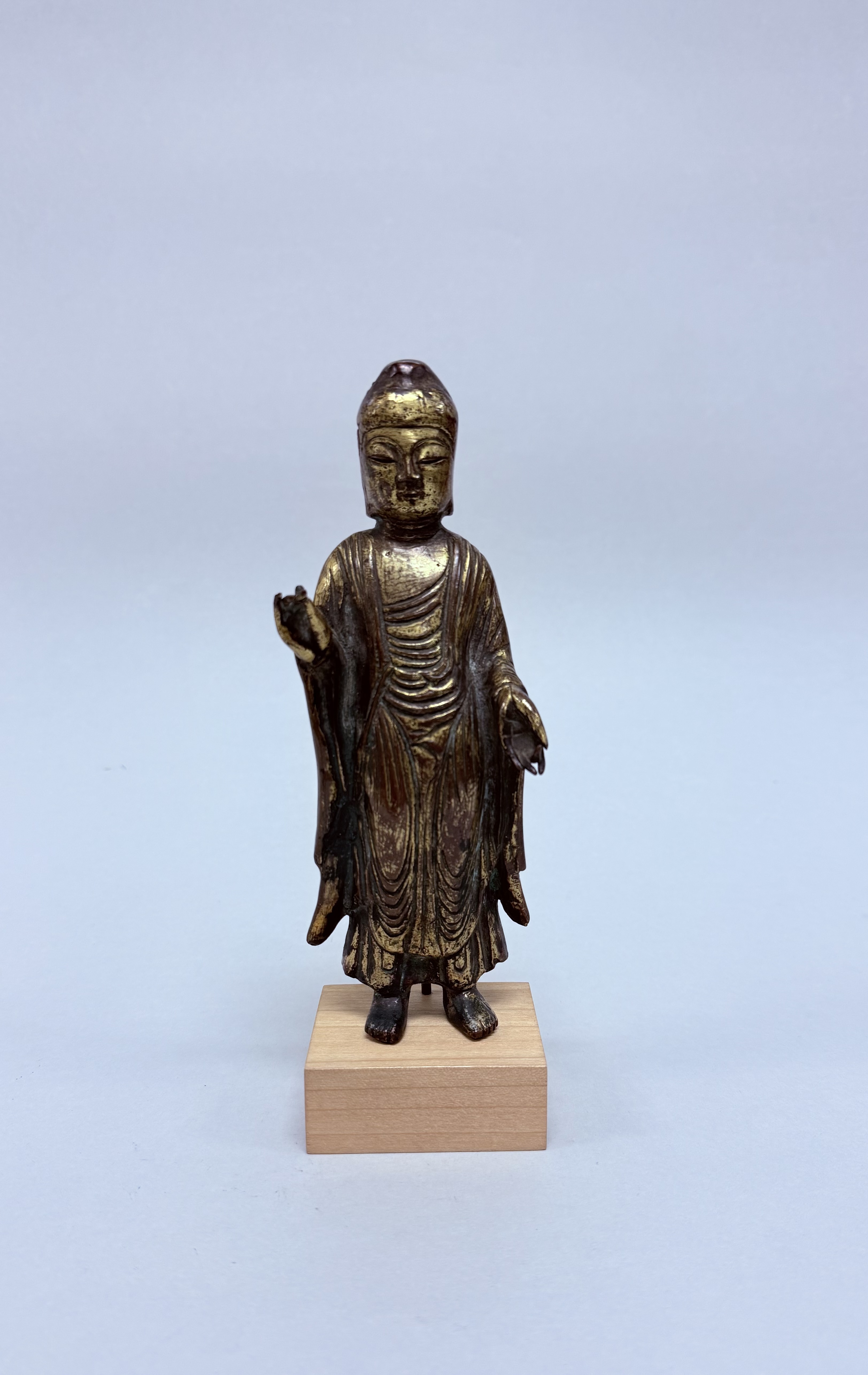
Heritage Analysis: The Standing Buddha of Korea
In the rarified echelons of high-end luxury, where materiality converges with metaphysics, the Korean Standing Buddha executed in gilt bronze represents a profound wellspring of symbolic power. For Katherine Fashion Lab, this artifact is not merely a relic of religious history; it is a strategic blueprint for a 2026 luxury strategy predicated on transcendence, quiet opulence, and the articulation of spiritual sovereignty. This analysis deconstructs the object’s historical adornment and spiritual meaning to propose a commercial framework that elevates brand narrative beyond the transactional.
Symbolic Power: The Sovereign Gesture of Abhaya Mudra
The Standing Buddha, cast in the fluid lines of the Three Kingdoms or early Unified Silla period (circa 6th–7th century), embodies a specific lexicon of power. The right hand, raised with the palm facing outward, executes the Abhaya Mudra—the gesture of fearlessness and reassurance. This is not a passive symbol; it is an active declaration of protection and authority. For the luxury consumer of 2026, who navigates a world of information saturation and existential uncertainty, this gesture translates into a brand promise of sanctuary and unassailable confidence.
The gilt bronze medium amplifies this power. Gold, in Korean Buddhist tradition, is not mere decoration but a materialization of enlightenment—the dharmakaya or truth body. The gilding process, involving the application of gold amalgam over a bronze core, creates a surface that catches light without being garish. This is a critical lesson for high-end design: power in luxury is not about volume but about luminosity. The Standing Buddha’s power is inherent, requiring no external validation, much like the ideal luxury brand that commands respect through presence rather than proclamation.
Historical Adornment: The Aesthetics of Restrained Opulence
The adornment of the Korean Standing Buddha diverges significantly from its Indian or Chinese counterparts. Here, the drapery is rendered with a rigorous economy of line. The monastic robe, or kashaya, falls in geometric, cascading folds that reveal the body’s form without clinging sensually. The ushnisha (cranial protuberance) is subtle, and the facial features are serene yet distant—an expression of compassionate detachment.
This aesthetic philosophy, known as “pyeomsa” (plain silk) in Korean art criticism, prioritizes essence over ornament. For Katherine Fashion Lab, this offers a direct counterpoint to the maximalist trends of the early 2020s. The 2026 luxury consumer will seek adornment that whispers rather than shouts. The historical accuracy of the gilt bronze—where the gold is burnished to a soft, matte finish rather than a mirror shine—suggests a material strategy. Consider a capsule collection using oxidized silver with micro-gilt accents, or satin-finish gold alloys that mimic the subdued luminosity of the statue. The adornment is not an overlay but an integral expression of the object’s essence.
Spiritual Meaning: The Paradox of Material Transcendence
At the core of this artifact lies a profound paradox: a luxurious object that symbolizes the renunciation of material attachment. The Buddha, having abandoned princely adornment, is depicted in the simplest of garments, yet the medium is the most precious metal known to antiquity. This tension is the spiritual engine of the object. It communicates that true luxury is not the accumulation of things but the mastery of self.
The Korean Buddhist tradition emphasizes “wonhyo” (interpenetration)—the idea that the absolute and the phenomenal are not separate. The gilt bronze Buddha is not a representation of enlightenment; it is, in a very real sense, a manifestation of it. For the luxury brand, this translates into a strategy of material transcendence. A handbag is not just a container; it is a vessel for the owner’s narrative. A silk scarf is not just a textile; it is a field for meditative pattern. The spiritual meaning for the consumer is the opportunity to participate in a tradition of conscious consumption, where the object serves as a tool for inner refinement, not external display.
2026 High-End Luxury Strategy: The Sanctuary of the Self
Based on this heritage analysis, Katherine Fashion Lab should position itself for 2026 around the concept of “The Sanctuary of the Self.” This strategy directly leverages the symbolic power, historical adornment, and spiritual meaning of the Standing Buddha.
1. Product Architecture: The Gilt Bronze Principle
The core collection should be defined by a monochromatic palette with singular, sacred accents. Just as the gilt bronze Buddha uses gold only on the surface of a dark bronze core, the 2026 line should feature charcoal, ink-black, and deep indigo bases with accents of 24-karat gold leaf or burnished brass. This creates a visual hierarchy of restraint and revelation. Key pieces could include a structured, sculptural tote with a single, gold-plated clasp mimicking the Abhaya Mudra, or a cashmere wrap with a subtle, embroidered mandala pattern that references the Buddha’s ushnisha.
2. Material Philosophy: The Paradox of Preciousness
Embrace the paradox of the ascetic luxury. Use materials that are precious but not ostentatious: hammered titanium, matte-finished platinum, and recycled bronze with gold inlay. The narrative should emphasize that the value lies in the craftsmanship and intention, not the raw material. This aligns with the spiritual meaning of the Buddha, where the gilding is a metaphor for the enlightenment that arises from the base metal of human experience.
3. Experiential Retail: The Meditative Space
Flagship stores should be designed as secular sanctuaries. The retail environment should evoke the quiet solemnity of a Korean temple hall: low, horizontal lines, natural light filtered through rice paper, and a single, focal point of gilded art. There should be no aggressive sales pressure. Instead, offer guided meditation sessions or tea ceremonies before the purchase. The transaction becomes a ritual, echoing the Buddha’s teaching that the path is the goal.
4. Marketing Narrative: The Gesture of Fearlessness
The campaign should center on the Abhaya Mudra. Visuals should feature models in serene, powerful poses, with hands raised in a subtle, stylized version of the gesture. The tagline: “Fearlessness is the New Luxury.” This speaks to the symbolic power of the Buddha, offering the consumer not just a product, but a psychological armor against the anxieties of the modern world. The narrative should avoid overt religious iconography, instead focusing on the universal principles of protection, clarity, and sovereignty.
5. Price Architecture: The Value of Silence
Price points should be set at a premium that reflects the intangible value of the narrative. This is not a product to be commoditized. The gilt bronze Buddha, though priceless, does not compete with other statues; it exists in a category of its own. Similarly, Katherine Fashion Lab’s 2026 line should be positioned as “beyond comparison”—a collection that serves as a cultural artifact for the discerning individual. The cost of production is secondary to the cost of meaning.
Conclusion: The Sovereign Object
The Korean Standing Buddha in gilt bronze is a masterclass in the alchemy of luxury. It transforms base metal into sacred art, and personal adornment into spiritual practice. For Katherine Fashion Lab, the strategy is clear: reduce to amplify, silence to be heard, and transcend to possess. By internalizing the symbolic power, historical restraint, and spiritual depth of this artifact, the brand can offer its 2026 clientele not just fashion, but a sovereign object that guards their peace and elevates their being. In a market saturated with noise, the Buddha’s golden silence is the ultimate competitive advantage.