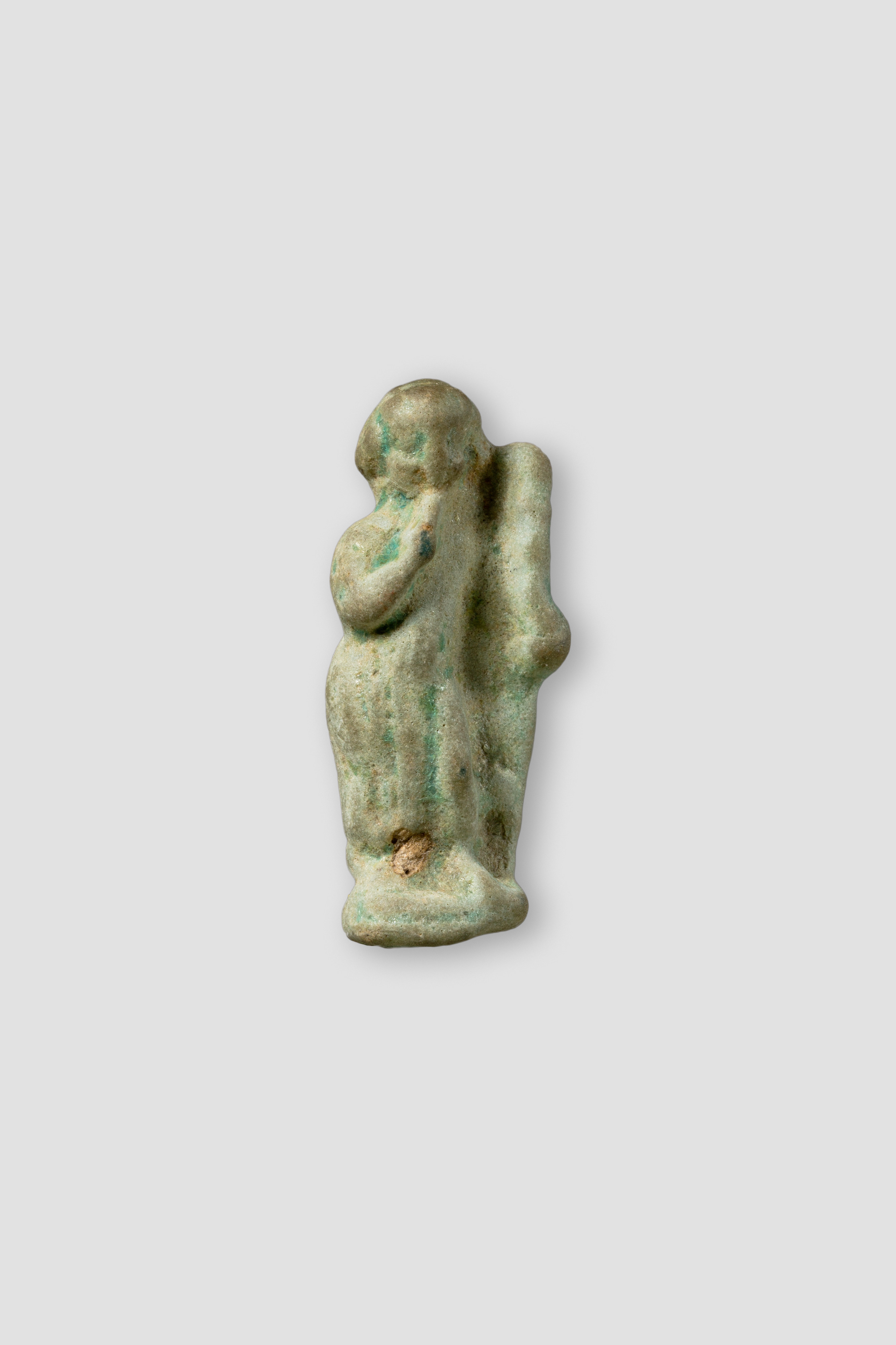
Heritage Analysis: Harpokrates with the Club of Herakles in Green Faience
Introduction: An Unlikely Convergence of Divine Power
The artifact under examination—a small figurine of Harpokrates, the Hellenized child god of silence and secrecy, clutching the club of Herakles, rendered in luminous green faience—represents a rare and sophisticated syncretism from the Ptolemaic period (circa 305–30 BCE). This object, likely produced in a temple workshop in Alexandria or Memphis, fuses Egyptian, Greek, and Near Eastern iconographic traditions into a single, potent symbol of divine protection, royal authority, and esoteric knowledge. For Katherine Fashion Lab, a luxury house that seeks to transcend mere ornamentation and embed deep cultural narratives into its creations, this artifact offers a compelling blueprint for 2026 high-end strategy: the reclamation of symbolic power through material storytelling.
Symbolic Power: The Child Who Wields the Hero's Club
Harpokrates, derived from the Egyptian Horus-the-Child (Har-pa-khered), is traditionally depicted as a nude infant with a finger to his lips—an emblem of silence, mystery, and the hidden wisdom of the gods. His association with secrecy made him a patron of initiates in mystery cults, particularly those of Isis and Serapis. The club of Herakles, by contrast, is an attribute of raw, masculine strength, heroic labor, and mortal triumph over chaos. To place this oversized weapon in the hands of a child god is to assert a profound paradox: power need not be loud, muscular, or overt. It can be quiet, nascent, and infinitely more potent because it is concealed.
In the context of luxury branding, this symbolism is revolutionary. The 2026 consumer, fatigued by ostentatious displays of wealth, will seek objects that whisper rather than shout. The Harpokrates-with-club motif suggests that true authority is held in reserve, revealed only to the discerning. For Katherine Fashion Lab, this translates into design language that prioritizes subtlety of form over spectacle—a garment or accessory that carries its power in the weight of its materials, the precision of its craftsmanship, and the depth of its reference, rather than in logos or overt branding.
Historical Adornment: The Materiality of Faience as a Luxury Medium
Green faience, a non-clay ceramic body composed primarily of crushed quartz, alkaline salts, and copper-based colorants, was one of the most prized materials in the ancient Egyptian and Ptolemaic worlds. Its brilliant turquoise-green hue was not merely decorative; it was symbolically charged, representing rebirth, fertility, and the regenerative powers of the Nile. Faience was also considered a substitute for precious stones like turquoise and emerald, making it a democratic luxury—accessible to elite and non-elite alike, yet always imbued with sacred significance.
The choice of green faience for this Harpokrates figurine is strategic. The child god, often associated with the morning sun and new beginnings, is rendered in a material that promises eternal renewal. The club, painted or incised with darker detail, contrasts against the luminous body, creating a visual tension between fragility and force. For Katherine Fashion Lab, this juxtaposition offers a lesson in material hierarchy. In 2026, high-end luxury will increasingly rely on unexpected materials—recycled metals, bio-resins, lab-grown gems—that carry their own symbolic weight. The faience of Harpokrates teaches that the value of a material lies not in its rarity but in its narrative resonance.
Spiritual Meaning: The Cult of Silence and the Luxury of Discretion
Harpokrates’ gesture of silence—the finger to the lips—was not merely an instruction to keep secrets. In the Hellenistic mystery cults, it signified the ineffable nature of divine truth. The initiate was not to speak of the sacred rites because language could not contain them. The club of Herakles, then, becomes a guardian of this silence—a weapon against those who would profane the mystery. Together, they form a talisman of protected inner knowledge.
This spiritual framework is directly applicable to the 2026 luxury market, where exclusivity is no longer about price but about access to meaning. The most coveted brands will be those that offer their clientele a private language—a code of symbols, materials, and rituals that are not immediately legible to the uninitiated. Katherine Fashion Lab can position itself as a custodian of such mysteries, creating collections that require cultural literacy to fully appreciate. A customer who understands the Harpokrates reference is not just buying a product; they are joining a lineage of discerning patrons who value wisdom over visibility.
2026 High-End Luxury Strategy: From Object to Amulet
Based on this analysis, I recommend the following strategic pillars for Katherine Fashion Lab’s 2026 direction, directly inspired by the Harpokrates-with-club figurine:
1. The Amulet Collection
Shift from fashion-as-fashion to fashion-as-talisman. Develop small, highly crafted accessories—pendants, rings, cufflinks, and belt buckles—that incorporate hybrid iconography. For example, a brooch featuring a child's hand holding a miniature club, rendered in oxidized silver and green enamel, would directly reference the artifact while remaining wearable. Each piece should come with a digital heritage card explaining its symbolic origins, transforming the purchase into an educational experience.
2. Material Alchemy
Invest in neo-faience technologies: ceramic composites, colored glass, and recycled gemstone dust that mimic the luminous, regenerative quality of ancient faience. Partner with artisanal studios in Italy, Japan, or Egypt to produce limited-edition runs. The material itself becomes a signature of the house, instantly recognizable and deeply meaningful.
3. The Silence Campaign
Rebrand exclusivity as discretion. Launch a global campaign titled “The Power of Silence,” featuring imagery that emphasizes concealment, mystery, and quiet authority. Models should be photographed in shadow, with minimal eye contact, and with hands or accessories subtly covering their lips. The campaign’s tagline: “Some truths are not spoken. They are worn.”
4. The Curatorial Partnership
Collaborate with museums and academic institutions—such as the British Museum, the Louvre, or the Egyptian Museum in Cairo—to co-curate heritage-inspired capsule collections. A portion of proceeds could fund conservation of Ptolemaic faience artifacts. This positions the brand not merely as a commercial entity but as a cultural steward, building trust and long-term loyalty among high-net-worth individuals who value preservation.
5. The Initiates’ Club
Create a private membership program for top clients, offering access to exclusive lectures, virtual reality tours of archaeological sites, and early previews of collections. Membership is not sold; it is bestowed, echoing the mystery cult initiation. The club’s symbol: a stylized Harpokrates finger-to-lips motif, rendered in green faience enamel.
Conclusion: The Enduring Power of the Silent Child
The green faience Harpokrates with the club of Herakles is far more than a historical curiosity. It is a strategic artifact that teaches us how to combine opposing forces—silence and strength, youth and heroism, fragility and durability—into a single, coherent symbol of power. For Katherine Fashion Lab, this object provides a roadmap for 2026: to create luxury that is intellectually rigorous, spiritually resonant, and materially innovative. In a market saturated with noise, the brand that learns to whisper—with the weight of a club in its hand—will command the most attention.