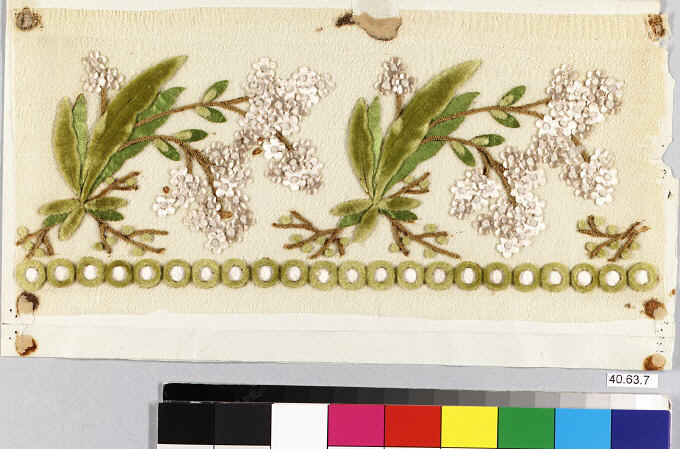
The Architecture of the Edge: A Couture Analysis of the Dress Border
In the rarefied world of haute couture, the dress border is often dismissed as a mere finishing detail—a hemline, a trim, or a decorative afterthought. Yet, at Katherine Fashion Lab, we recognize the border as a site of profound technical and conceptual significance. It is the liminal space where fabric meets air, where structure yields to fluidity, and where the garment communicates its final statement. This analysis dissects the dress border as a standalone study, exploring its execution in silk, its debt to global heritage, and its capacity to define the silhouette’s narrative. The border is not an ending; it is a threshold.
Materiality and the Silk Paradox
Silk, as the chosen substrate, presents a unique paradox for border construction. Its inherent luster and drape demand a technique that respects its fluidity while imposing deliberate structure. At Katherine Fashion Lab, the silk border is engineered to serve as a counterpoint to the fabric’s natural tendency toward movement. The material’s high tensile strength allows for intricate, weight-bearing finishes—such as rolled hems, piped edges, or bias-cut bands—that would collapse in lesser textiles. Yet, silk’s fragility requires precision: a single misaligned stitch can distort the entire border’s geometry.
The lab employs a double-faced silk organza for structural borders, a technique borrowed from Japanese obi construction. This creates a crisp, architectural edge that retains the silk’s signature softness. The border becomes a rigid yet luminous frame, contrasting with the garment’s body. In one study piece, a 12-centimeter band of silk satin is cut on the true bias, then stabilized with a horsehair braid—a nod to 19th-century crinoline techniques—allowing the border to stand away from the body without sacrificing flexibility. The result is a border that breathes: it holds its shape but yields to the wearer’s movement, a testament to silk’s dual nature as both restraint and release.
Global Heritage: The Border as Cultural Cartography
The dress border at Katherine Fashion Lab is not merely a technical feature; it is a canvas for global heritage. Each stitch, fold, and embellishment references a lineage of craftsmanship from across civilizations. The lab’s research draws from three primary traditions: the Indian zardozi, the Chinese cloud collar, and the European passementerie. These are not appropriated but reinterpreted through a contemporary lens, creating a border that speaks to a shared human history of adornment.
From India, the lab adapts the zardozi technique—metallic thread embroidery on silk—to create borders that mimic the weight and opulence of Mughal court garments. However, the lab substitutes traditional gold wire with fine silk-wrapped copper threads, reducing weight while preserving the luminous effect. The border is then applied as a detachable panel, allowing the wearer to transform the garment’s formality. This modularity echoes the dupatta’s versatility, yet the execution is purely couture.
Chinese heritage informs the border’s silhouette. The lìng, or cloud collar, traditionally frames the neckline with layered, scalloped edges that symbolize celestial protection. Katherine Fashion Lab translates this into a hem border: a series of overlapping silk petals, each hand-cut and stitched to create a three-dimensional wave. The petals are dyed in gradient shades—from deep indigo to pale cerulean—referencing Chinese blue-and-white porcelain. The border thus becomes a narrative of sky and water, grounding the garment in a mythic geography.
European passementerie contributes the finishing vocabulary. The lab’s artisans hand-braid silk cords into intricate guipure patterns, then couch them along the border’s edge. This technique, perfected in 18th-century French courts, adds a tactile richness that contrasts with the silk’s smooth surface. Yet, the lab subverts tradition by using asymmetrical placement: the braiding is denser on the left side, creating an intentional imbalance that challenges the Western preference for symmetrical borders. This deliberate dissonance reflects a globalized aesthetic, where heritage is not uniform but dialogical.
Standalone Study: The Border as Autonomous Object
To treat the dress border as a standalone study is to divorce it from the garment’s body—a radical act in couture analysis. At Katherine Fashion Lab, we isolate the border as an independent artifact, examining its structural logic, symbolic weight, and kinetic behavior. This approach reveals the border as a microcosm of the entire garment’s design philosophy.
Consider a recent study piece: a 90-centimeter silk border, detached from any dress, suspended in a custom frame. The border is constructed from a single length of Charmeuse silk, folded and stitched into a Möbius-like loop. One edge is left raw, frayed deliberately to evoke decay, while the opposite edge is finished with a hand-rolled hem so fine it appears invisible. This duality—raw versus refined—mirrors the tension between creation and entropy, a theme central to the lab’s ethos. The border becomes a philosophical object, questioning the very nature of finish and edge.
Structural analysis reveals a hidden armature: a thin strip of crinoline is encased within the silk, providing vertical stability without visible support. This interior scaffolding allows the border to stand upright when laid flat, defying the silk’s natural drape. The border thus occupies a third space—neither flat nor fully dimensional—challenging the viewer’s perception of textile as purely two-dimensional. It is a study in controlled contradiction.
Kinetic tests further illuminate the border’s autonomy. When attached to a mannequin, the border’s movement is dictated by the wearer’s gait; isolated, it responds to ambient air currents, swaying with the subtlety of a living organism. The lab documents these movements using high-speed photography, capturing the border’s oscillation as a series of frozen gestures. This data informs future designs: borders are now calibrated for specific motion profiles, from the stately sweep of a ball gown to the sharp pivot of a cocktail dress. The border is no longer passive; it is an active participant in the garment’s performance.
Technical Execution: The Art of the Invisible
The mastery of the dress border lies in its invisibility. At Katherine Fashion Lab, the most accomplished borders are those that appear effortless—a seamless transition from garment to edge. This requires a hierarchy of techniques: hand-stitching for flexibility, fusible interfacing for stability, and micro-pleating for texture. Each method is chosen based on the border’s role within the garment’s ecosystem.
For a border designed to frame a train, the lab employs a crinoline-stiffened hem, using a horsehair braid that is hand-sewn to the silk’s underside. The braid is then covered with a bias-cut silk strip, creating a smooth, rolled edge that resists curling. The result is a border that glides across floors without snagging, a feat of engineering that goes unnoticed by the viewer.
For a neckline border, the lab uses a French seam technique, encasing raw edges within a folded silk tube. This creates a delicate, rounded finish that sits softly against the skin. The seam is then topstitched with silk thread at eight stitches per centimeter, a density that prevents fraying while maintaining pliability. The thread itself is dyed to match the fabric exactly, rendering the stitching invisible except under magnification.
These technical choices are not arbitrary; they are responses to the border’s functional demands. The lab’s emphasis on invisible construction elevates the border from a mere finish to a silent collaborator, supporting the garment’s form without asserting its own presence. It is the ultimate expression of couture humility: the border disappears so the dress can speak.
Conclusion: The Border as Beginning
In the context of Katherine Fashion Lab, the dress border is not a terminus but a genesis. It is where the garment meets the world, where technique meets tradition, and where the body meets the fabric’s edge. By studying the border as a standalone entity—rooted in silk, animated by global heritage, and executed with invisible precision—we uncover a new vocabulary for couture. The border is a threshold, and every threshold invites crossing. At the lab, we do not finish garments; we begin them at the edge.