The Sacred Alchemy of Form: A Couture Analysis of the North Italian Ivory Plaque
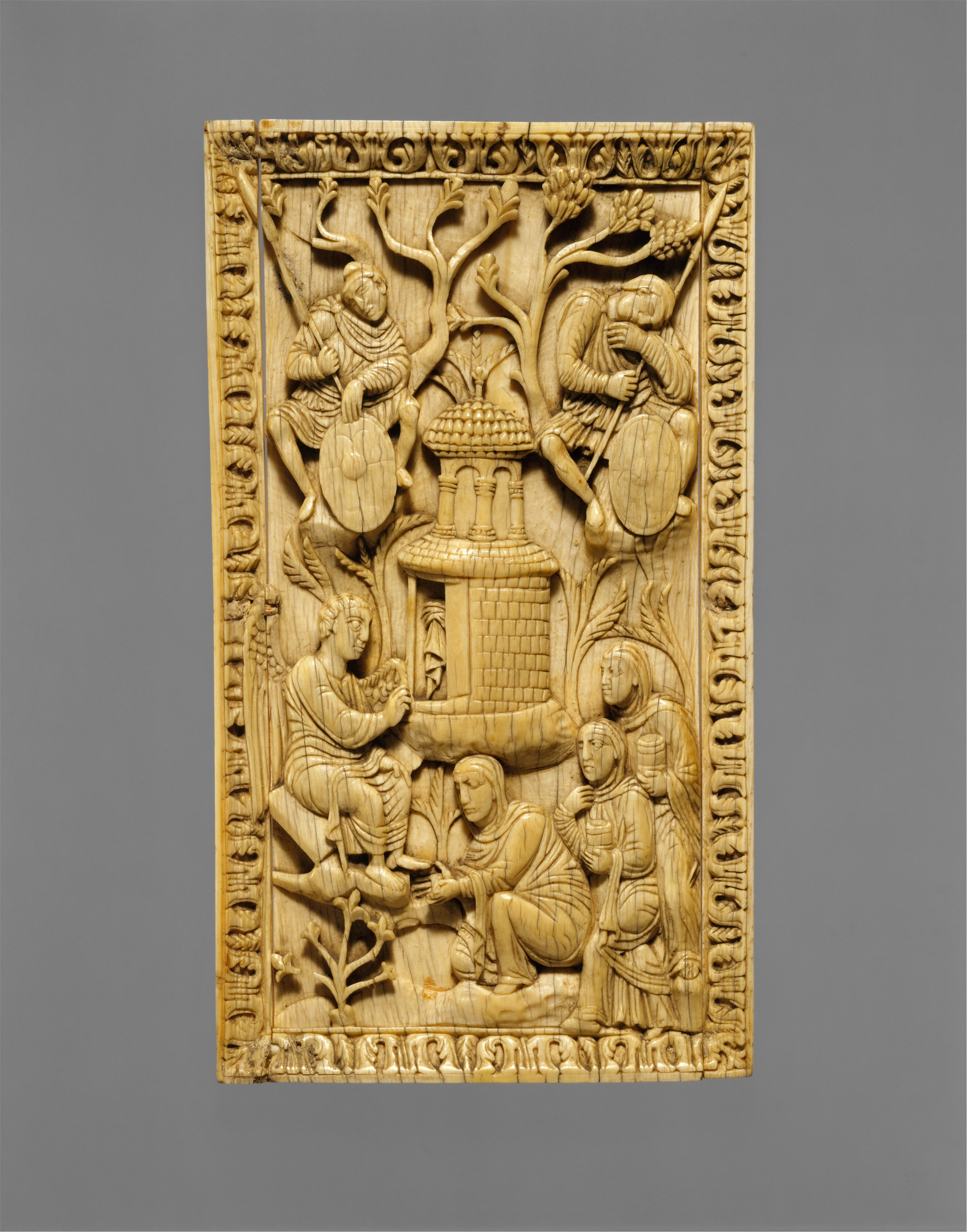
In the rarefied domain where haute couture meets the archaeology of sacred art, the Plaque with the Holy Women at the Sepulchre emerges as an artifact of profound textile and sculptural resonance. Carved from elephant ivory in the workshops of North Italy, likely during the late 10th or early 11th century, this object transcends its liturgical function to become a masterclass in the interplay of materiality, drapery, and spatial composition. For Katherine Fashion Lab, a house dedicated to the alchemy of form and narrative, this plaque offers a lexicon of principles—tension, weightlessness, and the architecture of grief—that can be translated directly into the language of high fashion.
Material as Metaphor: The Ivory as a Textile Substrate
The choice of elephant ivory is not incidental but central to the plaque’s couture significance. In fashion, the substrate—whether silk, organza, or leather—dictates the garment’s behavior. Here, ivory functions as a rigid yet luminous canvas, its warm patina and natural grain evoking the tactile memory of aged bone and polished pearl. The carver’s chisel has transformed this dense material into a fluid, almost diaphanous surface. The Holy Women’s garments are not merely incised; they are sculpted folds that mimic the fall of heavy silk or wool, creating a chiaroscuro effect that would be the envy of any draping atelier. The way the ivory catches and diffuses light—softening under direct illumination, deepening in shadow—parallels the behavior of a matte crepe or a double-faced satin. This is not a static carving; it is a frozen moment of textile movement, where the material itself becomes a performative element.
From a couture perspective, the plaque teaches us that hardness can yield softness. The ivory’s resistance to the chisel mirrors the tension in a structured corset or a tailored jacket, yet the resulting folds are as supple as a bias-cut gown. Katherine Fashion Lab can draw from this paradox: a garment that appears rigid from a distance but reveals intricate, flowing lines upon closer inspection. The ivory’s natural veining, often overlooked, becomes a design motif—an organic pattern that could be echoed in hand-embroidered threadwork or laser-cut leather, marrying the ancient with the avant-garde.
Drapery as Narrative: The Holy Women’s Silhouette
The composition centers on the three Holy Women approaching the empty tomb, their bodies entwined in a choreography of sorrow and awe. Their cloaks and mantles are not mere coverings; they are architectural volumes that define space and emotion. The central figure, often identified as Mary Magdalene, is rendered with a downward gaze and a hand raised in a gesture of lamentation. Her garment falls in vertical, almost columnar folds, suggesting a weight of grief that anchors her to the ground. This is a study in verticality and compression—a silhouette that elongates the torso and creates a sense of vertical pilgrimage, much like a floor-length column gown in heavy crepe.
In contrast, the two flanking women exhibit more horizontal, flaring drapery, their mantles billowing outward as if caught in a spiritual wind. This interplay between vertical and horizontal lines is a fundamental principle of pattern cutting. For a couture collection, this could translate into a dress where the bodice is tightly fitted (vertical) while the skirt expands in a dramatic, asymmetrical flare (horizontal). The plaque’s carver understood that drapery is not decorative but narratological—each fold tells a story of movement, emotion, and divine encounter. The Holy Women’s garments are, in essence, emotional armor, shielding them from the sacred terror of the empty tomb while simultaneously revealing their vulnerability through the subtle play of light and shadow on ivory.
The Architecture of the Sepulchre: Spatial Composition and Negative Space
The plaque’s background is not empty but carefully constructed. The sepulchre itself is depicted as a small, domed structure, its architectural details carved in low relief. This creates a dialogue between figure and ground that is central to both sculpture and fashion design. In couture, negative space—the gaps between garments, the cutouts in a bodice, the openness of a neckline—is as important as the fabric itself. The plaque’s carver uses the ivory’s smooth surface to frame the women, their forms emerging from the material like figures rising from a sea of cloth. This technique is analogous to the architectural draping of a garment, where the body is the “empty tomb” and the fabric is the “stone rolled away.”
The composition also employs a triadic structure—three figures, three steps, three moments of revelation. This numerical symbolism, common in medieval art, can be reinterpreted in fashion through a triptych of textures or a three-part silhouette. For instance, a Katherine Fashion Lab gown might feature a bodice in matte silk, a mid-section in sheer organza, and a train in heavy velvet, each representing a different emotional register: grief, hope, and transcendence. The plaque’s spatial economy—where every inch of ivory is purposeful—teaches the couturier to edit ruthlessly, ensuring that every seam, pleat, and embellishment serves the narrative.
Color and Texture: The Monochromatic Palette of Devotion
While the plaque is monochromatic—carved ivory on a natural, uncolored ground—its tonal range is remarkably rich. The carver achieved this through varying depths of relief: shallow incisions for delicate folds, deeper cuts for shadows, and polished high points for highlights. This is a monochromatic masterclass in texture, where the absence of color is compensated by the tactile variety of the surface. In fashion, this translates to a collection built on a single hue—say, ivory or alabaster—but differentiated by fabric weights, weaves, and finishes. A sheath dress in ribbed silk, a cape in brushed wool, and gloves in polished leather would create a similar play of light and shadow, evoking the plaque’s liturgical gravity without resorting to ornamentation.
The plaque also suggests a palette of devotion: the soft, warm tones of aged ivory evoke candlelight, parchment, and human skin. For a contemporary collection, this could be expanded to include shades of bone, pearl, and ash—colors that feel both ancient and modern, sacred and wearable. The absence of bright pigments forces the viewer to focus on form, line, and texture, a discipline that Katherine Fashion Lab can embrace in its commitment to craftsmanship over trend.
From Liturgy to Runway: Translating the Sacred into the Secular
The plaque’s original context—a liturgical object, possibly part of a book cover or an altar piece—imbues it with a ritualistic quality that is highly relevant to fashion. Clothing, too, is a form of ritual, transforming the wearer into a participant in a daily ceremony of identity. The Holy Women’s garments are not merely historical; they are archetypes of mourning and revelation. In a Katherine Fashion Lab collection, this could manifest as a series of “ceremonial” pieces—a tailored coat with exaggerated shoulders (the sepulchre’s dome), a floor-length skirt with knife pleats (the vertical folds of grief), and a sheer veil (the mystery of the resurrection).
Furthermore, the plaque’s iconographic clarity—the women’s gestures, the empty tomb, the angel’s presence—offers a lesson in narrative compression. Every element is legible, yet the whole remains mysterious. In fashion, this means designing garments that tell a story through their construction: a zipper that mimics a seam, a pocket that suggests a hidden relic, a sleeve that folds like a prayer shawl. The plaque teaches that less is more—that a single, well-executed detail can carry more meaning than a cacophony of embellishments.
Conclusion: The Ivory as a Mirror of the Atelier
The Plaque with the Holy Women at the Sepulchre is not merely an object of religious art; it is a textbook of couture principles rendered in the most unforgiving of materials. From the tension between rigidity and fluidity in the ivory, to the narrative power of drapery, to the sacred geometry of the composition, this North Italian masterpiece offers a timeless vocabulary for the fashion designer. For Katherine Fashion Lab, it serves as a reminder that the highest form of craft is not in the addition of detail, but in the subtraction of the superfluous, leaving only the essential—a fold, a shadow, a moment of grace. In the atelier, as in the ivory workshop, the hand that carves is the hand that prays, and the garment that emerges is a testament to the enduring dialogue between the material and the divine.