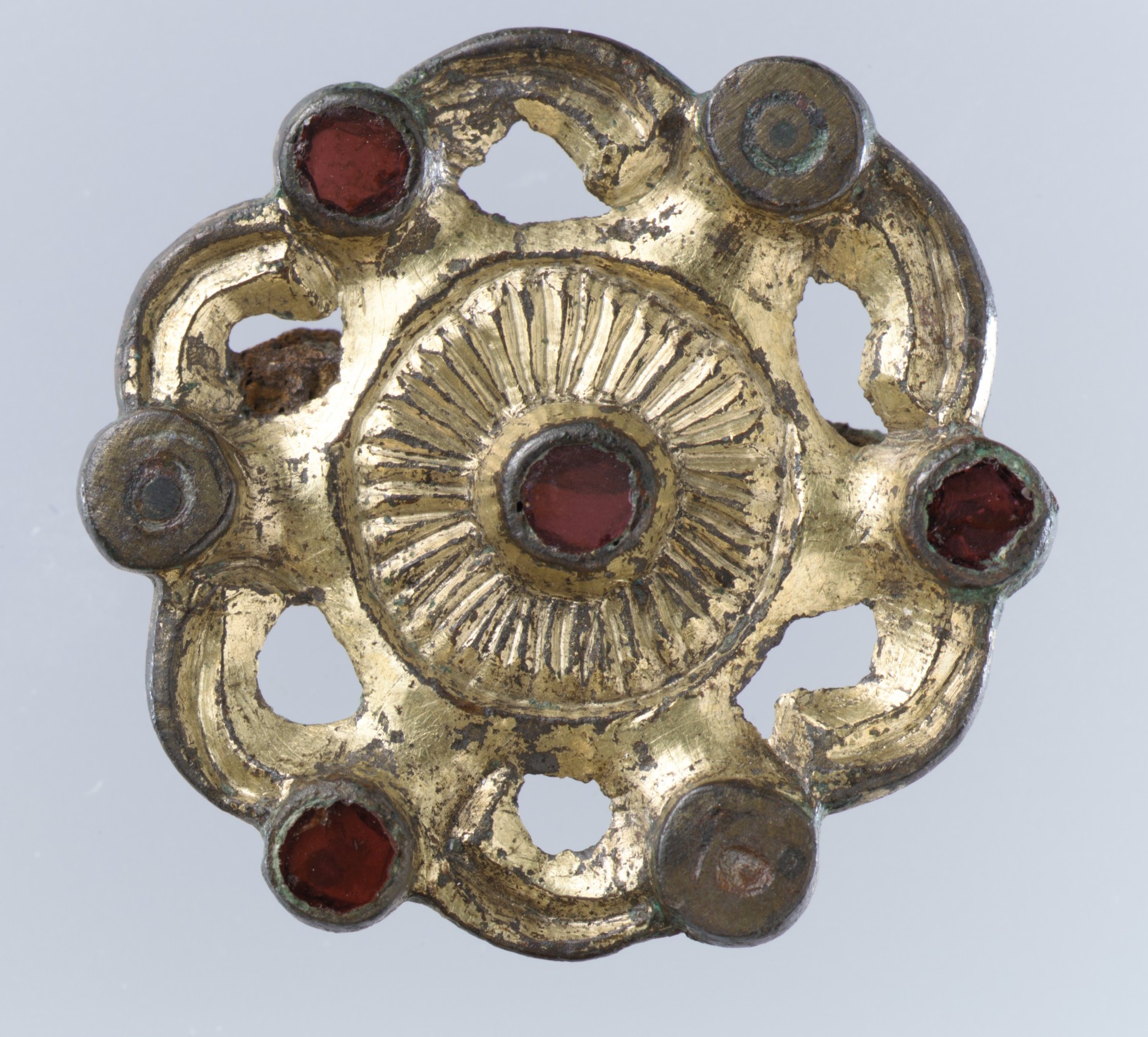
Heritage Analysis: The Whorl-Shaped Brooch of the Frankish Elite
This strategic heritage analysis examines the Whorl-Shaped Brooch, a quintessential artifact of Frankish material culture, through the lens of symbolic power, historical adornment, and spiritual meaning. Commissioned as a standalone research piece for Katherine Fashion Lab, this study evaluates the brooch’s relevance for a 2026 high-end luxury strategy, drawing on its metallurgical complexity and cultural resonance to inform contemporary brand positioning. The brooch, crafted from copper alloy with gilding, niello, and garnet, represents a convergence of technical mastery and ideological expression within early medieval Europe.
Historical Adornment and Material Significance
The Whorl-Shaped Brooch belongs to the Frankish period (circa 5th–8th centuries CE), a formative era in Western European identity. Frankish jewelry was not merely decorative; it functioned as a marker of status, lineage, and regional affiliation. The brooch’s material composition—copper alloy, gilding, niello, and garnet—demonstrates advanced metalworking techniques that were highly prized across Merovingian courts. Gilding, achieved through fire-gilding processes, conveyed wealth and access to rare materials, while niello (a black metallic inlay) provided contrast and depth, highlighting the artisan’s skill. Garnets, often sourced from distant trade networks such as Sri Lanka or Bohemia, signified cosmopolitan reach and economic power.
For Katherine Fashion Lab, this brooch exemplifies the Frankish emphasis on conspicuous craftsmanship. The whorl motif—a spiral or concentric circular pattern—was not arbitrary; it echoed earlier Celtic and Germanic traditions, linking the wearer to ancestral narratives. In a luxury context, this suggests that heritage-driven design can command premium valuation when it authentically references historical techniques. The brooch’s small scale (typically 3–5 cm diameter) belies its symbolic weight, reminding modern strategists that intimacy and detail often carry greater exclusivity than ostentation.
Symbolic Power and Social Hierarchy
The whorl shape itself is a potent symbol within Frankish cosmology. Archaeologists interpret the spiral as a representation of cyclical time, eternal return, or solar movement—concepts central to early medieval spirituality. For Frankish elites, wearing such a brooch was an assertion of divine favor and temporal authority. The brooch likely fastened a cloak or tunic at the shoulder, a placement that drew the eye upward, emphasizing the wearer’s stature. This strategic positioning aligns with what luxury strategists now term “power dressing”—the use of adornment to command attention and project control.
Moreover, the brooch’s combination of gilded copper and garnet invokes a chromatic duality: gold for eternity, red for vitality and sacrifice. In Frankish burial contexts, such brooches were often interred with high-status women, suggesting a gendered dimension to its symbolic power. The whorl motif may have also served as an apotropaic device, warding off malevolent forces. For Katherine Fashion Lab, this dual function—status and protection—offers a rich narrative for 2026 luxury storytelling. A collection inspired by this brooch could position each piece as a talisman, merging aesthetic appeal with perceived metaphysical value, a strategy increasingly viable in a market driven by experiential consumption.
Spiritual Meaning and Cosmological Resonance
Spirituality in the Frankish world was syncretic, blending Germanic paganism with emerging Christianity. The whorl pattern, found on early medieval fibulae across Northern Europe, often mirrored natural forms such as whirlpools, galaxies, or the labyrinthine pathways of the soul. For the Frankish wearer, the brooch was a microcosm—a portable universe that connected the individual to cosmic order. Gilding, with its reflective quality, was believed to capture sunlight, imbuing the object with life force. Niello, by contrast, evoked the darkness of the underworld, creating a visual dialectic between light and shadow, life and death.
This spiritual dimension is critical for Katherine Fashion Lab’s 2026 strategy. Contemporary luxury consumers increasingly seek objects that offer meaning beyond materiality. The whorl-shaped brooch can be reinterpreted as a symbol of continuity and resilience—values that resonate in an era of geopolitical uncertainty. By emphasizing the brooch’s role as a spiritual anchor, the Lab can position its products as heirlooms-in-the-making, appealing to clients who prioritize legacy over trend. The use of garnet, historically associated with protection and passion, further reinforces this narrative, allowing for a color-driven marketing campaign that ties red to vitality and exclusivity.
2026 High-End Luxury Strategy: Implications for Katherine Fashion Lab
Translating the Frankish whorl-shaped brooch into a 2026 luxury strategy requires a nuanced approach that respects historical authenticity while embracing modern brand architecture. The following strategic pillars emerge from this analysis:
1. Heritage as a Differentiator: The brooch’s Frankish origin offers a distinct European lineage that is less commodified than Roman or Egyptian motifs. Katherine Fashion Lab can leverage this rarity to create a capsule collection titled “Merovingian Spirals,” emphasizing the whorl as a signature motif across jewelry, accessories, and even textile patterns. This aligns with the luxury sector’s growing appetite for micro-histories—specific, research-backed narratives that differentiate brands in a crowded market.
2. Material Storytelling: The combination of copper alloy, gilding, niello, and garnet provides a template for a “material palette” that communicates depth and complexity. For 2026, the Lab could experiment with modern equivalents: oxidized silver for niello’s darkness, lab-grown garnets for sustainability, and hand-applied gold leaf for gilding. Each material choice should be documented and shared through immersive digital content, reinforcing transparency and craftsmanship as luxury values.
3. Symbolic Rebranding: The whorl motif can be abstracted into a brand logo or monogram, evoking eternity and protection without appearing derivative. This symbol can be applied across packaging, store design, and digital interfaces, creating a cohesive visual identity rooted in historical authority. The spiritual dimension—particularly the apotropaic function—can be marketed as “The Whorl Effect,” a concept that positions the brand as a guardian of personal narrative and well-being.
4. Exclusivity through Craft: The original brooch’s small scale and intricate detailing suggest a strategy of limited editions and bespoke commissions. Katherine Fashion Lab should prioritize artisan partnerships with master metalworkers who can replicate niello and garnet settings, ensuring each piece is unique. Pricing should reflect the labor-intensive process, targeting ultra-high-net-worth individuals who value rarity over volume.
5. Experiential Retail: The brooch’s cosmological symbolism lends itself to immersive retail experiences. Pop-up exhibitions featuring Frankish artifacts, accompanied by holographic reconstructions of Merovingian courts, could launch the collection. Clients could participate in “symbolic consultations,” choosing whorl variations that align with their personal narratives—a service that merges luxury with self-discovery.
Conclusion
The Whorl-Shaped Brooch of the Frankish elite is far more than a decorative object; it is a repository of symbolic power, historical identity, and spiritual meaning. For Katherine Fashion Lab, this artifact offers a strategic blueprint for 2026 high-end luxury that prioritizes authenticity, craftsmanship, and narrative depth. By honoring the brooch’s material complexity and cultural resonance, the Lab can create a collection that not only appeals to discerning clients but also establishes a lasting heritage framework for future innovation. The whorl, as a motif, reminds us that luxury is not linear—it is cyclical, eternal, and deeply human.